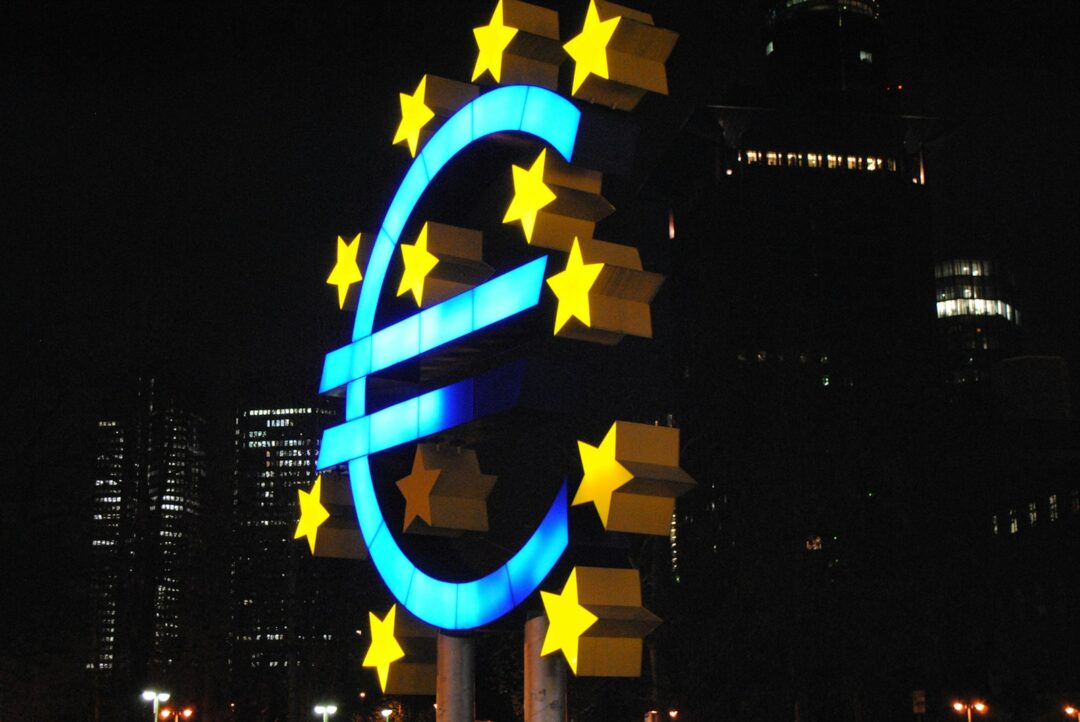
Thirty-seven European banks have now joined the Amsterdam-based consortium Qivalis to launch a euro-backed stablecoin in the second half of 2026.
Qivalis, a euro stablecoin intended to be fully regulated, has expanded from 12 to 37 members of Europe’s leading banks, including major institutions such as ABN AMRO, Rabobank, Bank of Ireland, BNP Paribas, ING, and UniCredit.
Spain leads Qivalis’ powerhouse expansion with five new banks joining, reflecting strong regional momentum.
Europe’s Push for a Euro Stablecoin
The consortium’s goal is clear: to create a regulated euro stablecoin fully backed 1:1 by reserves, operating under the supervision of the Dutch central bank and compliant with the EU’s Markets in Crypto-Assets Regulation (MiCA).
This initiative comes at a time when 98% of the global stablecoin market is denominated in United States (U.S.) dollars, dominated by Tether’s USDT and Circle’s USDC.
Euro-denominated stablecoins currently account for only about €395 million, or 0.2% of circulation. Qivalis aims to change that by embedding European principles of compliance, data protection, and financial stability into its infrastructure.
Global Stablecoin Regulation in 2026
The Qivalis project reflects a broader regulatory shift.
In the U.S., the GENIUS Act requires stablecoin issuers to maintain strict 1:1 reserves in dollars or Treasuries, publish monthly audits, and prohibits paying interest to holders.
In Europe, MiCA has already reshaped the market, forcing exchanges like Coinbase and Binance to delist non-compliant stablecoins.
Asia presents a fragmented landscape: Singapore and Japan have functioning frameworks, Hong Kong has begun licensing, while China bans private stablecoins in favor of its digital yuan.
This convergence of regulation underscores that stablecoins are now treated as financial infrastructure, not niche crypto products.
The International Monetary Fund (IMF) and Bank of International Settlements (BIS) have warned that their rapid growth—over $315 billion in capitalization and $33 trillion in annual transactions—ties them directly to global financial markets, raising risks of de-pegging, redemption runs, and spillovers into U.S. Treasury market
Strategic Outlook
Qivalis’s expansion marks a turning point for Europe’s digital finance strategy.
While the European Central Bank (ECB) continues to prioritize its own digital euro project, private banks are moving faster, building infrastructure that could rival U.S. stablecoin dominance.
Analysts project that euro stablecoins could reach €1.1 trillion in market value by 2030, driven by institutional adoption and tokenized asset settlement.
For global crypto markets, the rise of Qivalis signals a new era of currency competition on-chain. Regulators, meanwhile, face the challenge of harmonizing frameworks to prevent arbitrage and ensure stability.
For traders, the launch of a euro stablecoin backed by Europe’s largest banks could provide new liquidity pools and trading pairs, reducing reliance on dollar-denominated assets.
This diversification may lower currency risk and offer more efficient settlement for European exchanges. However, liquidity fragmentation could occur if euro stablecoins gain traction regionally but remain less adopted globally.
For investors, Qivalis represents a regulated alternative to USDT and USDC, potentially offering greater transparency and institutional trust.
Yet, the ECB has cautioned that widespread adoption of euro stablecoins could weaken the transmission of monetary policy, as funds shift from bank deposits into tokenized reserves.
Emerging markets may also benefit. Just as USDT has become a lifeline in countries like Argentina and Nigeria, a euro stablecoin could provide a hedge against local currency volatility, especially in regions with strong trade ties to Europe.
This implies that the stablecoin race may no longer be just about crypto—it is about the future of money itself.