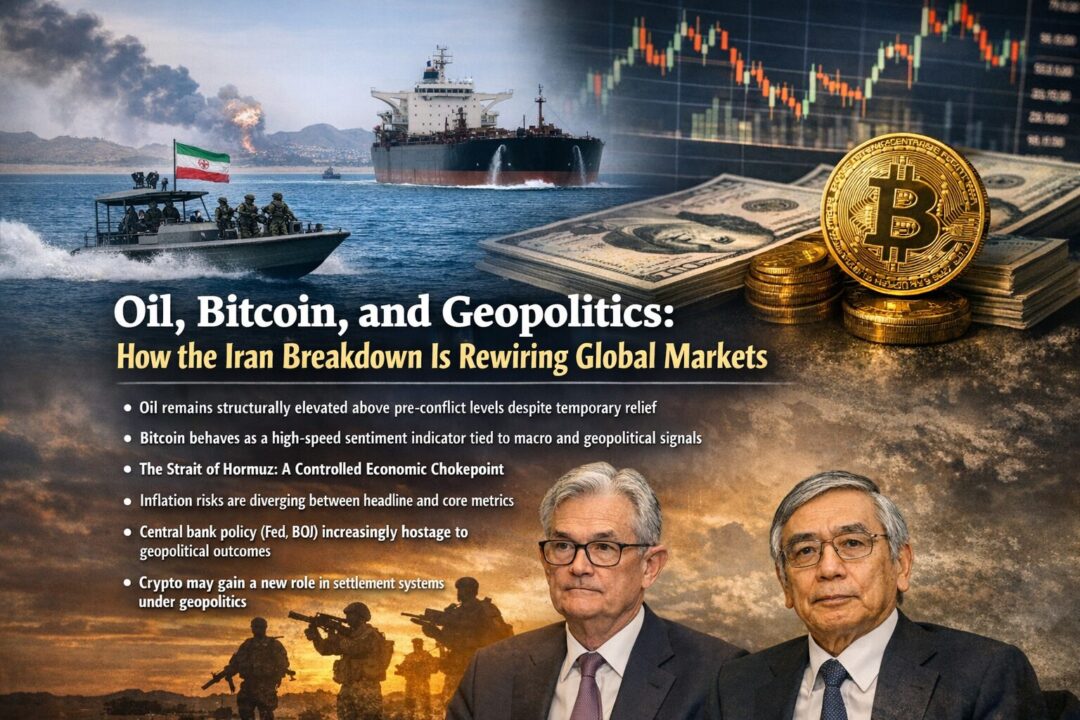
Key Points :
- Oil remains structurally elevated above pre-conflict levels despite temporary relief
- Bitcoin behaves as a high-speed sentiment indicator tied to macro and geopolitical signals
- The Strait of Hormuz is no longer “open” — it is a controlled economic chokepoint
- Inflation risks are diverging between headline and core metrics
- Central bank policy (Fed, BOJ) is increasingly hostage to geopolitical outcomes
- Crypto may gain a new role in settlement systems under geopolitical stress
1. From Shock to Uncertainty: A Market That Can No Longer Price Risk Cleanly
The recent breakdown in negotiations between the United States and Iran has pushed global markets into a far more complex phase than the initial shock period. In the early days of escalation, the reaction was straightforward: oil surged past $100, inflation expectations rose sharply, and risk assets—including equities and cryptocurrencies—sold off aggressively.
However, the current phase is fundamentally different. It is not driven by a single directional narrative, but by instability in expectations. A fragile ceasefire, rapidly shifting diplomatic signals, and inconsistent enforcement of agreements have created a market environment where pricing risk is no longer linear.
On April 8, a last-minute ceasefire agreement temporarily reversed market sentiment. Oil prices dropped sharply, equities rebounded, and Bitcoin surged to approximately $72,700—marking a rapid 5% daily gain. This rally was amplified by approximately $600 million in liquidations in the futures market, largely driven by short positions built during the escalation phase.
Yet this optimism proved short-lived. By April 11, after 21 hours of negotiations in Islamabad ended without agreement, uncertainty returned immediately. Markets retraced, Bitcoin pulled back toward $71,600, and risk appetite declined once again.
This pattern reflects a deeper structural shift: markets are no longer pricing outcomes—they are reacting to headlines in real time.
2. Bitcoin as a Real-Time Macro Sensor
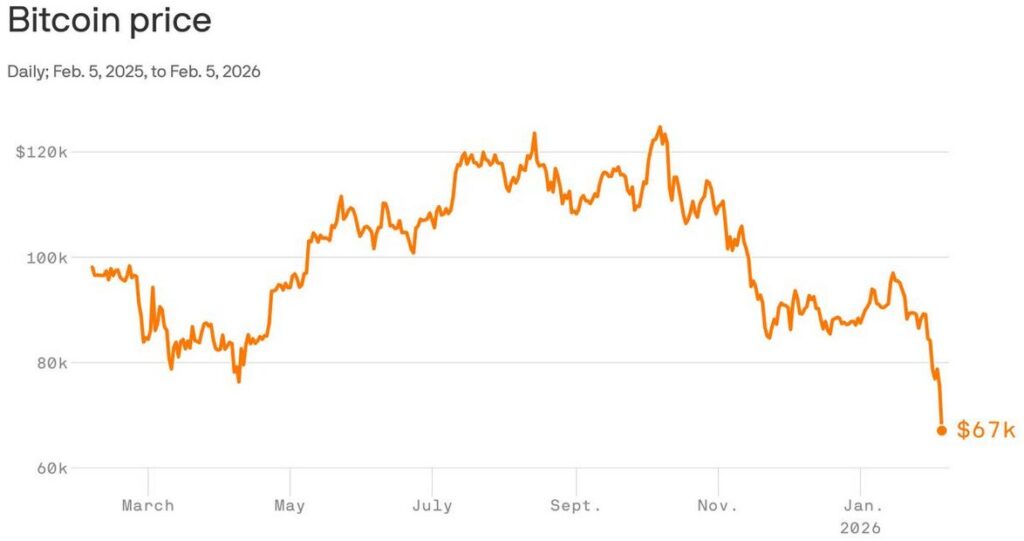
Bitcoin’s behavior during this period reinforces its evolving role—not as a hedge, but as a high-beta macro asset.
Between April 7 and April 11, Bitcoin traded in a range between $68,000 and $72,700, closely tracking shifts in oil prices, inflation expectations, and geopolitical developments. The correlation with equities remained strong, while sensitivity to macro headlines intensified.
Ethereum climbed above $2,200 during the ceasefire rally, while Solana and XRP recorded gains of 5–8%. However, these gains were not driven by crypto-native fundamentals. Instead, they mirrored broader risk-on sentiment triggered by declining oil prices and easing inflation fears.
Importantly, derivatives markets revealed a cautious positioning environment:
- Open interest declined during the rally
- Funding rates remained near neutral
- Options traders increased both upside exposure and downside hedging
This suggests that investors were not fully convinced by the bullish move. Instead, they were positioning for volatility—expecting sharp moves in either direction.
In this context, Bitcoin is acting less like “digital gold” and more like a real-time sentiment index—reacting faster than traditional assets but ultimately driven by the same macro forces.
3. Oil Markets and the New Reality of the Strait of Hormuz
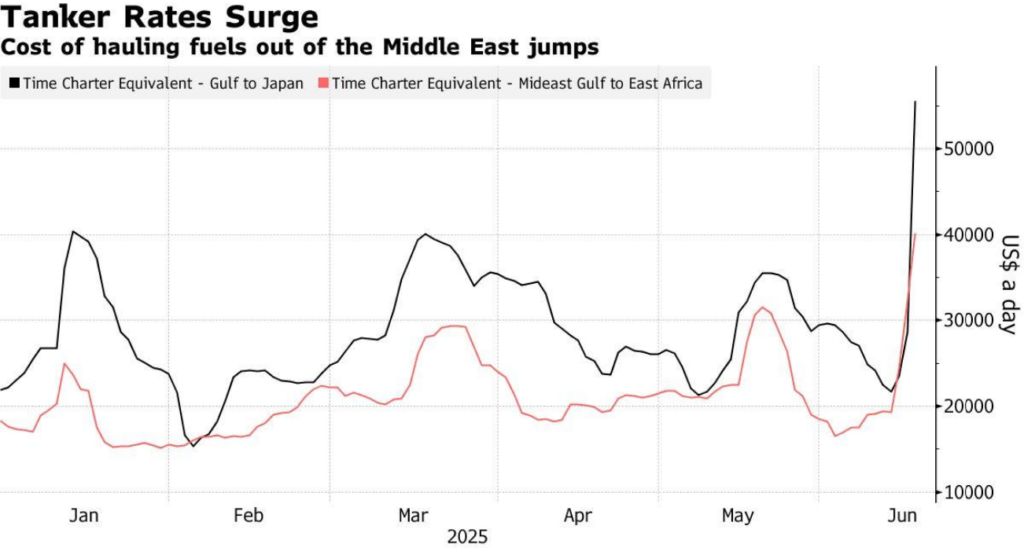
The energy market tells a deeper story about structural risk.
Following the ceasefire announcement, Brent crude dropped approximately 13% to around $94.75, while U.S. crude recorded a more than 16% decline in a single session—the largest since 2020. However, this decline must be viewed in context. Prices remain significantly above pre-conflict levels near $70, indicating that geopolitical risk remains deeply embedded in the market.
The key issue is not price volatility—it is structural access.
The Strait of Hormuz, one of the world’s most critical oil transit routes, has not returned to normal operation. Traffic volumes remain below typical levels, and Iran has introduced new transit conditions that fundamentally alter the nature of the route.
Tankers are now reportedly required to pay fees of up to $2 million per vessel, with payments accepted in Chinese yuan, Bitcoin, or stablecoins. This effectively transforms the Strait from an open international passage into a controlled economic corridor.
This development has profound implications:
- It introduces a new pricing layer into global oil logistics
- It embeds geopolitical risk directly into transaction mechanisms
- It creates a precedent for crypto usage in international settlement under stress
The gap between ceasefire headlines and actual shipping conditions is now a primary driver of oil market volatility.
4. Inflation Divergence and Policy Paralysis
The macroeconomic consequences of the conflict are already visible in inflation data.
U.S. headline CPI rose 0.9% month-over-month in March, driven largely by higher energy costs linked to the conflict. However, core CPI increased only 0.2%, indicating that underlying inflation pressures remain relatively stable.
This divergence is critical.
Central banks, particularly the Federal Reserve, must now decide whether to respond to headline inflation driven by geopolitical shocks or to focus on underlying trends. This creates a policy dilemma that markets are struggling to price.
In Japan, the sensitivity to energy prices is even more pronounced. As a major importer of energy through the Strait of Hormuz, Japan’s economy reacts quickly to oil price fluctuations.
On April 8, the Nikkei surged approximately 5.4%, one of its largest gains in history, driven by falling oil prices. At the same time, the yen traded around ¥158 per dollar (approximately $1 = ¥158), reflecting continued currency weakness.
However, domestic indicators are deteriorating. Consumer confidence fell to 33.3 in March, its lowest level since May 2025. This raises concerns about tightening monetary policy in an already fragile environment.
The Bank of Japan now faces a difficult decision: proceed with rate hikes to normalize policy, or delay tightening due to rising uncertainty. Markets are divided, with some expecting postponement beyond April into June or later.
5. Crypto as a Geopolitical Settlement Layer

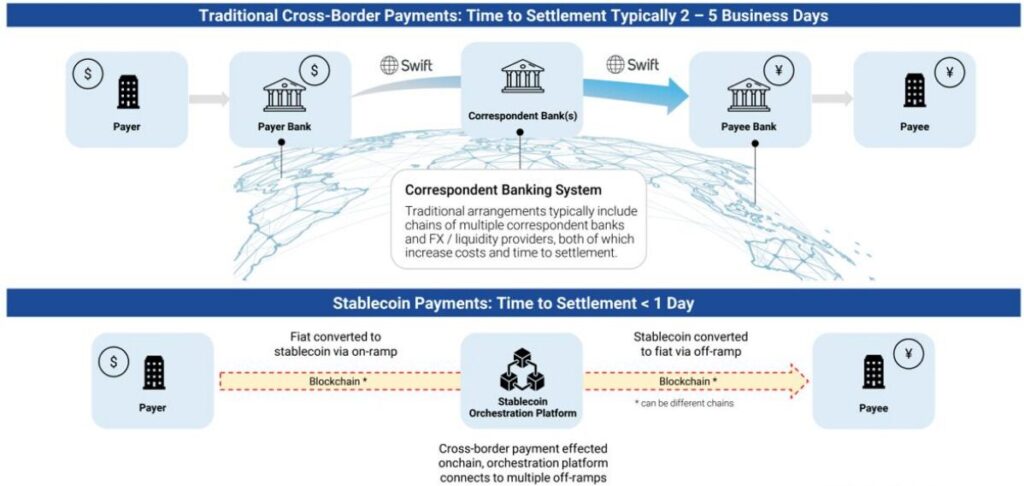
One of the most intriguing developments is the emerging role of cryptocurrencies in geopolitical infrastructure.
The reported acceptance of Bitcoin and stablecoins for transit fees in the Strait of Hormuz—whether fully verified or not—signals a broader trend. Under conditions of geopolitical fragmentation, traditional financial rails become constrained. Sanctions, currency restrictions, and settlement delays create friction in global trade.
Cryptocurrencies offer an alternative:
- Borderless settlement
- Reduced reliance on correspondent banking
- Faster execution under constrained conditions
This aligns with a growing trend where digital assets are not just speculative instruments but tools for operational resilience.
Stablecoins, in particular, are gaining traction as settlement instruments due to their price stability. Meanwhile, Bitcoin serves as a censorship-resistant alternative in politically sensitive environments.
For investors and builders, this represents a key opportunity: the intersection of geopolitics and blockchain is no longer theoretical—it is becoming operational.
6. Scenario Analysis: What Comes Next?
Insert Figure 1 Here
(Recommended: Bitcoin price scenario projection chart showing bullish vs bearish paths)
Insert Figure 2 Here
(Recommended: Oil price vs Bitcoin correlation chart)
Looking ahead, market direction will depend on three key variables:
1. Oil Flow Through the Strait of Hormuz
If shipping conditions normalize and oil stabilizes in the $80–$90 range, inflation pressures may ease. This would support liquidity and potentially drive a recovery in risk assets, including cryptocurrencies.
2. Escalation or Prolonged Restrictions
If access remains constrained and oil returns above $100, inflation risks will persist. This could delay monetary easing by the Federal Reserve and maintain downward pressure on risk assets.
3. Central Bank Response
Policy decisions by the Federal Reserve and the Bank of Japan will play a decisive role. Markets are increasingly sensitive to signals regarding rate cuts or hikes, and geopolitical uncertainty complicates forward guidance.
Conclusion: A New Market Regime Driven by Geopolitics
The breakdown in Iran negotiations marks more than a temporary disruption—it signals a structural shift in how global markets function.
We are entering a regime where:
- Geopolitical events directly influence financial infrastructure
- Energy logistics shape macroeconomic outcomes
- Cryptocurrencies emerge as tools of settlement, not just speculation
Bitcoin’s role as a fast-reacting macro asset, oil’s transformation into a politically managed commodity, and the growing use of digital assets in real-world transactions all point to a new paradigm.
For investors seeking new crypto assets, revenue opportunities, and practical blockchain applications, the message is clear:
The next wave of value will not come from isolated innovation—but from systems that operate effectively under geopolitical stress.