
Main Points :
- The U.S. Department of the Treasury has launched a cyber threat intelligence-sharing program for digital asset firms.
- The initiative is led by Office of Cybersecurity and Critical Infrastructure Protection to deliver actionable, real-time threat data.
- The goal is a shift from reactive incident disclosure to proactive, pre-emptive defense across exchanges, wallets, and custodians.
- Rising sophistication and frequency of cyberattacks on crypto platforms is driving policy urgency.
- The program aligns with recommendations from the Presidential Working Group on Financial Markets.
- This move may redefine crypto firms as critical financial infrastructure—impacting compliance, investment flows, and valuation models.
Introduction: A Structural Shift in Crypto Security
The global cryptocurrency industry is entering a new phase—one where cybersecurity is no longer an operational concern but a macro-level driver of capital flows, regulatory alignment, and institutional adoption. In a landmark development, the U.S. Department of the Treasury has launched a dedicated cyber threat intelligence-sharing program aimed specifically at digital asset companies.
This initiative, led by the Office of Cybersecurity and Critical Infrastructure Protection, represents a critical shift in how governments perceive crypto platforms: not as fringe innovation sectors, but as integral components of national financial infrastructure.
For investors, builders, and operators seeking the next opportunity in crypto, this development is not just about security—it signals where capital, regulation, and institutional trust are heading next.
Main Point 1: From Post-Mortem Disclosure to Preemptive Defense
A New Operating Model for Crypto Security
Traditionally, crypto firms have operated in a reactive security environment. Breaches are disclosed after the fact, often when funds are already lost. The Treasury’s program fundamentally changes this paradigm.
Participating firms will receive:
- Real-time alerts on active attack campaigns
- Indicators of compromise (IOCs)
- Tailored best practices for exchanges, wallet providers, and custodians
This transforms cybersecurity into a shared intelligence layer, similar to systems already used in traditional banking networks.
Implication for the Market
This model reduces:
- Time-to-detection
- Time-to-response
- Systemic contagion risk across platforms
For investors, platforms with access to such intelligence will likely command higher trust premiums, especially in institutional flows.
Main Point 2: Rising Threat Pressure Is Reshaping the Industry
The Escalation of Crypto-Targeted Cyber Threats
According to Treasury officials, cyberattacks targeting digital asset platforms are increasing in both frequency and sophistication. This includes:
- Advanced phishing targeting exchange operators
- Smart contract exploits in DeFi protocols
- Infrastructure-level attacks on custodians
- State-sponsored cyber activities
Notably, groups linked to geopolitical actors have increasingly targeted crypto as a funding vector.
Global Crypto Hack Trends (2019–2026)
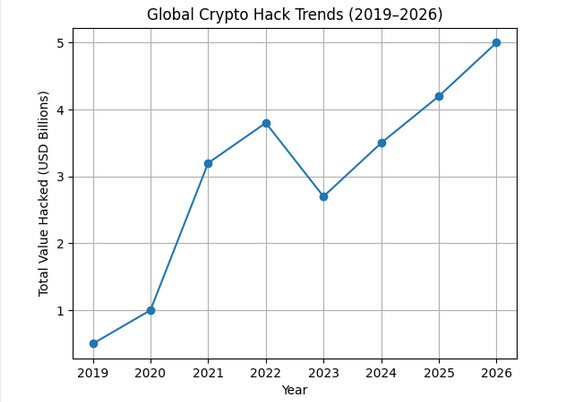
(Image: A line chart showing rising total value of crypto hacks from 2019 to 2026 in USD)
Why This Matters for Investors
Cyber risk is now directly tied to:
- Asset valuation
- Platform survivability
- Insurance costs
- Regulatory approval
A platform’s security posture is becoming as important as liquidity or user growth.
Main Point 3: Institutionalization of Crypto as Critical Infrastructure
A Strategic Policy Signal
This initiative is not isolated. It follows recommendations from the Presidential Working Group report titled “Enhancing the U.S. Leadership in Digital Financial Technology.”
The key message is clear:
Crypto is no longer optional infrastructure—it is systemically relevant.
By creating a direct intelligence-sharing channel between government cyber teams and crypto firms, the U.S. is:
- Formalizing crypto’s role in financial stability
- Integrating it into national security frameworks
- Elevating compliance expectations
Crypto Infrastructure Maturity Model
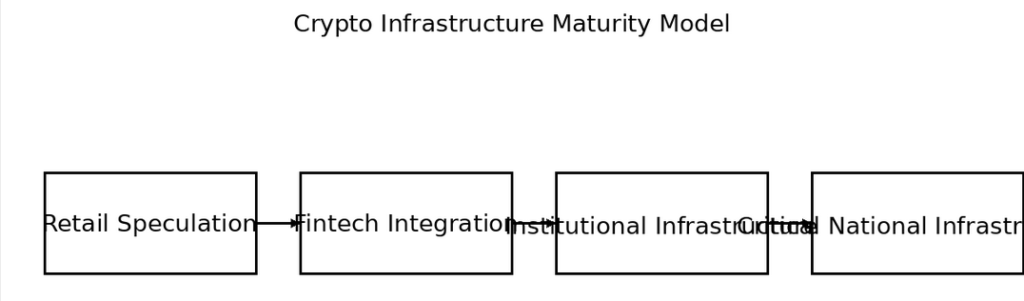
(Image: A layered diagram showing evolution from retail speculation → fintech integration → institutional infrastructure → critical national infrastructure)
Market Impact
This shift will likely:
- Accelerate institutional adoption
- Increase regulatory clarity
- Favor compliant, well-governed platforms
Main Point 4: Competitive Advantage for Participating Firms
Free but Selective Access
The program is reportedly free for eligible firms that meet Treasury standards. However, participation is not universal.
This creates a tiered ecosystem:
- Tier 1: Firms integrated with government intelligence
- Tier 2: Firms operating independently
Strategic Implications
For crypto businesses:
- Access to intelligence becomes a competitive moat
- Security becomes a differentiator, not just a requirement
For investors:
- Participation status may become a due diligence factor
- Premium valuations may emerge for “trusted” platforms
Main Point 5: Global Spillover Effects and Emerging Opportunities
Beyond the United States
Although the program targets U.S.-based firms, its impact will be global.
Other jurisdictions may:
- Replicate similar frameworks
- Require participation for licensing
- Integrate with cross-border intelligence networks
This aligns with trends seen in:
- FATF Travel Rule enforcement
- Cross-border AML coordination
- Stablecoin regulatory frameworks
Global Regulatory Convergence in Crypto
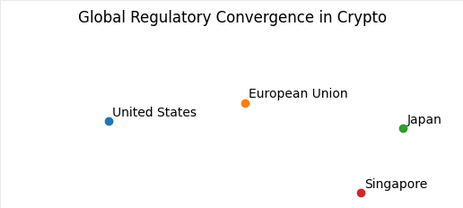
(Image: World map highlighting US, EU, Japan, Singapore as tightening crypto regulation hubs)Opportunities for Builders
This creates new opportunities in:
- Cybersecurity-as-a-service for crypto
- On-chain threat intelligence platforms
- Compliance automation tools
- Secure wallet infrastructure
Conclusion: Security as the New Alpha in Crypto
The launch of the Treasury’s cyber intelligence-sharing program marks a turning point for the cryptocurrency industry.
What was once a fragmented, reactive ecosystem is evolving into a coordinated, intelligence-driven financial network.
For market participants, the implications are profound:
- Security is no longer a backend function—it is a core investment thesis
- Government alignment is becoming a signal of legitimacy and survivability
- The next wave of crypto winners will be those who integrate security, compliance, and infrastructure at scale
In the search for the next high-growth opportunity—whether in tokens, platforms, or infrastructure—understanding this shift is essential.
The future of crypto will not just be decentralized.
It will be secure, interconnected, and institutionally embedded.