Key Takeaways :
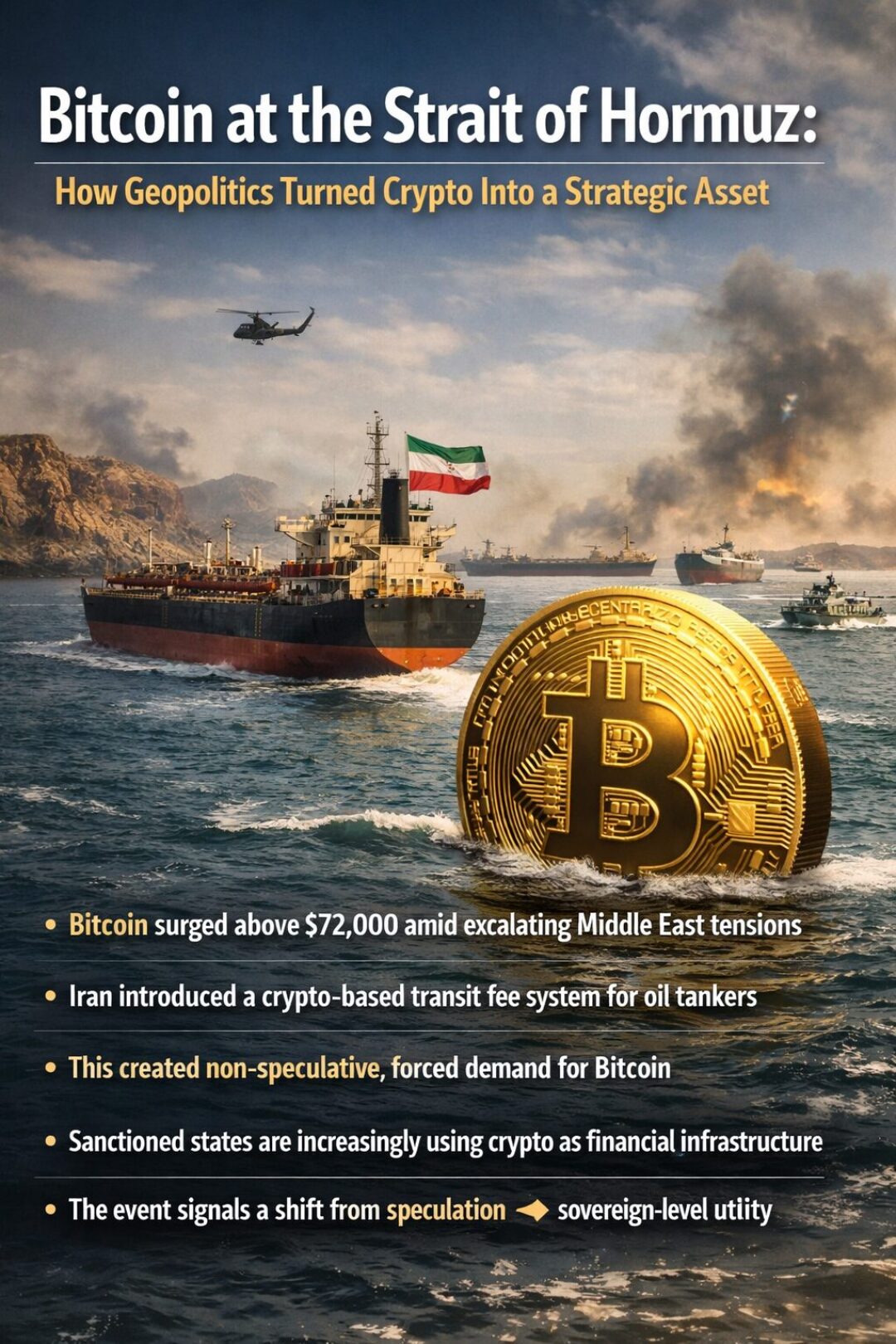
- Bitcoin surged above $72,000 amid escalating Middle East tensions
- Iran introduced a crypto-based transit fee system for oil tankers
- This created non-speculative, forced demand for Bitcoin
- Sanctioned states are increasingly using crypto as financial infrastructure
- The event signals a shift from speculation → sovereign-level utility
1. A New Catalyst: Bitcoin Rises Amid Conflict
In April 2026, an unprecedented market dynamic emerged. Contrary to traditional expectations, Bitcoin did not fall during geopolitical instability—it surged.
Following military escalation involving Iran, the Strait of Hormuz—responsible for approximately 20% of global oil supply—became the focal point of global concern. Yet the most unexpected development was not merely the disruption of energy flows, but the introduction of a crypto-based economic mechanism tied directly to global trade.
Bitcoin briefly exceeded $72,000, driven not by speculation, but by something far more structural: compulsory transactional demand.
This marks a turning point. Bitcoin is no longer just a speculative hedge or digital gold—it is becoming operational financial infrastructure in constrained geopolitical environments.
2. What Happened in the Strait of Hormuz
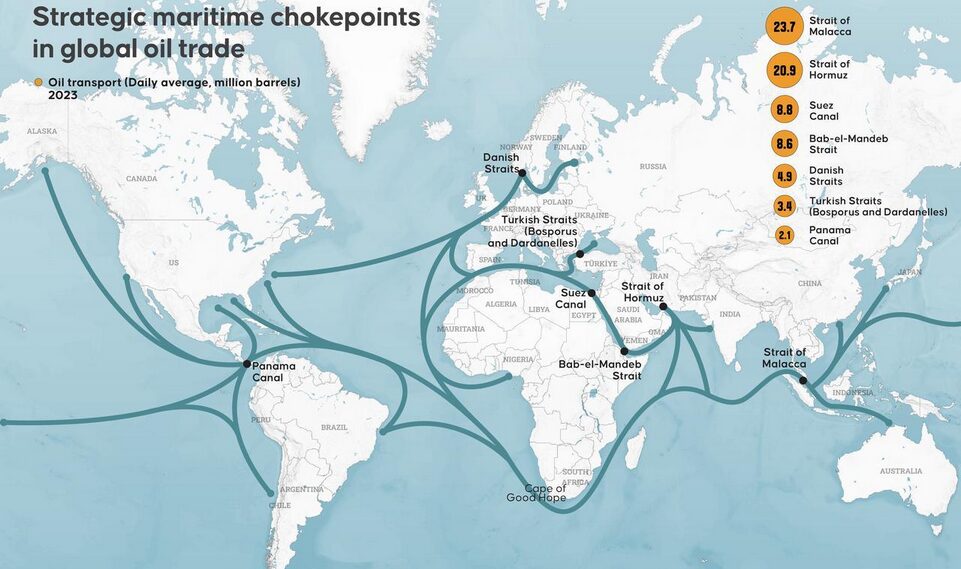
The Strait of Hormuz is one of the most critical chokepoints in global trade. Any disruption sends shockwaves across energy markets.
After military strikes in late February 2026, Iran effectively imposed control over the strait. Oil prices reacted immediately, rising from around $67 per barrel to nearly $120.
However, the most impactful move came later:
Iran announced that fully loaded oil tankers must pay a transit fee equivalent to $1 per barrel, payable in:
- Bitcoin
- Other cryptocurrencies
- Chinese yuan
Notably, US dollars were excluded.
This policy transformed a geopolitical crisis into a direct driver of crypto demand.
3. The “Bitcoin Transit Fee” Mechanism
The system operates in a structured manner:
- Tankers declare cargo in advance
- Iranian authorities issue payment instructions
- Payment is made in Bitcoin or yuan
- Ships receive clearance and escort
A single tanker carrying millions of barrels may require hundreds of thousands to millions of dollars worth of Bitcoin.
Crucially, this is not optional.
Failure to comply results in denial of passage.
Bitcoin Demand Flow from Oil Logistics
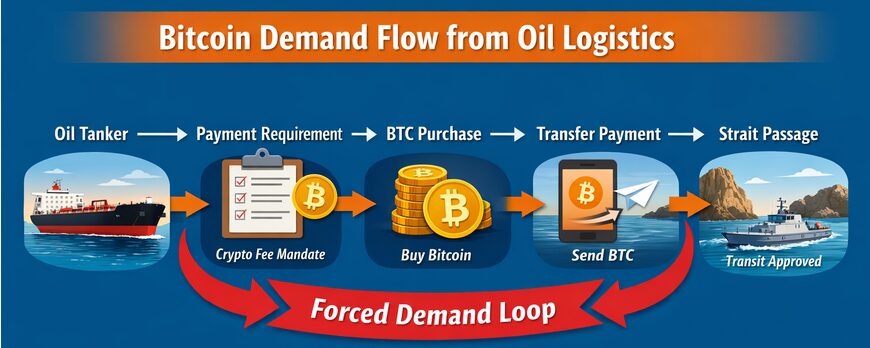
Suggested diagram:
- Oil tanker → Payment requirement → BTC purchase → Transfer → Strait passage
- Highlight “forced demand loop”
4. Why Bitcoin Instead of the Dollar
The answer lies in one concept: sanctions resistance.
Traditional global payments rely on systems such as SWIFT, which are ultimately subject to US influence. These systems can be blocked, frozen, or monitored.
Bitcoin, by contrast:
- Operates on a decentralized network
- Cannot be easily censored
- Requires no intermediary approval
For Iran, this creates a powerful tool:
a payment rail outside the reach of sanctions enforcement.
This is not theoretical—it is practical, immediate, and scalable.
5. The Rise of “Non-Elastic Demand”
Historically, Bitcoin has been driven by:
- Speculation
- Institutional allocation
- Retail trading cycles
However, the Hormuz situation introduces a new category:
Non-elastic demand
Energy companies and shipping operators must acquire Bitcoin regardless of price.
Unlike traders:
- They cannot “wait for dips”
- They cannot substitute alternatives easily
- Their operations depend on compliance
This creates a price-insensitive demand curve, fundamentally different from previous market drivers.
Elastic vs Non-Elastic Bitcoin Demand
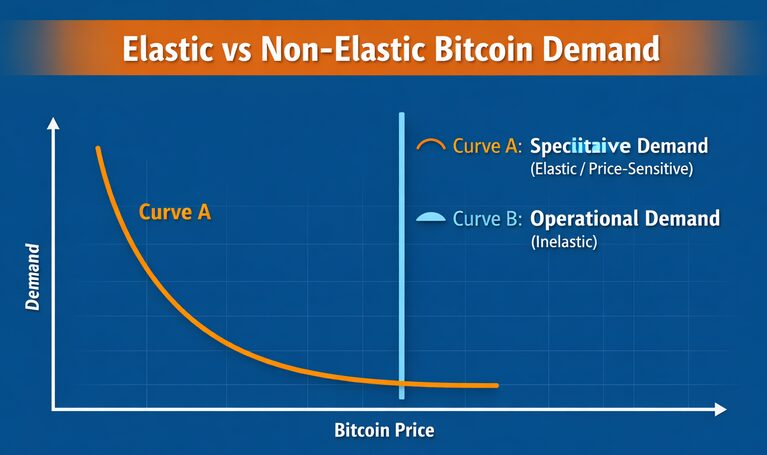
Suggested visualization:
- Curve A: speculative demand (price-sensitive)
- Curve B: operational demand (vertical / inelastic)
6. Iran’s Long-Term Crypto Strategy
This development did not emerge overnight.
Iran has spent over a decade building a crypto-based economic workaround, including:
- Utilizing excess energy for Bitcoin mining
- Converting mined BTC into import payments
- Establishing regulated mining frameworks
By 2025, Iran’s crypto ecosystem reached approximately $7.78 billion in annual flow.
This reflects a broader strategy:
Energy → Mining → Bitcoin → Trade Settlement
The Strait of Hormuz policy is simply the next evolution:
Externalizing Bitcoin demand onto global trade participants.
7. A Global Pattern: Crypto and Sanctioned Economies
Iran is not alone.
Similar patterns can be observed globally:
- Russia legalized crypto settlement after SWIFT exclusion
- North Korea has leveraged cyber operations to acquire crypto
- Emerging economies are experimenting with alternative settlement rails
The common thread:
The more restricted access to the dollar system becomes,
the more valuable decentralized alternatives become.
This dynamic is reshaping the global financial landscape.
8. Why Bitcoin Rose Instead of Falling
Traditionally, geopolitical crises trigger:
- Risk-off behavior
- Sell-offs in volatile assets
- Flight to safety
Bitcoin historically followed this pattern.
However, in early March 2026, Bitcoin dropped from around $74,000 to $65,000, reflecting initial panic.
The reversal came with the realization of structural demand:
- Continuous tanker payments
- Mandatory Bitcoin acquisition
- Persistent flow regardless of price
This created sustained upward pressure, pushing Bitcoin back above $72,000.
9. Implications for Japan and Global Economies
Japan is particularly exposed:
- ~94% of oil imports come from the Middle East
- Much of it passes through Hormuz
Consequences include:
- Rising energy costs
- Inflation in food and utilities
- Yen depreciation
- Increased import burden
Additionally, a weaker yen amplifies Bitcoin prices in local terms.
10. Three Future Scenarios
Scenario 1: Prolonged Disruption
- Continuous Bitcoin demand
- Structural price support
Scenario 2: De-escalation
- Short-term correction
- Demand disappears rapidly
Scenario 3: Oil Shock + Tightening
- Macroeconomic pressure
- Potential Bitcoin downside
Most likely outcome:
A hybrid scenario combining geopolitical tension and macro constraints.
11. Strategic Implications for Investors and Builders
This event signals a deeper transformation:
Bitcoin as Infrastructure
Not just an asset—but a settlement layer under geopolitical stress
Stablecoin & Payment Opportunities
- Cross-border settlement alternatives
- Compliance-resistant rails
- Real-time liquidity demand
Trading Strategy Shift
- Monitor real-world demand drivers, not just market sentiment
- Track geopolitical triggers as crypto catalysts
Conclusion
The Strait of Hormuz event represents more than a temporary market anomaly.
It demonstrates that:
- Bitcoin can function as a sovereign-level financial tool
- Geopolitics can generate forced, non-speculative demand
- The global financial system is entering a phase of fragmentation and decentralization
This is not merely a price story.
It is a structural shift.