
Key Points :
- Early Bitcoin and Ethereum whales are beginning to redistribute long-held assets
- This signals a structural shift from individual-driven narratives to institutional dominance
- Wealth dilution is accelerating true decentralization
- Institutional capital is transforming crypto into global financial infrastructure
- The market is entering a more predictable, regulated, and capital-efficient phase
1. The Silent Guardians Are Finally Moving: A Generational Shift in Crypto
For over a decade, the cryptocurrency ecosystem has been shaped by a small group of early adopters—often referred to as “whales”—who accumulated vast amounts of assets during the infancy of networks like Bitcoin and Ethereum. These individuals were not merely investors; they were ideological participants who believed in decentralization, sovereignty, and a reimagined financial system.
Now, a historic shift is unfolding.
Dormant wallets are awakening. Long-held assets are being redistributed. What we are witnessing is not just market activity—it is the closing chapter of crypto’s founding mythology.
These early holders endured extreme volatility, regulatory uncertainty, and technological fragility. Their decision to release assets at this stage is deeply symbolic. It reflects a recognition that crypto has evolved beyond an experimental ideology into a functioning global system.
This transition represents a critical milestone:
the network no longer depends on belief—it operates on inevitability.
The departure of these early figures may feel like the loss of pioneers. However, it is also a necessary step toward true decentralization. A system cannot be globally trusted if it remains disproportionately influenced by a small group of early insiders.
As these assets flow into broader markets, they are being absorbed by a new class of participants—institutional investors, sovereign funds, and global financial entities.
Evolution of Crypto Ownership Structure (2009–2026)
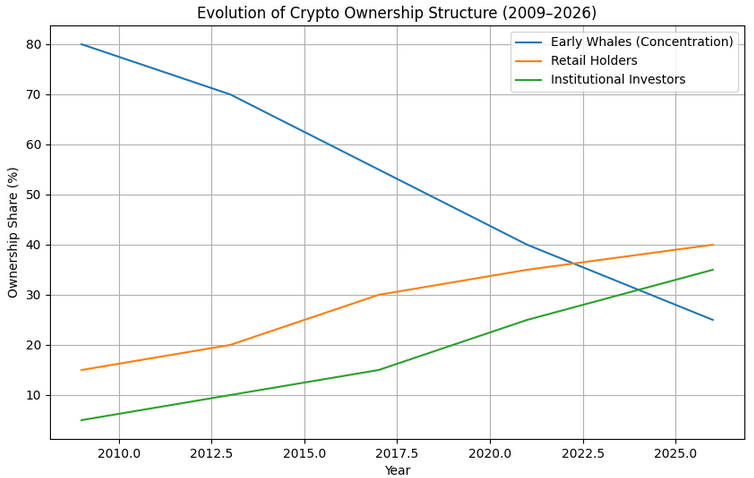
- Early Phase: Concentration in few wallets
- Transition Phase: Gradual redistribution
- Institutional Phase: Broad ownership + institutional custody
2. The Great Dilution: Breaking Concentrated Power
One of the core contradictions of cryptocurrency has always been this:
A system designed for decentralization began with extreme concentration of wealth.
The current wave of asset redistribution acts as a structural correction mechanism—a “great dilution” of power.
As early whales exit or reduce holdings, their influence diminishes. In their place, ownership becomes distributed across millions of participants and institutional structures.
Short-term, this creates volatility. Large sell-offs introduce uncertainty. However, long-term, this process strengthens the system in several ways:
- Increased liquidity
- Reduced market manipulation risk
- More stable price discovery
- Broader participation
This is not simply a financial shift—it is a governance transformation.
When no single entity holds disproportionate influence, networks like Bitcoin and Ethereum approach their intended state: trustless systems governed by protocol rather than personality.
Interestingly, this transition also marks a philosophical evolution. Early adopters were emotionally invested in the technology. Institutional participants, by contrast, are driven by:
- Risk-adjusted returns
- Portfolio diversification
- Regulatory compliance
- Capital efficiency
This introduces discipline into the ecosystem.
Wealth Distribution Before vs After Dilution
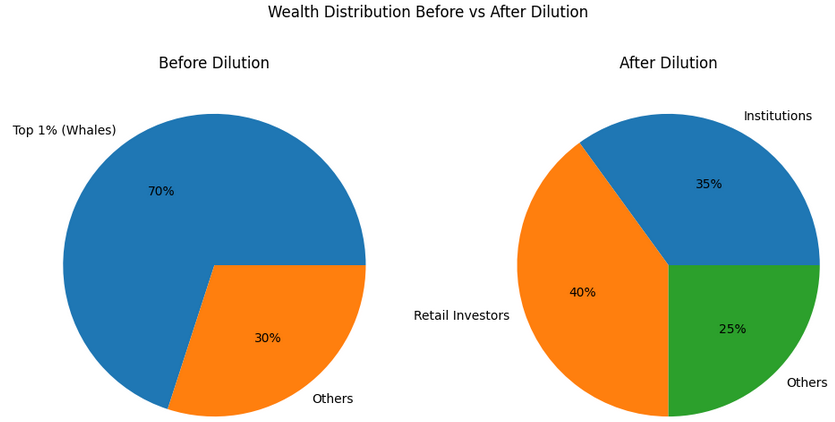
- Before: Top 1% controls majority
- After: Wider distribution across retail + institutions
3. The Rise of Institutional Dominance
As early holders release assets, institutional players are stepping in at scale.
Major asset managers, hedge funds, and even pension funds are increasing exposure to crypto. Products such as spot Bitcoin ETFs have accelerated this trend, allowing traditional capital to enter the market through familiar structures.
This transition is redefining crypto’s role:
- From speculative asset → macro asset class
- From niche innovation → financial infrastructure
Institutional involvement brings several structural changes:
1. Capital Depth
Large-scale capital inflows stabilize markets and reduce extreme volatility over time.
2. Regulatory Alignment
Institutions require compliance frameworks, pushing the industry toward clearer regulation.
3. Infrastructure Maturity
Custody solutions, trading systems, and settlement layers become more robust.
4. Integration with Traditional Finance
Crypto increasingly interacts with banking systems, payment rails, and global liquidity networks.
This is the phase where Bitcoin begins to fully realize its identity as digital gold, while Ethereum evolves into a global computation layer.
Capital Flow Shift (Retail → Institutional)
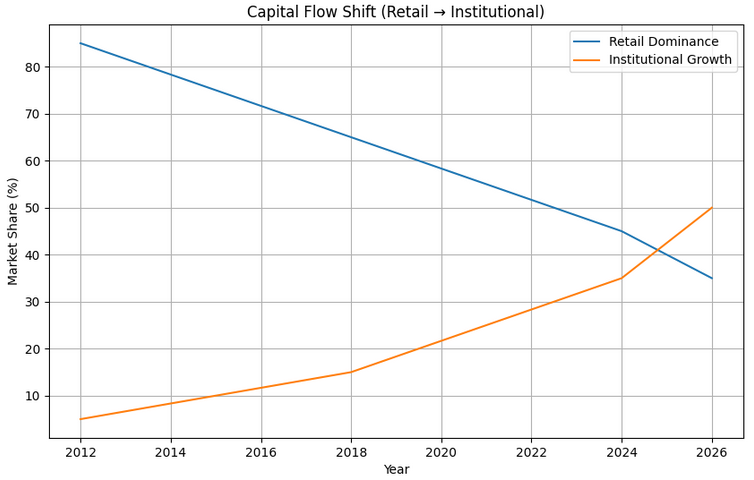
- Timeline showing increasing institutional dominance
4. From Ideology to Infrastructure
In its early days, crypto was driven by ideals:
- Financial sovereignty
- Resistance to centralized power
- Trustless peer-to-peer systems
Today, those ideals are being translated into practical infrastructure.
Crypto is no longer just a belief system—it is becoming:
- Settlement rails for cross-border payments
- Collateral layers for global finance
- Programmable platforms for financial applications
This transformation is critical.
A technology only achieves true success when it becomes invisible—when it is used without being noticed. Just as the internet moved from novelty to necessity, crypto is undergoing the same evolution.
The shift from individual wallets to institutional custody is part of this process. While it may appear to contradict decentralization, it actually expands accessibility and usability at scale.
5. What This Means for Investors and Builders
For readers seeking new crypto opportunities, this transition creates both risks and advantages.
Opportunities
- Institutional adoption increases long-term valuation stability
- Infrastructure projects (custody, compliance, settlement) gain importance
- New asset classes (real-world assets, tokenized securities) emerge
Risks
- Reduced volatility may limit speculative upside
- Increased regulation may restrict certain activities
- Market dynamics become more macro-driven
Strategic Insight
The key question is no longer:
“Which coin will 100x?”
But rather:
“Which protocols will underpin the next financial system?”
This requires a shift in perspective—from speculation to infrastructure thinking.
6. The Final Transition: Crypto as Global Financial Infrastructure
The exit of early whales is not an end—it is a handover.
Their assets are not disappearing; they are entering a new phase of circulation within a much larger system.
This is the moment where crypto transitions from:
- Myth → Mechanism
- Ideology → Utility
- Experiment → Infrastructure
The emotional energy of early communities is being replaced by structured capital and systematic growth.
This may feel less romantic—but it is far more powerful.
Because it signals that crypto is no longer dependent on belief.
It has become inevitable.
Conclusion: Beyond Nostalgia, Toward Reality
We are witnessing one of the most important transitions in financial history.
The early guardians of crypto are stepping aside—not in defeat, but in completion of their role. Their vision has materialized into something far greater than individual ownership.
As capital redistributes and institutions take the lead, crypto is entering a phase defined by:
- Stability
- Integration
- Global relevance
The mythology of crypto is ending.
In its place, a new order is emerging—one that is colder, more calculated, and far more enduring.
For those who understand this shift, the opportunity is not in chasing the past—but in building and positioning within the future.