Main Points :
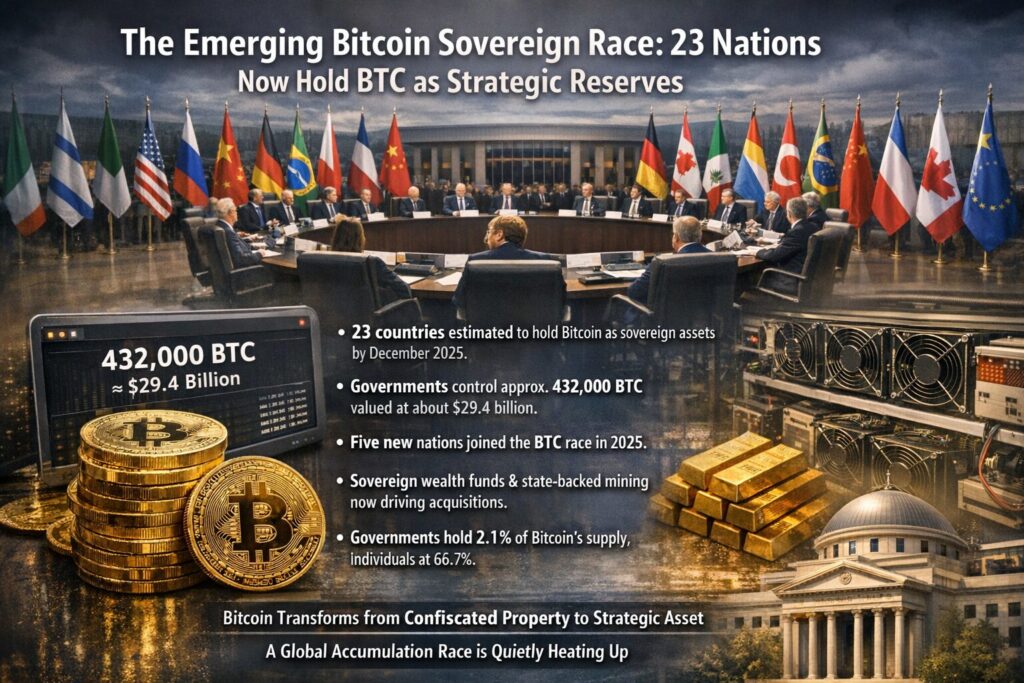
- 23 countries are estimated to hold Bitcoin as sovereign assets as of December 2025.
- Governments collectively control approximately 432,000 BTC, valued at about $29.4 billion.
- Five new nations reportedly entered the sovereign Bitcoin landscape in 2025.
- Acquisition methods are diversifying beyond seizures to include sovereign wealth funds, central bank purchases, and state-sponsored mining.
- Bitcoin ownership structure shows governments hold 2.1% of total supply, while individuals still dominate at 66.7%.
- The shift signals Bitcoin’s transformation from confiscated property to strategic reserve asset.
- A quiet global accumulation race may accelerate over the next 2–3 years.
Introduction: From Confiscation to Strategic Accumulation
In February 2026, the U.S.-based Bitcoin financial services firm River released its “Bitcoin Adoption Report 2026,” revealing a striking development: an estimated 23 countries now hold Bitcoin as sovereign assets. What began as incidental holdings through law enforcement seizures is evolving into a calculated strategy among governments seeking monetary diversification, geopolitical hedging, and long-term asset appreciation.
As of December 31, 2025, governments collectively hold approximately 432,000 BTC—worth around $29.4 billion at prevailing market prices—representing about 2.1% of Bitcoin’s total supply. While this percentage may appear modest, the implications are profound. Nation-state participation marks a structural shift in Bitcoin’s maturation from a retail-driven phenomenon to a sovereign-level strategic asset.
For investors, institutions, and blockchain practitioners searching for the next revenue stream or structural market inflection point, sovereign Bitcoin adoption may represent one of the most important macro developments of the decade.
Section 1: The Current Landscape of Sovereign Bitcoin Holdings
Top Sovereign Holders and Their Acquisition Methods
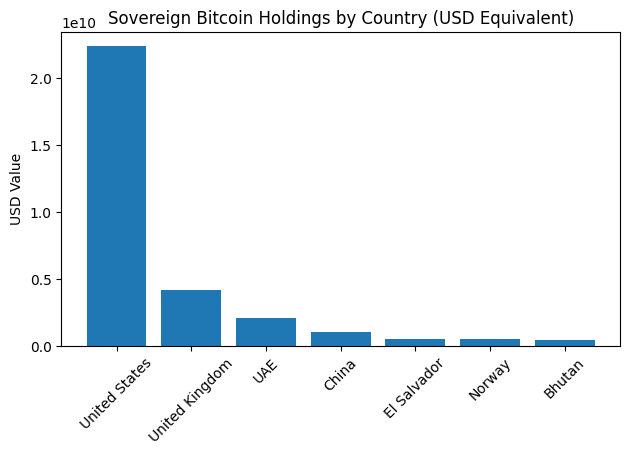
According to River’s estimates, the largest sovereign holder is the United States, with approximately 328,372 BTC. The majority of these holdings were acquired through law enforcement seizures, particularly from darknet marketplaces and cybercrime cases.
The United Kingdom follows with 61,245 BTC, also primarily from asset confiscations.
The United Arab Emirates holds approximately 30,382 BTC. Unlike Western governments, the UAE has reportedly accumulated Bitcoin through a combination of sovereign wealth fund allocations and state-supported mining initiatives.
China is estimated to hold 15,000 BTC through confiscations, while El Salvador, the first country to adopt Bitcoin as legal tender in 2021, holds approximately 7,514 BTC acquired through direct purchases.
Other notable holders include:
- Norway (7,161 BTC via sovereign wealth fund exposure)
- Bhutan (5,984 BTC through state-sponsored mining)
- Switzerland (1,084 BTC through indirect central bank exposure)
- North Korea (803 BTC via hacking operations, according to public estimates)
In 2025 alone, five new countries reportedly joined the sovereign Bitcoin holders’ group: Luxembourg, Saudi Arabia, the Czech Republic, Brazil, and Taiwan.
This diversification of participants signals that sovereign accumulation is no longer confined to fringe adopters or enforcement byproducts.
Section 2: The Shift in Acquisition Strategy
Central Banks Enter the Arena
One of the most significant developments highlighted in River’s report is the move by central banks to directly purchase Bitcoin.
In November 2025, the Czech National Bank (CNB) announced the creation of a pilot crypto portfolio, marking its first direct Bitcoin purchase. Governor Aleš Michl stated that the move aimed to diversify foreign reserves, with a formal evaluation scheduled within 2–3 years.
This development is notable because central banks traditionally focus on gold, sovereign bonds, and foreign currency reserves. Bitcoin’s inclusion—even on a trial basis—signals institutional recognition of its monetary characteristics.
The United States: Toward a Strategic Digital Reserve
In June 2025, U.S. congressional hearings revealed that seized Bitcoin was being transferred into a form of strategic reserve rather than immediately liquidated. Officials characterized Bitcoin as “digital gold,” emphasizing a fiscally neutral approach to reserve expansion.
This represents a major policy evolution. Historically, seized Bitcoin was auctioned off. Retention instead of liquidation implies a long-term strategic perspective.
Section 3: Ownership Structure and Market Implications
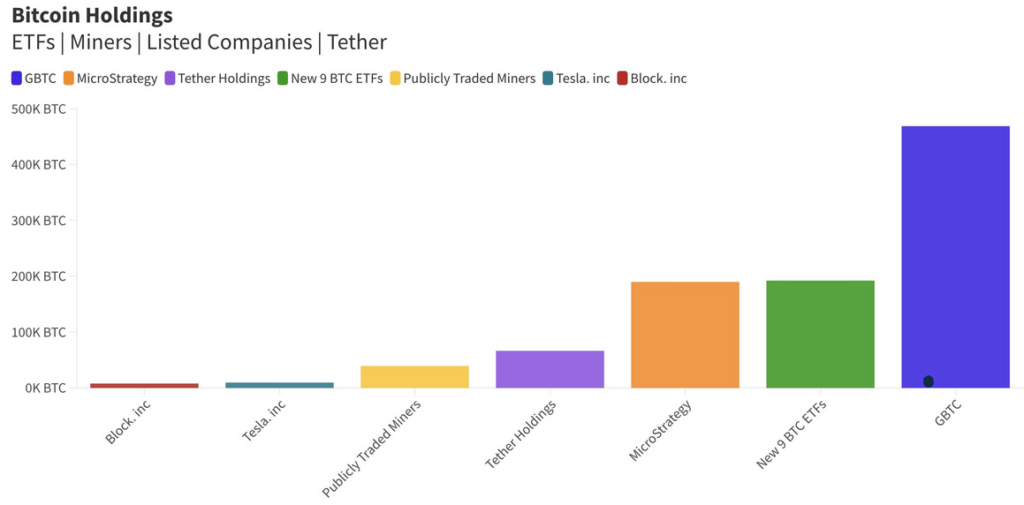
Global Bitcoin Ownership Distribution
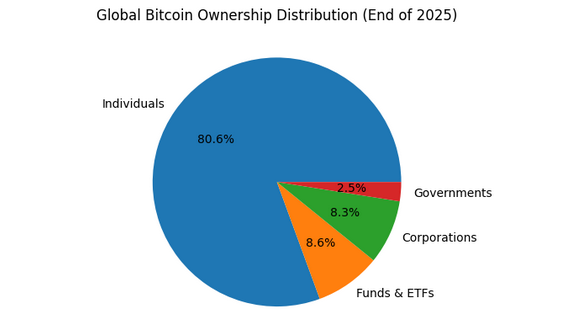
As of December 31, 2025, Bitcoin ownership is estimated as follows:
- Individuals: 14.01 million BTC (66.7%)
- Funds and ETFs: 1.49 million BTC (7.1%)
- Corporations: 1.45 million BTC (6.9%)
- Governments: 432,000 BTC (2.1%)
- Other entities and lost coins comprise the remainder.
Despite the rise of institutional and sovereign participation, Bitcoin remains predominantly a retail-held asset. However, the incremental shift toward state accumulation introduces a new supply dynamic.
With Bitcoin’s hard cap of 21 million coins, a sovereign competition to accumulate even 1 million BTC collectively could materially affect circulating supply.
Pantera Capital CEO Dan Morehead recently suggested that within 2–3 years, countries could compete to secure 1 million BTC positions, potentially triggering a supply shock.
Section 4: Geopolitical and Financial Motivations
Reserve Diversification
For emerging economies, Bitcoin offers a non-sovereign reserve alternative. Unlike U.S. Treasuries, it carries no counterparty risk tied to a foreign government.
Sanctions Resistance and Neutral Settlement
Countries facing sanctions or geopolitical risk may view Bitcoin as a neutral settlement asset. While not immune to blockchain surveillance, it operates outside traditional SWIFT-based systems.
Strategic Mining as Energy Monetization
Nations such as Bhutan and the UAE have leveraged surplus energy resources to mine Bitcoin. For energy-rich countries, mining converts stranded energy into globally liquid digital reserves.
This opens revenue pathways for developing economies seeking to monetize hydroelectric, geothermal, or flare gas energy.
Section 5: What This Means for Investors and Builders
For crypto-native investors and institutional strategists, sovereign accumulation signals three major trends:
- Reduced Long-Term Float: Government-held BTC may not return to market quickly.
- Legitimization: Central bank participation reduces regulatory stigma.
- Strategic Premium: Bitcoin could increasingly trade as a geopolitical hedge asset.
For builders and entrepreneurs, opportunities include:
- Sovereign-grade custody solutions
- Compliance-integrated mining infrastructure
- Nation-state treasury analytics
- Digital reserve management software
- Energy-to-Bitcoin monetization platforms
Insert Graph Here
[Sovereign Bitcoin Holdings by Country – Bar Chart in USD Equivalent]
[Bitcoin Ownership Distribution – Pie Chart]
Conclusion: The Quiet Accumulation Era
The River report’s estimate of 23 sovereign Bitcoin holders marks a turning point. What began as confiscated contraband has evolved into strategic reserve allocation. While governments still hold only 2.1% of supply, the trend direction is unmistakable.
If the next 2–3 years witness accelerated accumulation, Bitcoin’s monetary narrative may shift from “digital gold” to “digital reserve asset.”
For investors seeking asymmetric upside, sovereign competition could become the catalyst that transforms Bitcoin’s supply constraints into a structural price driver.
The quiet race has begun. Whether it becomes a full-scale sovereign scramble for 1 million BTC remains to be seen—but the foundations are already in place.