
Main Points :
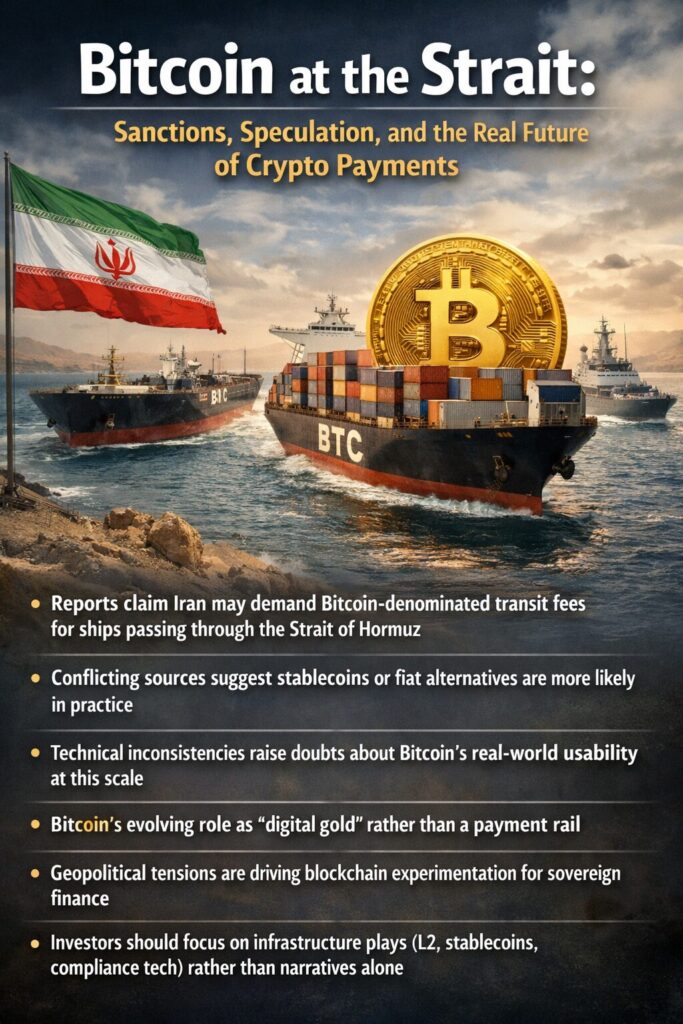
- Reports claim Iran may demand Bitcoin-denominated transit fees for ships passing through the Strait of Hormuz
- Conflicting sources suggest stablecoins or fiat alternatives (e.g., yuan) are more likely in practice
- Technical inconsistencies raise doubts about Bitcoin’s real-world usability at this scale
- The case highlights Bitcoin’s evolving role as “digital gold” rather than a payment rail
- Geopolitical tensions are accelerating experimentation with blockchain for sovereign finance
- Investors should focus on infrastructure plays (L2, stablecoins, compliance tech) rather than narratives alone
1. A Geopolitical Flashpoint Meets Crypto Narrative
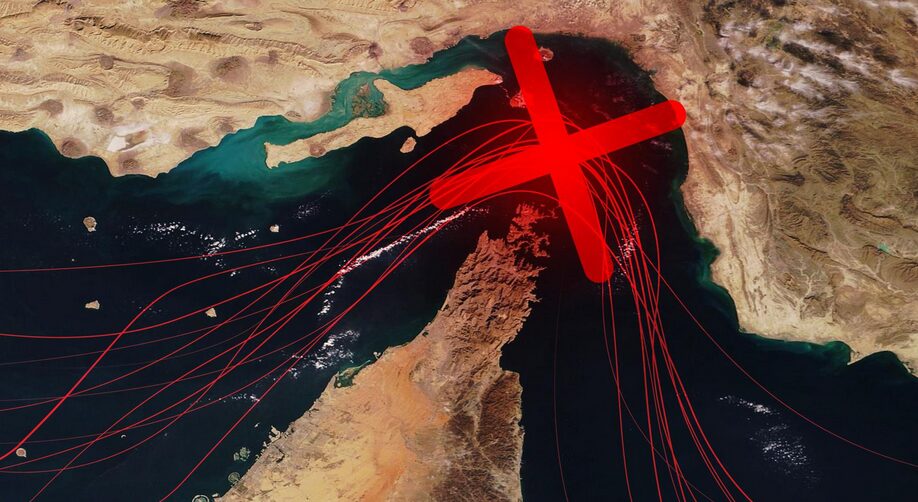
A recent report suggesting that Iran may demand Bitcoin payments for ships transiting the Strait of Hormuz has captured global attention—not only because of its geopolitical implications, but also because of what it signals about the evolving role of cryptocurrency in sovereign finance.
The Strait of Hormuz is one of the world’s most critical energy chokepoints, responsible for roughly 20% of global oil flows. Any change in how transit is priced or enforced carries immediate global consequences. According to initial reports, Iran was allegedly considering charging approximately $1 per barrel in Bitcoin, potentially resulting in fees as high as $2 million per supertanker.
This narrative quickly spread across financial and crypto media, triggering a short-term rally in Bitcoin prices—briefly pushing it above $72,000. However, as more detailed analysis emerged, particularly from Alex Thorn of Galaxy Digital, the situation appeared far more complex—and far less certain.
2. Contradictions Across Intelligence and Media Reports
The initial claim originated from reporting by Financial Times, citing an Iranian oil export association spokesperson. However, subsequent reports from Bloomberg suggested alternative payment mechanisms, including stablecoins or Chinese yuan settlements.
Further complicating the narrative, TRM Labs stated that there is no on-chain evidence supporting large-scale Bitcoin payments tied to maritime transit. Meanwhile, independent field research indicated that many shipping payments are still being handled through traditional mechanisms such as negotiated sanction relief or indirect settlements.
This divergence highlights a critical issue in crypto markets: narrative often precedes verification. For investors and builders, distinguishing signal from noise is essential.
3. Technical Reality: Why Bitcoin May Not Fit the Use Case
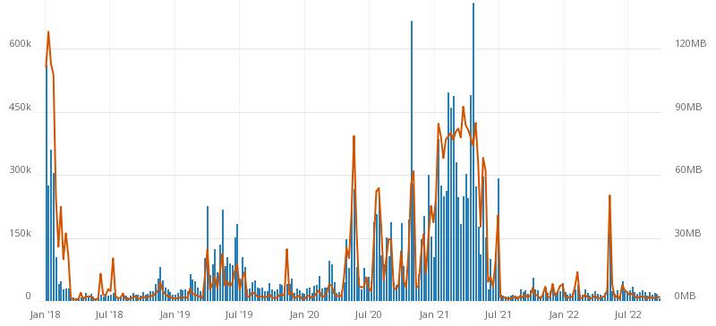
Even if Iran were inclined to use cryptocurrency for sanctions evasion, Bitcoin presents several practical challenges.
First, the claim that payments could be completed “within seconds with privacy” is technically inaccurate for standard Bitcoin transactions. On-chain Bitcoin transfers typically require multiple confirmations, taking anywhere from several minutes to an hour depending on network conditions.
The alternative would be the Lightning Network, a Layer 2 scaling solution designed for faster and cheaper transactions. However, this introduces another constraint: liquidity and channel capacity.
- Known large Lightning transactions (as of early 2026) have reached approximately $1 million
- A single tanker fee could exceed $2 million
- Routing such a transaction reliably would be non-trivial
Additionally, Bitcoin’s transparent ledger may not provide the level of obfuscation required for sanctions evasion, especially when compared to privacy-focused tools or off-chain arrangements.
4. Bitcoin vs Stablecoins: The Real Battle for Utility
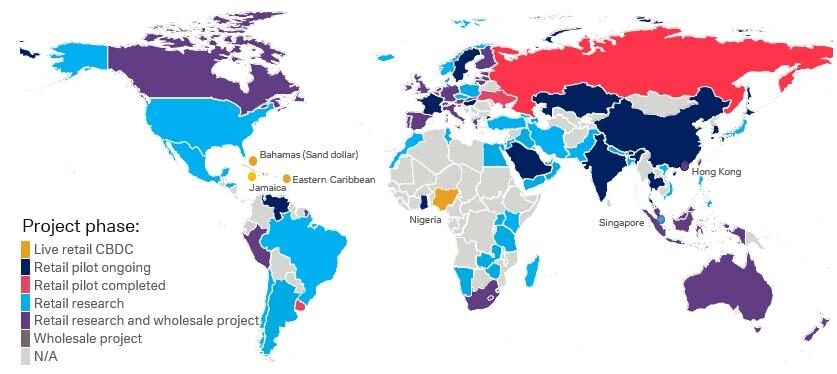
If the goal is to bypass sanctions while maintaining usability, stablecoins may present a more practical solution.
However, stablecoins come with a critical limitation: issuer control. Assets like USDT or USDC can be frozen by centralized entities, making them vulnerable in geopolitical conflict scenarios.
Bitcoin, on the other hand, offers:
- Censorship resistance
- Decentralized validation
- No central issuer
This is why analysts like Alex Thorn emphasize Bitcoin’s similarity to gold. It may not be ideal for high-frequency payments, but it excels as a neutral reserve asset in politically sensitive environments.
5. Iran vs North Korea: Two Different Crypto Strategies
The comparison between Iran and North Korea is often misunderstood.
North Korea has been linked to crypto theft and cyberattacks, using stolen assets to fund state operations. Iran, by contrast, has historically used blockchain as a tool for economic survival, particularly under heavy sanctions.
This distinction is crucial:
- North Korea → Offensive cyber strategy
- Iran → Defensive financial adaptation
Understanding these differing motivations helps investors and policymakers better assess long-term adoption patterns.
6. Market Implications: What Investors Should Actually Watch
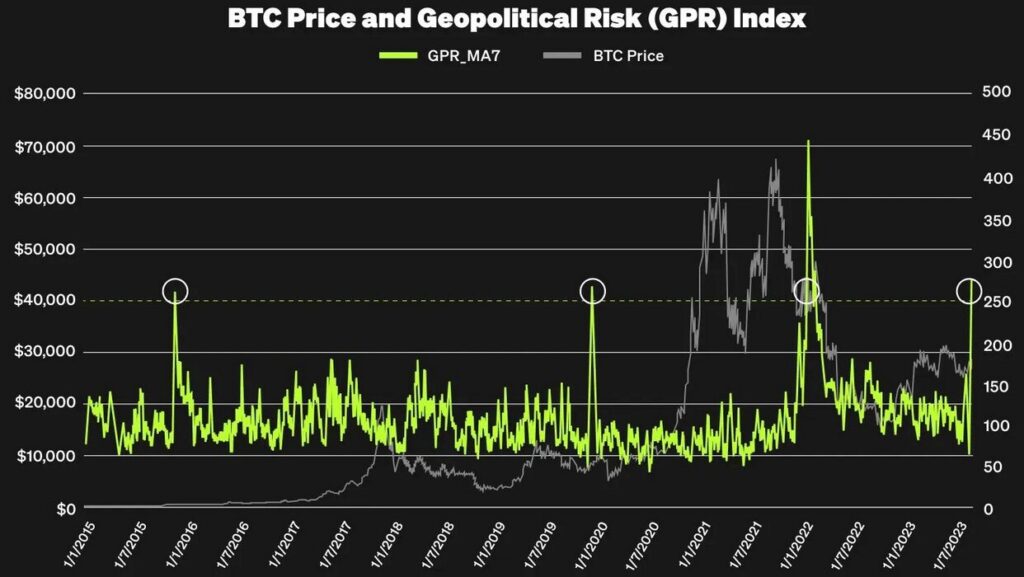
While the headline narrative may be exaggerated, the underlying trend is real: nation-states are exploring blockchain-based financial rails.
For investors seeking new opportunities, the key is to look beyond sensational news and focus on infrastructure layers:
6.1 Payment Infrastructure
- Lightning Network scaling solutions
- Cross-border settlement protocols
- On/off-ramp providers
6.2 Stablecoin Ecosystem
- Non-USD stablecoins (e.g., yuan-linked or commodity-backed)
- Decentralized stablecoin models resistant to freezing
6.3 Compliance and Analytics
- Blockchain surveillance tools
- AML/KYT integration systems
- Regulatory technology (RegTech)
These sectors are likely to benefit regardless of whether the Iran-Bitcoin narrative proves true.
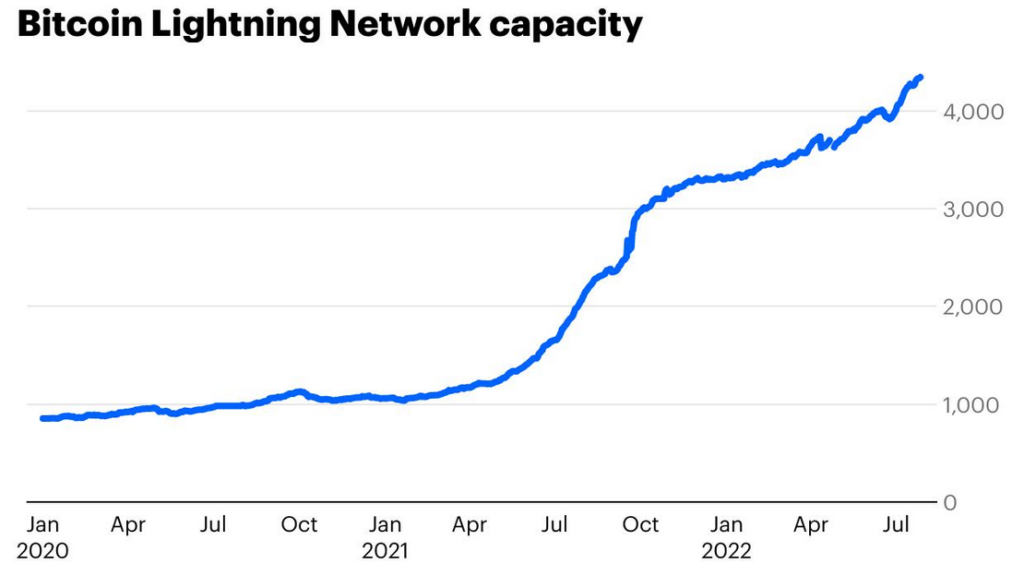
Bitcoin Payment Feasibility vs Transaction Size (Illustrative Chart)
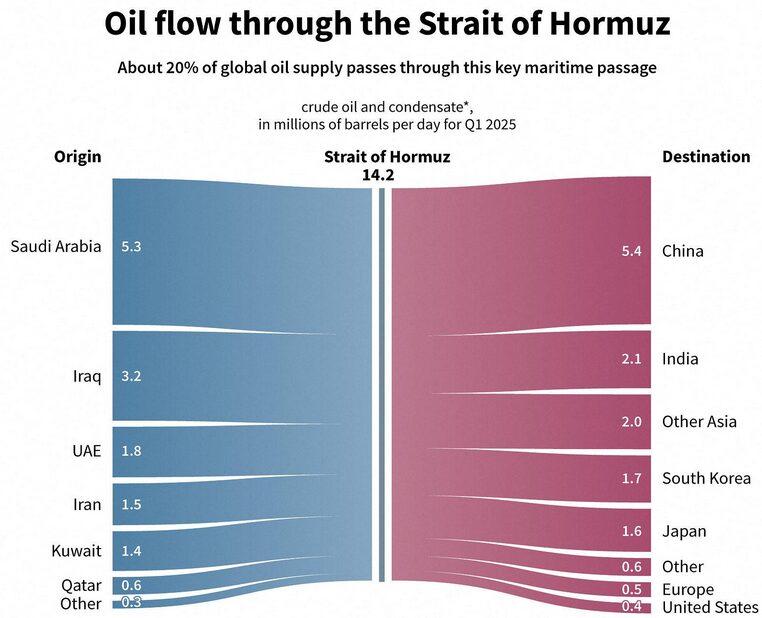
Global Oil Flow Through the Strait of Hormuz (Impact Visualization)
7. Conclusion: Narrative vs Reality in the Next Phase of Crypto
The idea that Iran is demanding Bitcoin payments for maritime transit is compelling—but remains unproven. What matters more is not whether this specific case is true, but what it represents.
We are entering a phase where:
- Geopolitics and crypto are converging
- Sovereign actors are experimenting with blockchain
- Narratives can move markets faster than fundamentals
Bitcoin’s role is becoming clearer: it is less a payment network and more a strategic asset, akin to digital gold. Meanwhile, the real innovation—and opportunity—lies in the layers being built around it.
For those seeking the next revenue streams or investment opportunities, the takeaway is simple:
Do not chase headlines. Build and invest in the infrastructure that makes them possible.
