
Key Points :
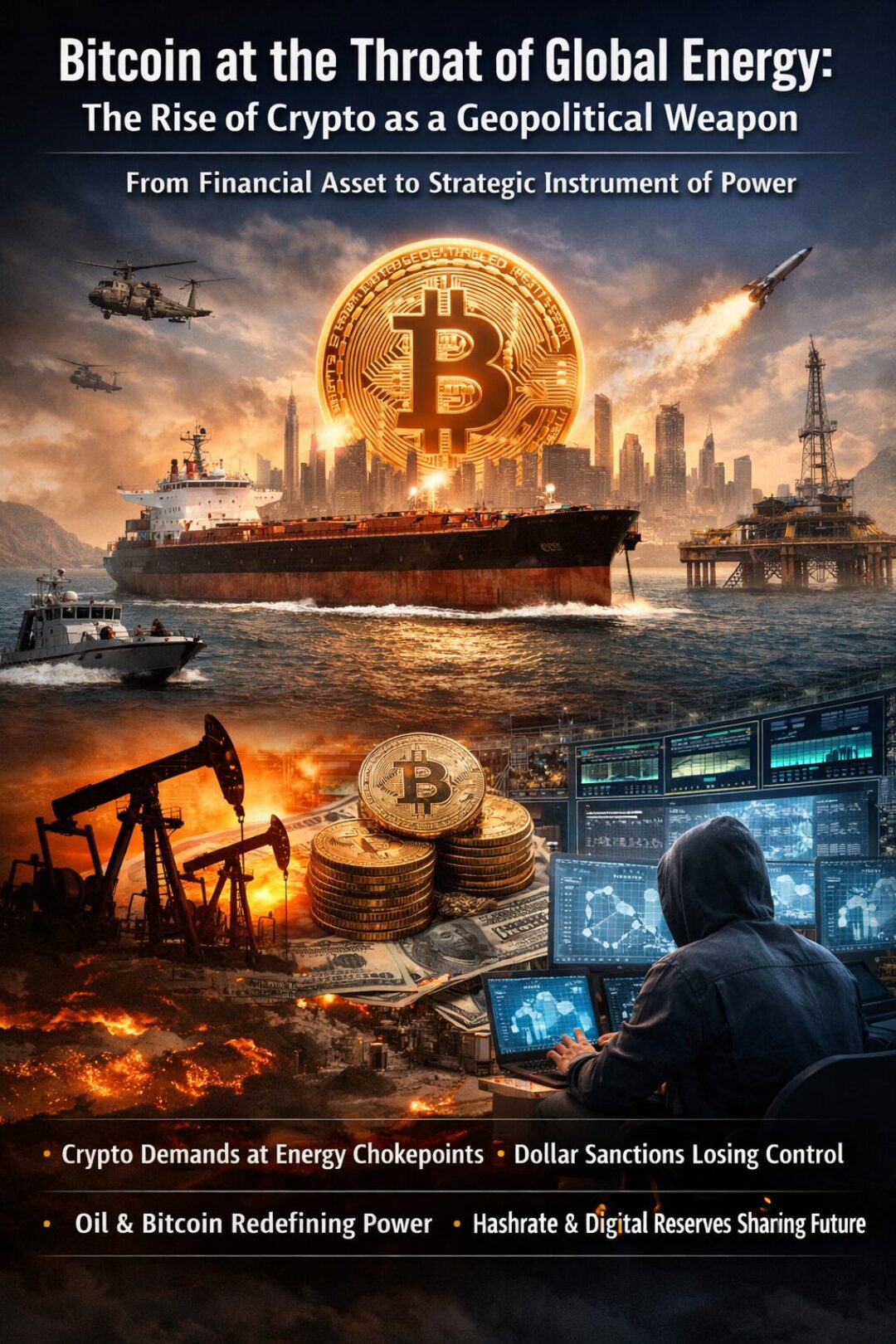
- Bitcoin is evolving from a financial asset into a state-level strategic instrument
- Energy chokepoints like the Strait of Hormuz could be influenced by crypto-based payment demands
- Sanctions based on the U.S. dollar are increasingly challenged by censorship-resistant systems
- The convergence of oil (physical asset) and Bitcoin (computational asset) is redefining global power
- Future geopolitics may depend on hashrate, digital reserves, and computational dominance
1. A Digital Shield Against Physical Blockades
The modern geopolitical landscape is undergoing a profound transformation—one where mathematics and computation are beginning to override physical force. The idea that a nation such as Iran could demand Bitcoin as a toll for passage through the Strait of Hormuz may still be speculative, but the implications are far from theoretical.
This narrow maritime corridor controls nearly 20% of the world’s oil supply, making it one of the most critical chokepoints in global trade. Historically, control over such routes meant naval dominance. However, in a world increasingly shaped by decentralized networks, control over payment systems may become just as powerful.
Bitcoin introduces a paradigm shift. Unlike traditional financial systems, which rely on centralized verification and enforcement, Bitcoin transactions are validated by a distributed network of nodes. This makes them immune to unilateral censorship or freezing by any government or institution.
If such a payment mechanism were enforced, it would effectively bypass the global banking system—rendering sanctions, compliance checks, and even diplomatic pressure less effective. The certainty of settlement through computation becomes more reliable than political agreements or military deterrence.
“From Tankers to Transactions: Physical vs Digital Control of Energy Flow”
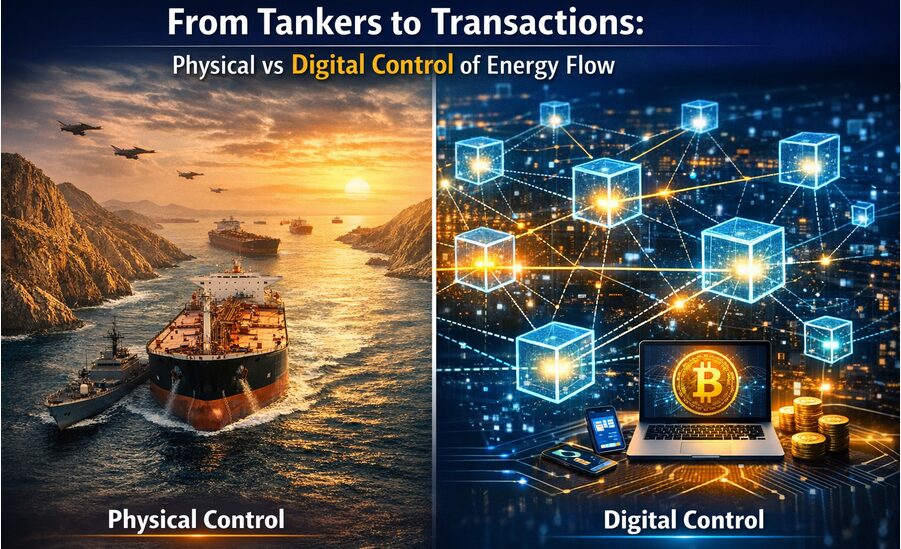
Image Prompt: A split visual showing oil tankers passing through a narrow strait on one side, and a glowing blockchain network routing transactions on the other.
2. The Erosion of Dollar Hegemony
For decades, the global financial system has revolved around the U.S. dollar. Through mechanisms such as sanctions and access to SWIFT, the United States has exercised unparalleled influence over international trade.
However, Bitcoin challenges this dominance in a fundamental way.
The borderless nature of cryptocurrency allows sanctioned nations to re-enter global economic circulation without relying on dollar-based systems. This creates a parallel financial infrastructure—one that is not governed by any single state.
Recent developments reinforce this trend:
- Institutional adoption of Bitcoin has accelerated
- Spot Bitcoin ETFs have legitimized BTC as a macro asset
- Countries are exploring central bank digital currencies (CBDCs) but face trust issues
In this context, Bitcoin emerges not just as an investment, but as a neutral settlement layer.
The idea of exchanging oil—a tangible, strategic resource—for Bitcoin represents a fusion of two fundamentally different forms of value:
- Physical scarcity (oil)
- Computational scarcity (Bitcoin)
This convergence signals the birth of a new economic order, where energy and computation become interchangeable dimensions of power.
3. Crypto as a Strategic Military Asset
What was once considered a tool for individual financial sovereignty is now being reinterpreted as a state-level strategic asset.
Bitcoin’s properties make it uniquely suited for geopolitical use:
- Censorship resistance: Transactions cannot be blocked
- Final settlement: No counterparty risk once confirmed
- Portability: Value can be transferred across borders instantly
In conflict zones, these characteristics become invaluable. A digital signature may carry more weight than physical currency, especially when traditional banking infrastructure is compromised.
Moreover, Bitcoin’s hashrate—the computational power securing the network—can be seen as a form of digital defense capability. Just as nations invest in military hardware, they may increasingly invest in computational infrastructure to secure their economic sovereignty.
This leads to a provocative idea:
Future wars may not only be fought with weapons, but also with algorithms, cryptographic keys, and computational dominance.
“Hashrate vs Military Power”
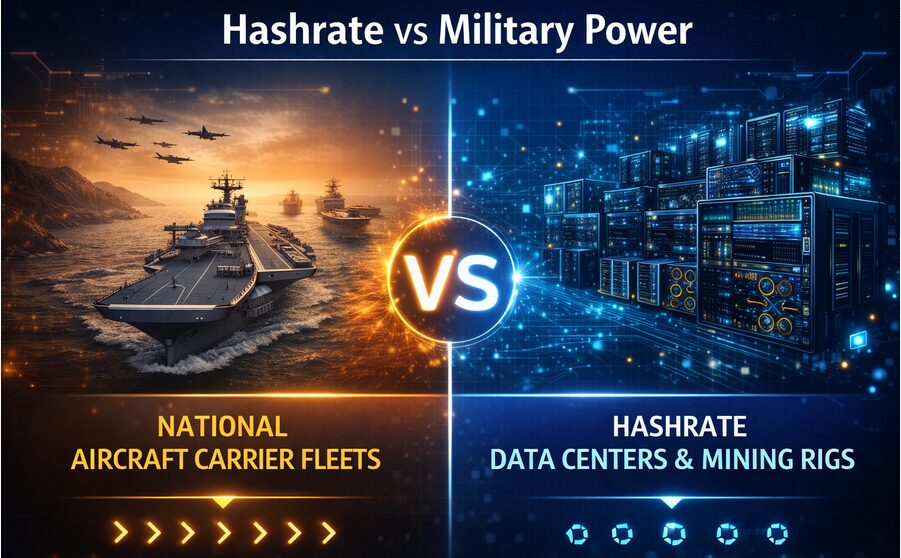
Image Prompt: A futuristic comparison chart showing aircraft carriers on one side and server farms/mining rigs on the other, labeled as competing power metrics.
4. The Rise of a Post-Nation Economic System
By 2026, the battlefield is no longer confined to land, sea, or air. It extends into cyberspace, where encrypted data flows determine real-world outcomes.
The concept of a “post-nation economy” is gaining traction. In this system:
- Transactions are governed by code, not policy
- Trust is derived from mathematical proof, not institutions
- Economic participation is permissionless
This shift challenges traditional notions of sovereignty. If a nation cannot control the flow of value within its borders, its ability to enforce policy diminishes.
At the same time, individuals and organizations gain unprecedented autonomy. They can transact, store wealth, and interact economically without relying on centralized authorities.
However, this also introduces new risks:
- Increased potential for financial warfare
- Difficulty in enforcing regulations
- Emergence of parallel economies
The paradox is striking:
Bitcoin was created to empower individuals, yet it is now being leveraged by states as a tool of power.
5. Information as the New Oil
In this evolving landscape, information itself becomes a strategic resource.
Just as oil fueled the industrial age, data and computation fuel the digital age. The value of information—whether it be transaction data, cryptographic keys, or network intelligence—rivals that of physical commodities.
Consider the implications:
- Control over data flows can influence energy logistics
- Blockchain networks can dictate trade routes
- Cyber capabilities can disrupt entire economies
The line between cyber warfare and economic activity is increasingly blurred.
We are witnessing the emergence of a world where a blockchain transaction can determine the movement of physical goods, and where hashrate rivals naval power in strategic importance.
“The Convergence of Energy and Computation”

Image Prompt: A visual merging oil pipelines with digital circuits, symbolizing the integration of physical and digital economies.
6. Strategic Implications for Investors and Builders
For readers seeking new crypto assets, revenue opportunities, or practical blockchain applications, this shift presents both risks and opportunities.
Key Opportunities:
- Infrastructure plays: Mining, energy integration, and data centers
- Cross-border payment systems: Leveraging crypto for remittance and trade
- Decentralized finance (DeFi): Alternative financial rails outside traditional systems
- Tokenized commodities: Bridging physical assets with blockchain
Key Risks:
- Regulatory crackdowns
- Geopolitical volatility
- Market manipulation in thin liquidity environments
The most important takeaway is this:
Bitcoin is no longer just an asset—it is infrastructure.
Conclusion: The Dawn of the Computational Age of Power
We are entering a new era where computation defines power.
The rules established by traditional hegemonic systems are being rewritten by decentralized technologies. The rise of Bitcoin as a geopolitical tool marks a turning point in history.
Whether or not the specific scenario of Bitcoin tolls in the Strait of Hormuz materializes is ultimately secondary. What matters is that such a scenario is now plausible—and widely discussed.
This alone demonstrates the growing recognition of Bitcoin’s core properties:
- Neutrality
- Immutability
- Resistance to control
In the years ahead, success will depend on the ability to understand, adapt to, and leverage this computational paradigm.
The question is no longer whether crypto will reshape the world—but how quickly, and who will lead.


