
Key Points :
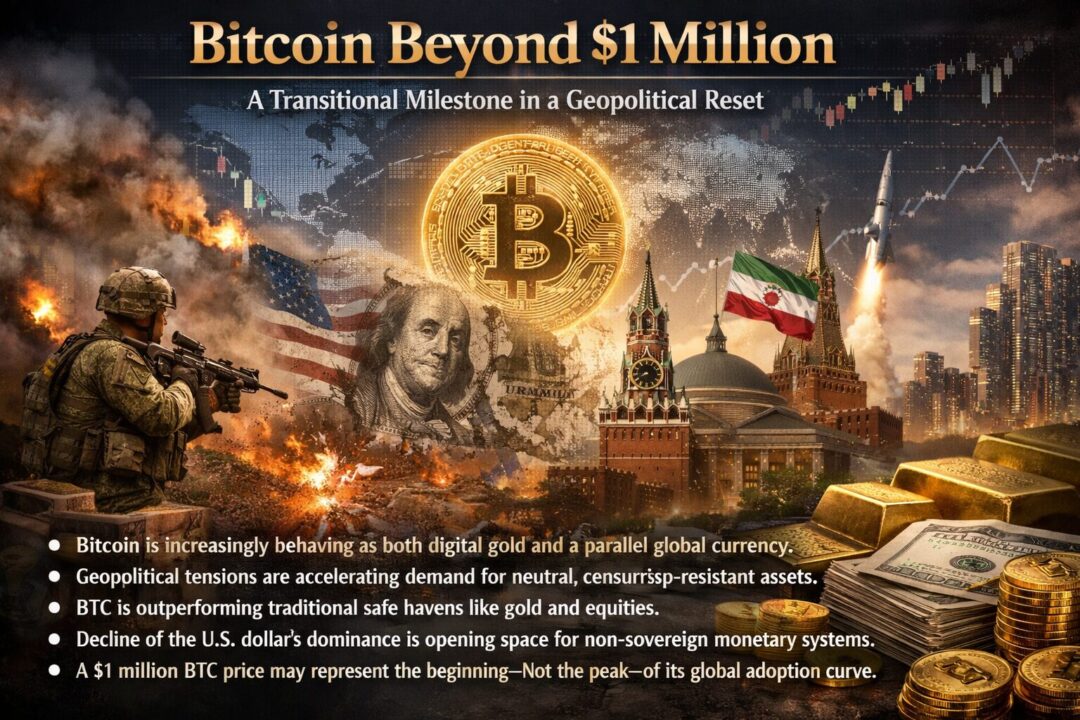
- Bitcoin is increasingly behaving as both digital gold and a parallel global currency.
- Geopolitical tensions (Russia–Ukraine, U.S.–Iran) are accelerating demand for neutral, censorship-resistant assets.
- Recent market data shows BTC outperforming traditional safe havens like gold and equities.
- The potential decline of the U.S. dollar’s global dominance is opening space for non-sovereign monetary systems.
- A $1 million BTC price may represent the beginning—not the peak—of its global adoption curve.
1. Introduction: Bitcoin in an Age of Fragmentation
The global financial system is entering a period of structural transformation. As geopolitical tensions intensify and traditional monetary systems face increasing strain, investors and institutions are re-evaluating what constitutes a reliable store of value. In this context, Bitcoin has emerged not merely as a speculative asset but as a strategic hedge against systemic uncertainty.
A recent analysis by Bitwise Asset Management suggests that Bitcoin’s long-term valuation could far exceed $1,000,000. Importantly, this figure is not framed as a peak, but rather as an early milestone in a broader transformation where Bitcoin assumes dual roles: a digital store of value and a global transactional currency.
2. Market Performance Under Geopolitical Stress
Comparative Asset Performance (Feb 27 – Apr 10, 2026)
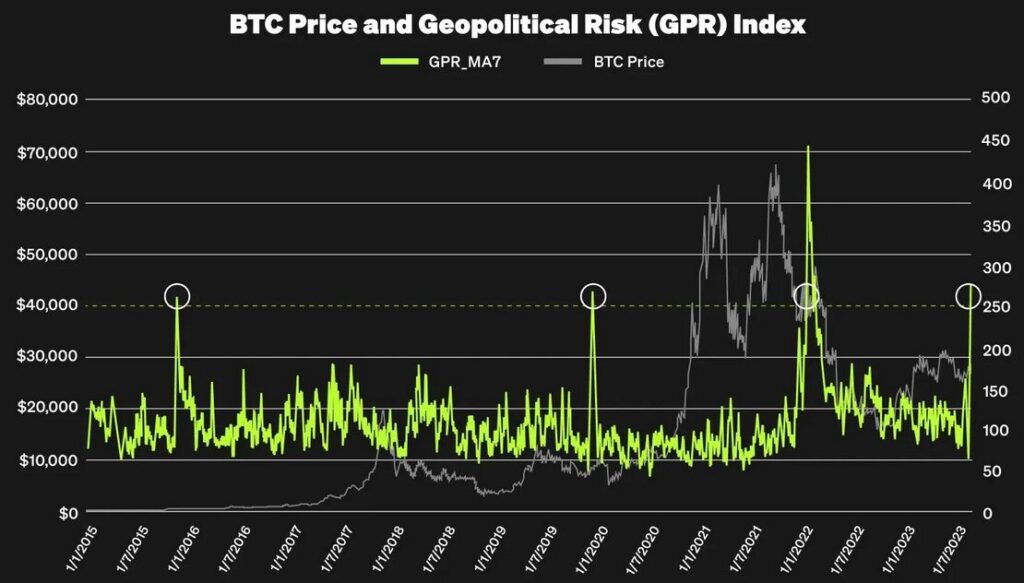
Following the escalation of conflict involving the United States, Israel, and Iran on February 28, 2026, Bitcoin demonstrated notable resilience. Between February 27 and April 10:
- Bitcoin rose approximately +12%
- The S&P 500 increased only +1%
- Gold declined by roughly -10%
This divergence is critical. Traditionally, gold has served as the primary safe-haven asset during geopolitical crises. However, Bitcoin’s outperformance suggests a shift in investor behavior—one that increasingly favors digital, borderless assets over physical commodities.
3. Bitcoin as Digital Gold: Store of Value Evolution
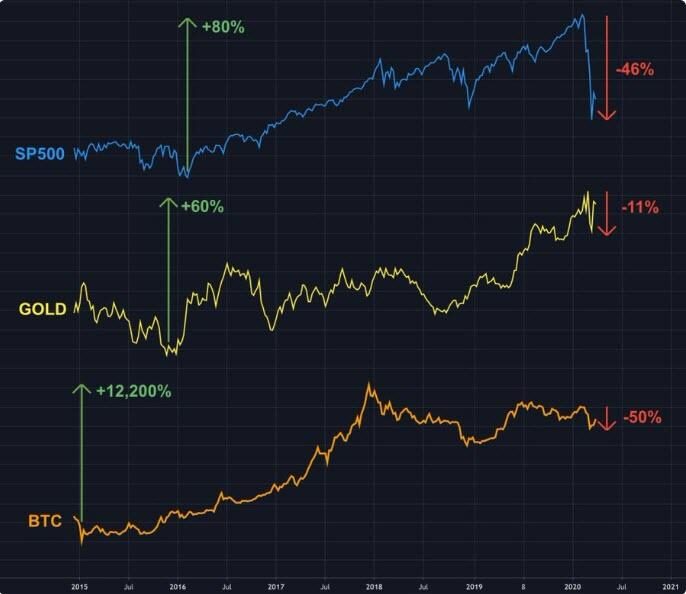
Bitcoin’s comparison to gold is not new, but its behavior in recent crises strengthens the argument.
Unlike gold, Bitcoin offers:
- Portability: Instantly transferable across borders
- Scarcity: Fixed supply of 21 million coins
- Censorship resistance: No central authority can freeze or seize it
While gold remains a physical hedge, Bitcoin represents a programmable and globally accessible alternative. In scenarios where capital controls, sanctions, or banking restrictions emerge, Bitcoin’s utility becomes significantly more pronounced.
4. The Rise of Bitcoin as an International Currency
Beyond being a store of value, Bitcoin is increasingly being considered for use in international transactions.
Geopolitical developments have accelerated this trend:
- Russia and China have actively reduced reliance on the U.S. dollar
- Sanctioned nations seek alternative settlement mechanisms
- Reports suggest discussions around Bitcoin-denominated payments in strategic regions
One notable example includes speculation that Iran could request transit fees (e.g., through the Strait of Hormuz) in Bitcoin. While still unconfirmed, the mere plausibility highlights a critical shift: Bitcoin is entering geopolitical discourse as a settlement layer.
5. The Decline of Dollar Dominance
The global financial system has long been anchored by the U.S. dollar, particularly through the petrodollar system established in the 1970s. However, recent developments indicate potential structural erosion:
- Increased bilateral trade settlements in non-USD currencies
- Emergence of the “petroyuan” in energy markets
- Growing distrust of dollar-based sanctions frameworks
As confidence in centralized monetary systems declines, Bitcoin’s neutrality becomes its greatest strength. It is not tied to any nation-state, making it uniquely positioned as a trustless global reserve alternative.
6. Dual Role Thesis: Store of Value + Medium of Exchange
Bitwise’s core thesis revolves around Bitcoin achieving dual functionality:
- Store of Value (Digital Gold)
- Medium of Exchange (Global Settlement Layer)
Individually, each use case supports significant valuation growth. Combined, they create exponential potential.
- The global store-of-value market (gold, real estate, bonds) exceeds $300 trillion
- The global payments and settlement market processes quadrillions annually
If Bitcoin captures even a fraction of both, a $1 million valuation becomes not only plausible—but conservative.
7. Institutional and Structural Tailwinds
Recent trends further reinforce Bitcoin’s trajectory:
- Expansion of Bitcoin ETFs and institutional custody solutions
- Integration of Bitcoin into corporate treasury strategies
- Increasing regulatory clarity in major economies
At the same time, advancements in Layer 2 technologies (e.g., Lightning Network) are improving Bitcoin’s transactional efficiency, addressing long-standing scalability concerns.
8. Risks and Counterarguments
Despite its potential, Bitcoin’s future is not without uncertainty:
- Regulatory crackdowns in major jurisdictions
- Volatility and speculative cycles
- Competition from central bank digital currencies (CBDCs)
- Environmental concerns related to mining
Additionally, its use in sanctions evasion and illicit finance remains a concern for policymakers, potentially leading to stricter oversight.
9. Conclusion: $1 Million as the Starting Line
Bitcoin’s journey toward $1 million should not be viewed as a speculative endpoint, but rather as a transition into global monetary relevance.
In a world defined by fragmentation, distrust in centralized systems, and geopolitical instability, Bitcoin offers a compelling alternative:
- A neutral store of value
- A borderless transactional medium
- A hedge against systemic risk
If these roles continue to expand, Bitcoin’s valuation ceiling may be far higher than current projections suggest.




