Main Points :
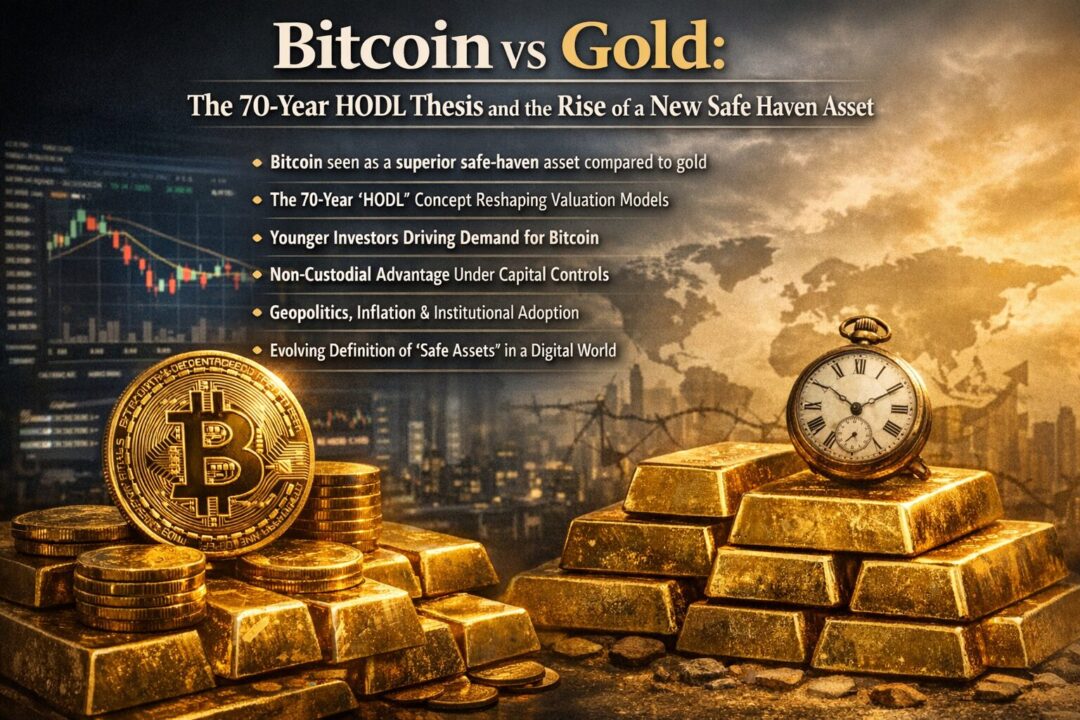
- Bitcoin is increasingly viewed as a superior safe-haven asset compared to gold
- The concept of long-term “HODL” (up to 70 years) is reshaping valuation models
- Younger investors are driving structural demand for Bitcoin
- Bitcoin’s non-custodial nature gives it an advantage under capital controls
- Macro trends (geopolitics, inflation, institutional adoption) reinforce Bitcoin’s position
- The definition of “safe assets” is evolving in a digital, borderless financial system
Introduction: A Paradigm Shift in Safe Haven Assets
The debate over whether Bitcoin can surpass gold as the ultimate safe-haven asset has intensified in recent years. According to Jeff Park, Chief Investment Officer at ProCap, Bitcoin is not just competing with gold—it is structurally superior in ways that traditional finance has yet to fully grasp.
While gold has served as a store of value for thousands of years, Bitcoin introduces a fundamentally different paradigm: a digital, decentralized, and non-custodial asset that aligns with the realities of a globalized and increasingly digital economy.
This article explores the emerging thesis that Bitcoin may not only rival gold but ultimately replace it as the dominant safe-haven asset. It expands on recent commentary while incorporating broader market trends, institutional behavior, and technological developments shaping this transformation.
The 70-Year HODL Thesis: A New Time Horizon for Wealth
One of the most striking ideas presented by Park is the concept of a “70-year holding period.” Unlike traditional assets, which are often evaluated on quarterly or annual performance, Bitcoin is increasingly being held with a generational mindset.
This shift is particularly evident among younger investors. Millennials and Gen Z participants—who are native to digital ecosystems—view Bitcoin not as a speculative trade but as a long-term store of value.
The implications are profound:
- Reduced circulating supply due to long-term holding
- Lower sell pressure during market downturns
- Increasing scarcity over time
This dynamic mirrors—but may ultimately exceed—the scarcity narrative of gold. While gold supply grows steadily through mining, Bitcoin’s supply is capped at 21 million, with issuance decreasing through halving cycles.
Bitcoin Supply vs Gold Supply Growth (Conceptual Chart)
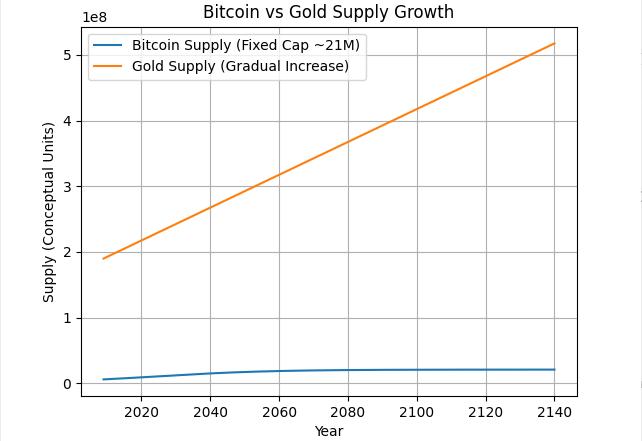
(A chart comparing Bitcoin’s fixed supply curve vs gold’s gradually increasing supply)
Digital Portability: Bitcoin’s “Superpower”
A key argument in favor of Bitcoin over gold is its non-custodial and portable nature.
Gold, while valuable, is inherently physical. It requires storage, security, and transportation—all of which introduce friction and risk. In contrast, Bitcoin can be stored in a private key and accessed anywhere in the world.
In extreme scenarios—such as capital controls, political instability, or forced asset seizures—this difference becomes critical.
Bitcoin enables:
- Borderless transfer of value
- Self-custody without reliance on institutions
- “Memory-based wealth” (e.g., seed phrases)
This “carry it in your head” capability represents a radical departure from traditional asset classes.
Macro Context: Geopolitics, Inflation, and Risk-On Sentiment
Recent developments, such as easing geopolitical tensions (e.g., Iran ceasefire negotiations), have contributed to a risk-on environment in financial markets. However, Park’s thesis emphasizes that Bitcoin’s value proposition extends beyond short-term market cycles.
In fact, Bitcoin thrives in both:
- Risk-on environments (as a high-growth asset)
- Risk-off environments (as a hedge against systemic risk)
This dual nature is increasingly attractive to institutional investors.
Additionally, persistent inflation concerns and monetary policy uncertainty continue to erode confidence in fiat currencies. As a result, capital is gradually shifting toward alternative stores of value—including Bitcoin.
Institutional Adoption: From Speculation to Strategic Allocation
Over the past few years, institutional interest in Bitcoin has accelerated dramatically.
Key developments include:
- Spot Bitcoin ETFs attracting billions in inflows
- Major asset managers integrating Bitcoin into portfolios
- Sovereign-level discussions around digital reserves
This institutionalization is critical for Bitcoin’s evolution into a recognized safe-haven asset.
Unlike retail-driven speculation cycles of the past, institutional participation brings:
- Stability
- Liquidity
- Long-term capital
Institutional Bitcoin Inflows Over Time (Bar Chart)
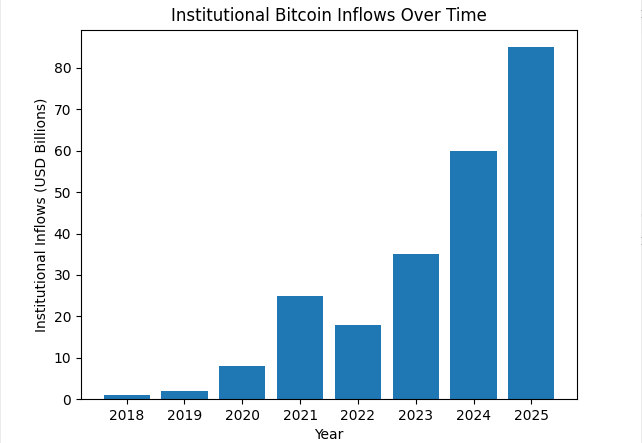
(A bar chart showing growth in institutional Bitcoin investment)
Bitcoin vs Gold: A Structural Comparison
| Feature | Bitcoin | Gold |
|---|---|---|
| Supply | Fixed (21M) | Expanding |
| Portability | Instant, digital | Physical, limited |
| Custody | Self-custody possible | Requires storage |
| Transferability | Global, permissionless | Restricted, slow |
| Transparency | Fully auditable | Limited |
This comparison highlights why many investors are beginning to view Bitcoin not as “digital gold,” but as an entirely new category of asset.
Behavioral Shift: The Psychology of Holding
Another important dimension is behavioral.
Gold investors typically view their holdings as a hedge—something to sell in times of crisis. Bitcoin investors, particularly long-term holders, exhibit a different mindset: accumulation rather than liquidation.
This “HODL culture” is reinforced by:
- Strong community narratives
- Historical price appreciation
- Increasing belief in Bitcoin as a monetary system
As a result, Bitcoin’s volatility—often seen as a weakness—may actually strengthen long-term holding behavior.
Risks and Counterarguments
Despite its advantages, Bitcoin is not without risks:
- Regulatory uncertainty
- Technological vulnerabilities
- Market volatility
Gold, by contrast, has a long track record and is widely accepted by governments and institutions.
However, these risks are gradually being mitigated:
- Regulatory frameworks are becoming clearer
- Infrastructure is improving
- Institutional adoption is increasing
Conclusion: Redefining the Safe Haven in the Digital Age
Bitcoin’s rise challenges one of the oldest assumptions in finance: that gold is the ultimate safe-haven asset.
Through its fixed supply, digital portability, non-custodial nature, and evolving investor base, Bitcoin introduces a new framework for understanding value preservation.
The “70-year HODL thesis” encapsulates this shift. It reflects not just a change in investment strategy, but a transformation in how wealth is stored, transferred, and protected.
As global financial systems continue to evolve, the question is no longer whether Bitcoin can coexist with gold—but whether it will ultimately surpass it.