Main Points :
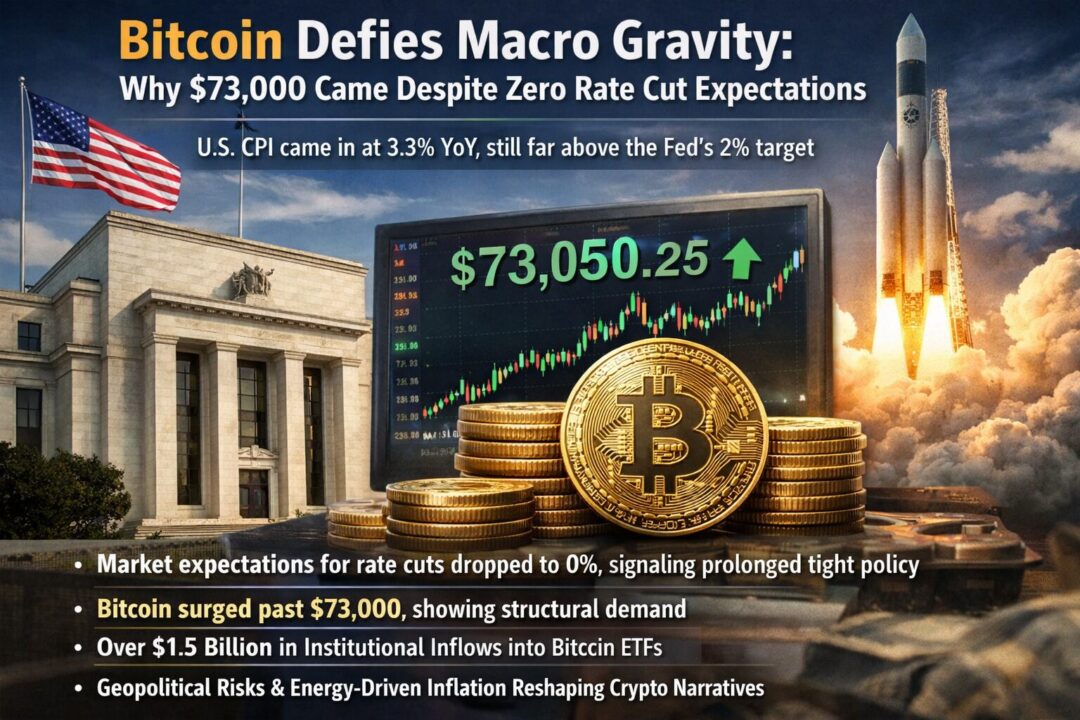
- U.S. CPI came in at 3.3% YoY, still far above the Fed’s 2% target
- Market expectations for rate cuts dropped to 0%, signaling prolonged tight policy
- Despite this, Bitcoin surged past $73,000, showing structural demand
- Institutional inflows exceeding $1.5 billion into Bitcoin ETFs support the rally
- Geopolitical risks and energy-driven inflation are reshaping crypto narratives
- Key resistance lies at $75,000, with $80,000–$100,000 emerging as upside scenarios
Bitcoin Surges Above $73,000 Despite Hawkish Macro Signals
In a market environment where traditional financial logic would typically suppress risk assets, Bitcoin has done the opposite. Following the release of the March 2026 Consumer Price Index (CPI) by the U.S. Bureau of Labor Statistics, Bitcoin surged past $73,000, marking a decisive move that surprised both macro traders and crypto-native participants.
The CPI report showed a 0.9% month-over-month increase and 3.3% year-over-year inflation, slightly below expectations but still significantly above the Federal Reserve’s 2% target. Under normal circumstances, such data would dampen enthusiasm for risk assets, especially when paired with tightening monetary conditions.
However, Bitcoin rose more than 1.5% immediately after the announcement, signaling a deeper structural shift in how markets perceive digital assets.
This divergence suggests that Bitcoin is no longer trading purely as a speculative asset but increasingly as a macro hedge and alternative store of value, especially in uncertain geopolitical and monetary environments.
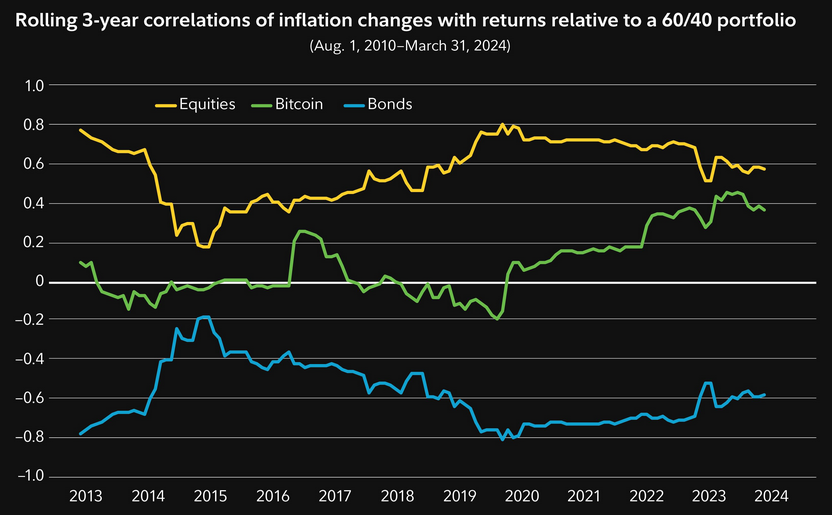
Bitcoin Price vs CPI Trend (2025–2026)
Why “Zero Rate Cut Probability” Didn’t Stop the Rally
According to market data from CME Group, expectations for a rate cut at the April FOMC meeting have fallen to 0%, while the probability of maintaining current rates surged to 98.4%.
This reflects a growing consensus that the Federal Reserve will maintain restrictive monetary policy longer than previously expected.
Historically, such a backdrop would pressure assets like Bitcoin. Higher interest rates increase the opportunity cost of holding non-yielding assets and strengthen the U.S. dollar.
Yet, Bitcoin’s rally indicates a decoupling from traditional liquidity cycles.
Several key factors explain this:
- Dollar Weakness Concerns
Even without rate cuts, structural concerns about U.S. debt and long-term currency debasement continue to drive demand for alternative assets. - Safe Haven Narrative Strengthening
Bitcoin is increasingly behaving like a hybrid between gold and a high-growth asset. - Institutional Positioning Ahead of Policy Shifts
Markets often price in future conditions before they materialize.
Energy Shock and Geopolitical Risk: The Hidden Catalyst
One of the most overlooked drivers of this market move is the surge in energy prices.
The CPI report revealed:
- Energy index: +11% month-over-month
- Gasoline prices: +21.2% month-over-month
These increases are closely tied to escalating tensions in the Middle East, particularly involving Iran. Supply disruption fears have pushed oil markets higher, feeding into broader inflation.
This creates a paradox:
- Inflation remains high → Rate cuts delayed
- Geopolitical instability rises → Demand for neutral assets increases
Bitcoin benefits from the second effect.
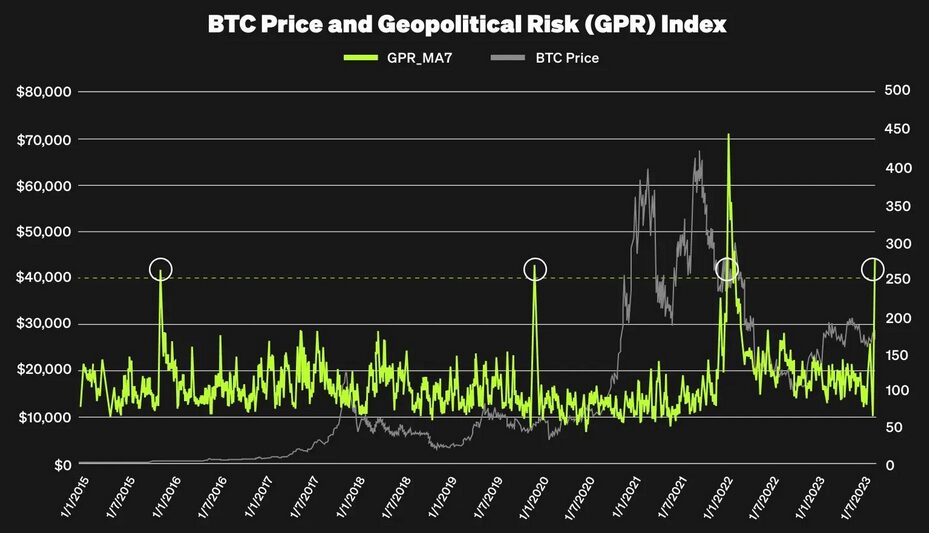
In times of geopolitical uncertainty, capital often flows into non-sovereign, censorship-resistant assets. Bitcoin fits this narrative more effectively than ever before.
Energy Prices vs Crypto Market Reaction
Institutional Demand: The Silent Force Behind the Rally
Beyond macro narratives, the data clearly shows that institutional capital is playing a dominant role.
According to research from 21Shares:
- Over $1.5 billion flowed into Bitcoin ETFs in the past month
- Large holder Bitcoin balances increased by approximately 6% year-to-date
This is not retail-driven speculation—it is strategic allocation.
Institutions are increasingly viewing Bitcoin as:
- A hedge against inflation
- A portfolio diversifier
- A long-term asymmetric asset
This shift is reinforced by the growing maturity of crypto market infrastructure, including ETFs, custody solutions, and regulatory clarity.
$75,000–$80,000: The Critical Breakout Zone
From a technical perspective, Bitcoin is approaching a crucial inflection point.
Market analysts highlight:
- $75,000 as the immediate resistance
- A breakout above $73,500 could trigger short liquidations
- A cascade effect may push prices toward $80,000
Some projections even extend toward $100,000 by late Q2, assuming continued institutional inflows and easing geopolitical tensions.
However, downside risks remain:
- Escalation of conflict could trigger volatility
- A breakdown below $66,000 is possible in adverse scenarios
This creates a high-stakes range-bound environment, where macro catalysts will determine direction.
Regulation as a Market Catalyst: The CLARITY Effect
Another major factor shaping the current market is regulatory development.
The proposed CLARITY Act in the United States aims to define the legal structure of digital assets more clearly.
If passed, it could:
- Reduce uncertainty for institutional investors
- Enable broader participation from traditional finance
- Accelerate capital inflows into crypto markets
Regulatory clarity has historically been one of the strongest catalysts for sustained bull markets.
The Bigger Trend: Bitcoin Is Becoming a Macro Asset
The most important takeaway from this market event is not just the price level—but the behavioral shift.
Bitcoin is no longer:
- Purely a speculative instrument
- Fully dependent on liquidity cycles
Instead, it is evolving into:
- A geopolitical hedge
- A monetary alternative
- A structurally demanded asset by institutions
This transition is critical for investors seeking long-term positioning.
Conclusion: A Market Redefined by Contradiction
Bitcoin’s rise to $73,000 in an environment of zero rate cut expectations is not an anomaly—it is a signal.
It reflects a market that is:
- Forward-looking rather than reactive
- Driven by structural demand rather than short-term liquidity
- Increasingly integrated into the global macro framework
For investors searching for new crypto opportunities and income-generating strategies, this shift opens several paths:
- Institutional-aligned assets (BTC, ETH, ETFs)
- Infrastructure plays (custody, compliance, liquidity layers)
- Macro-driven trading strategies
The coming months will be defined by three critical variables:
- Federal Reserve policy decisions
- Geopolitical developments in the Middle East
- Regulatory clarity in major markets
As these forces converge, Bitcoin stands at the center of a new financial paradigm—one where traditional rules no longer fully apply.