
Key Points :
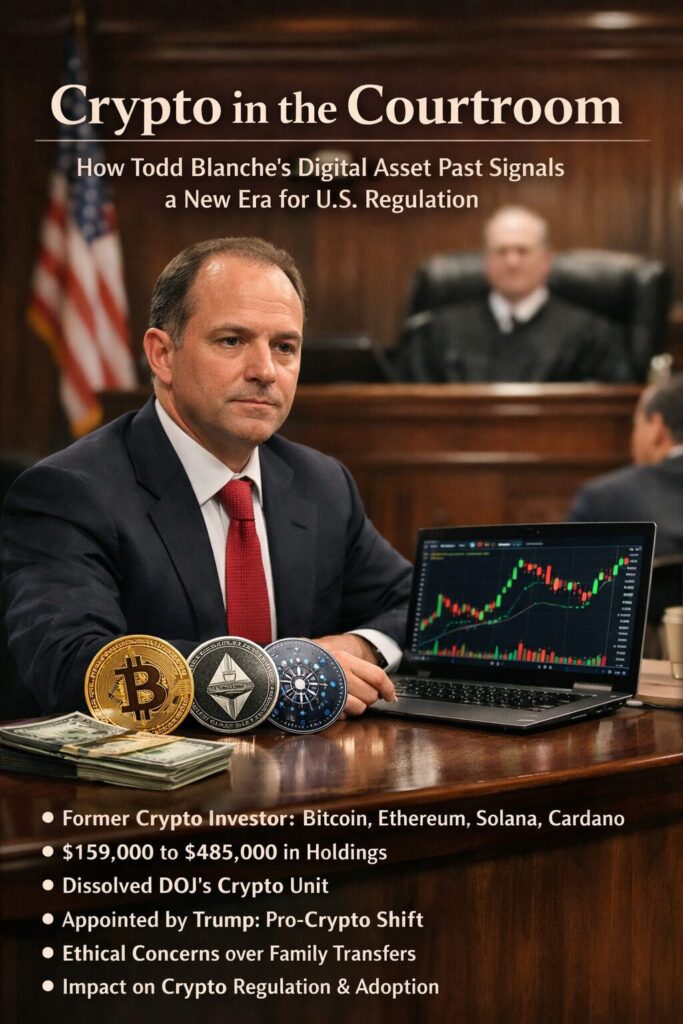
- Todd Blanche previously held a diversified crypto portfolio including Bitcoin, Ethereum, Solana, and Cardano
- Estimated holdings ranged between $159,000 and $485,000 (USD)
- He ordered the dissolution of the DOJ’s crypto enforcement unit
- Appointed by Donald Trump, signaling a pro-crypto policy shift
- Raises ethical concerns over asset transfers to family members
- Could reshape enforcement, compliance, and institutional crypto adoption
Introduction: When Regulators Become Participants
The appointment of Todd Blanche as Acting Attorney General under Donald Trump marks a turning point in the relationship between the U.S. government and the cryptocurrency industry. Unlike previous legal leaders, Blanche is not merely a regulator observing the market from the outside—he is a former participant in the very ecosystem he is now tasked with overseeing.
According to government ethics disclosures, Blanche previously held a wide range of digital assets, including Bitcoin, Ethereum, Solana, and Cardano, alongside other tokens such as Polygon, Polkadot, and Quant. His total crypto exposure ranged between $159,000 and $485,000 USD, placing him among a rare class of policymakers with direct financial experience in decentralized assets.
This development raises profound questions: What happens when the architect of enforcement policy understands crypto not as an abstract risk, but as a lived investment? And more importantly, what does this mean for the future of blockchain regulation, innovation, and institutional adoption?
A Diversified Crypto Portfolio at the Top of Justice
From Bitcoin to Altcoins: A Strategic Allocation
Blanche’s disclosed holdings suggest a deliberate and diversified strategy rather than speculative exposure. His portfolio included:
- Bitcoin (store of value and institutional benchmark)
- Ethereum (smart contract infrastructure)
- Solana (high-performance blockchain)
- Cardano (academic-driven blockchain ecosystem)
- Polygon, Polkadot, and Quant (interoperability and scaling solutions)
This allocation reflects a deep awareness of the crypto stack—from base-layer value storage to next-generation infrastructure.
For regulators, this matters. A policymaker who understands the difference between Layer 1 protocols, scaling solutions, and interoperability frameworks is less likely to impose blunt, one-size-fits-all regulations.
Insert Figure 1 Here — Crypto Portfolio Allocation (Example Visualization)
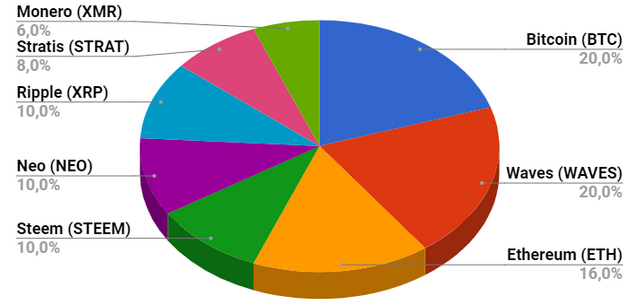
Figure 1: Example of a diversified crypto portfolio similar to disclosed holdings
Ethics vs Legality: The Family Transfer Controversy
Despite divesting his crypto holdings, Blanche’s method of doing so has triggered debate. According to disclosures dated July 10, 2025, he transferred his digital assets to his children and grandchildren.
While technically legal, this move has drawn criticism from ethics experts who argue that such transfers may violate the spirit—if not the letter—of conflict-of-interest laws.
The concern is straightforward:
- If policy decisions impact crypto markets
- And immediate family members hold those assets
- Then indirect financial influence may still exist
This issue highlights a broader regulatory gap. Traditional financial disclosure frameworks were not designed for decentralized, easily transferable assets like cryptocurrencies.
Dismantling Enforcement: A Strategic Pivot
The End of the National Cryptocurrency Enforcement Team
One of Blanche’s most consequential decisions prior to his appointment was ordering the dissolution of the DOJ’s National Cryptocurrency Enforcement Team, originally established in 2022 under the Biden administration.
This unit had been responsible for:
- Investigating crypto-related financial crimes
- Coordinating cross-border enforcement
- Pursuing regulatory violations in digital asset markets
Its removal signals a fundamental shift away from aggressive enforcement toward a more permissive—or at least restrained—approach.
Prosecutorial Discretion and Industry Relief
Blanche also signed a memo instructing prosecutors to avoid pursuing certain regulatory violations within the crypto industry. This effectively reduces legal pressure on:
- Exchanges
- Token issuers
- DeFi platforms
For startups and innovators, this is significant. Regulatory uncertainty has long been one of the biggest barriers to entry in the crypto space. A softer enforcement stance could unlock:
- New token launches
- Increased venture capital inflows
- Expansion of DeFi and Web3 applications
Trump’s Broader Crypto Strategy
Blanche’s appointment does not exist in isolation. It aligns with a broader policy direction under Donald Trump, which includes:
- Establishing a strategic Bitcoin reserve
- Advancing stablecoin regulation frameworks
- Encouraging institutional participation in crypto markets
This represents a stark contrast to previous administrations that emphasized enforcement and risk mitigation.
Insert Figure 2 Here — U.S. Crypto Policy Shift Timeline
Figure 2: Evolution of U.S. crypto policy from enforcement to institutional integration
Market Implications: What Investors Should Watch
1. Regulatory Arbitrage Opportunities
With reduced enforcement pressure in the U.S., projects may increasingly choose American jurisdictions for:
- Token issuance
- Exchange operations
- Blockchain development
This could reverse the trend of crypto firms relocating offshore.
2. Institutional Acceleration
Blanche’s background—and the administration’s stance—could accelerate institutional adoption. Financial institutions may feel more comfortable entering the space if regulatory hostility decreases.
This includes:
- Banks integrating crypto custody
- Payment providers adopting blockchain rails
- Asset managers launching crypto funds
3. Risk: Over-Correction and Regulatory Gaps
However, a reduced enforcement environment carries risks:
- Increased fraud and scams
- Weak consumer protection
- Market manipulation
The challenge will be balancing innovation with accountability.
Blockchain Beyond Speculation: Practical Applications Expand
For readers interested in real-world blockchain use, this shift could have tangible effects:
- Payments: Faster cross-border settlement using blockchain rails
- Tokenization: Real-world assets (real estate, securities) on-chain
- Compliance Tech: On-chain audit trails and automated AML tools
- Hybrid Exchanges: Models like WIBS App combining UX with on-chain execution
These developments align with a broader trend: crypto is moving from speculation to infrastructure.
Conclusion: A Turning Point for Crypto Governance
Todd Blanche’s appointment represents more than a personnel change—it is a signal.
A signal that:
- Crypto is no longer fringe
- Policymakers are becoming participants
- Regulation is shifting from suppression to integration
For investors, builders, and institutions, this moment presents both opportunity and responsibility. The next phase of crypto will not be defined solely by price movements, but by how effectively the industry integrates into legal, financial, and societal frameworks.
The real question is no longer whether crypto will be regulated—but how, and by whom.
And now, for the first time, that “who” includes someone who has already been part of the system.



