
Key Points :
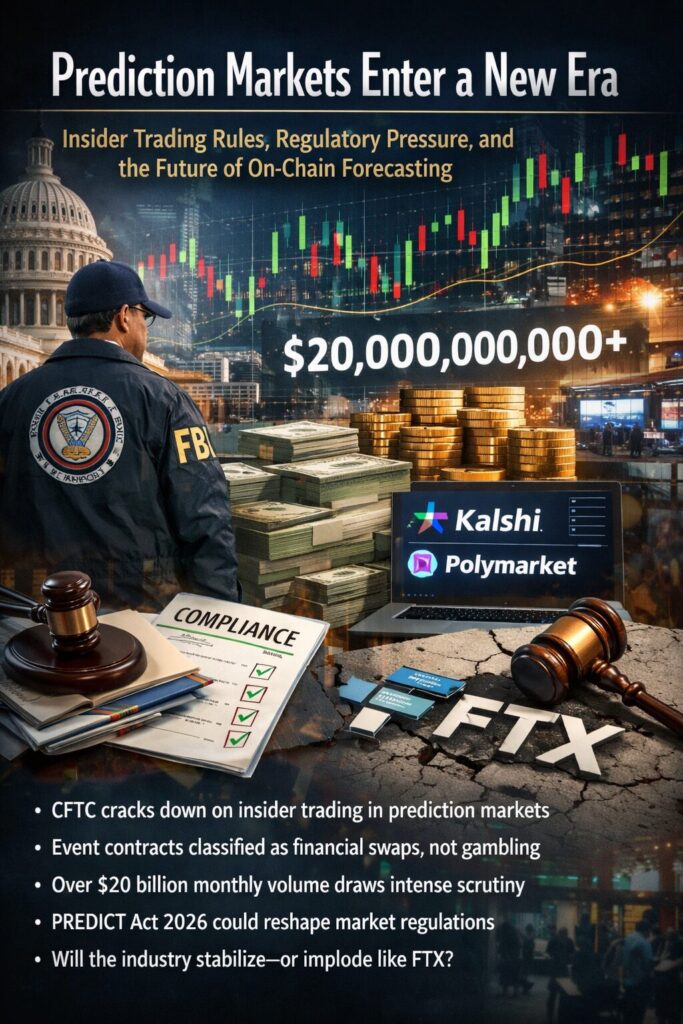
- The U.S. Commodity Futures Trading Commission (CFTC) is increasing enforcement against insider trading in prediction markets
- Event contracts are being treated as swaps, not gambling—making them subject to financial regulation
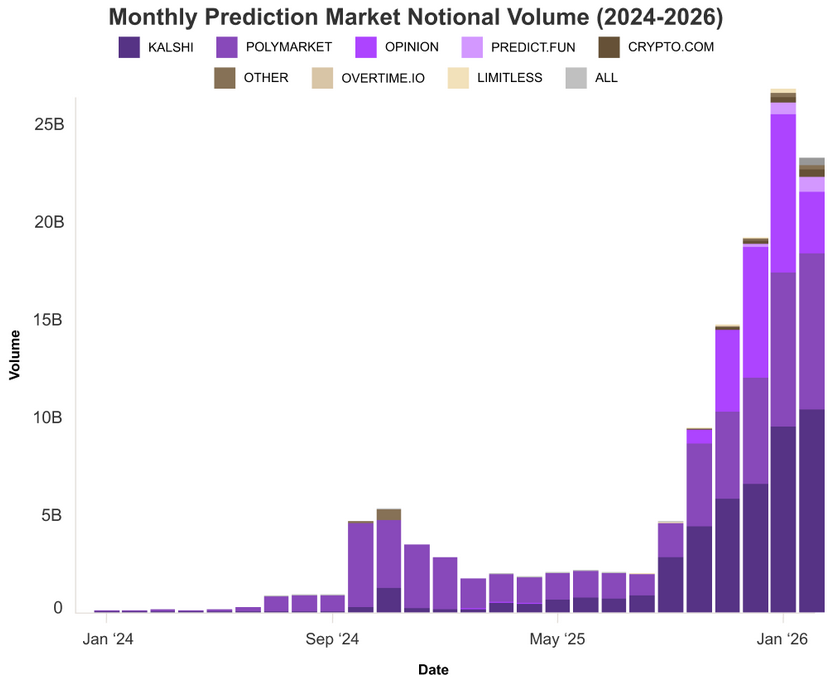
- Rapid growth (over $20 billion monthly volume) is attracting institutional and political scrutiny
- Platforms like Kalshi and Polymarket are implementing internal compliance controls
- Proposed legislation (e.g., PREDICT Act 2026) may reshape participation rules and data access
- The sector faces a turning point: evolve into regulated financial infrastructure—or risk collapse like FTX
Introduction: From Curiosity to Financial Infrastructure
Prediction markets—platforms where users trade on the outcomes of future events—have evolved from niche experimentation into a rapidly expanding financial category. Once seen as digital betting platforms, they are now being redefined as structured financial instruments, particularly as blockchain technology enables transparent, on-chain settlement.
However, with growth comes scrutiny. The U.S. Commodity Futures Trading Commission (CFTC) has made it clear: prediction markets are no longer operating in a regulatory gray zone. Instead, they are being treated as part of the broader derivatives ecosystem—bringing with them the full weight of insider trading laws, anti-manipulation rules, and AML obligations.
This shift represents a pivotal moment not only for platforms like Polymarket and Kalshi, but also for the broader convergence of crypto, finance, and information markets.
Prediction Market Growth Trend (Monthly Volume)
The Regulatory Shift: Insider Trading Rules Now Apply
At the core of the CFTC’s position is a fundamental reclassification: prediction market contracts are not gambling instruments—they are financial derivatives, specifically a type of swap.
This distinction is critical.
According to statements from CFTC enforcement leadership, including remarks delivered at New York University, any trading activity based on material non-public information (MNPI) may constitute insider trading.
This directly challenges a previously widespread assumption among users—that prediction markets operate outside traditional financial regulations.
The implications are immediate:
- Trading based on leaked political decisions
- Using unpublished economic data
- Acting on internal corporate or government intelligence
All of these could now trigger enforcement actions.
The CFTC has also clarified that enforcement will be selective but serious, focusing on high-impact violations rather than minor infractions.
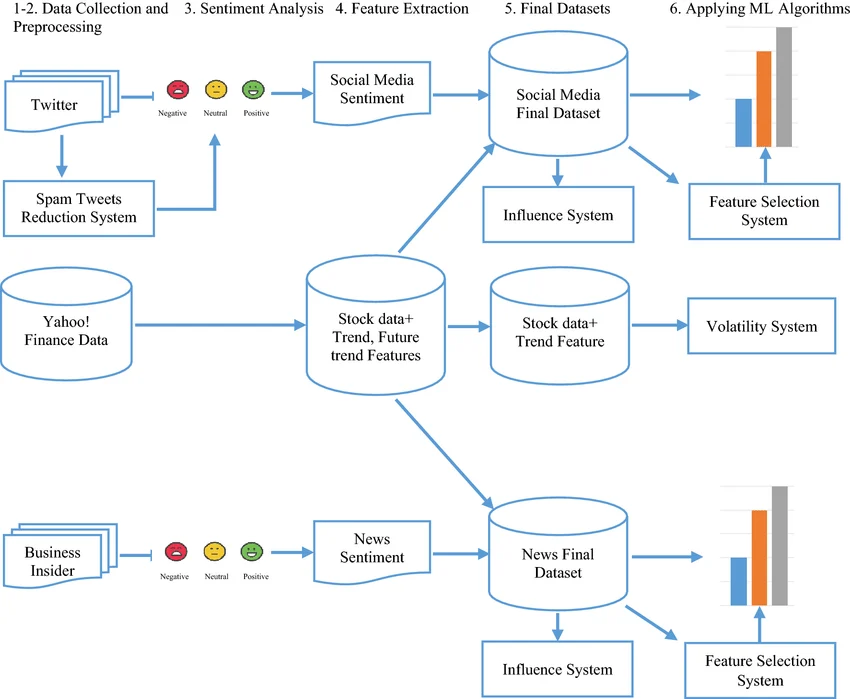
How Insider Trading Works in Prediction Markets
Market Growth and the Rise of Information Arbitrage
Prediction markets have reached an estimated $20 billion+ monthly trading volume, fueled by:
- Political events (elections, policy decisions)
- Macroeconomic indicators (interest rates, inflation)
- Sports and entertainment outcomes
This expansion has created a new form of trading edge: information arbitrage.
Unlike traditional financial markets, where data dissemination is relatively standardized, prediction markets often depend on fragmented, real-time, and sometimes opaque information sources.
This creates an environment where:
- Well-connected participants may gain unfair advantages
- Timing discrepancies can be monetized
- Market signals may reflect insider knowledge rather than collective wisdom
Several reported cases suggest traders earning over $400,000 using early access to sensitive information—raising alarms among regulators and lawmakers.
Platform Response: Compliance as a Competitive Advantage
Leading platforms such as Kalshi and Polymarket have begun proactively implementing compliance frameworks, including:
- Restrictions on certain participants
- Monitoring for suspicious trading patterns
- Internal policies against insider trading
This mirrors the evolution seen in centralized crypto exchanges post-FTX, where transparency and compliance became essential for survival.
In fact, compliance may soon become a key differentiator:
| Platform Type | Competitive Edge |
|---|---|
| Unregulated offshore | Speed, anonymity |
| Regulated domestic | Trust, institutional access |
The long-term winner will likely be the platform that balances both.
Legislative Momentum: The PREDICT Act and Beyond
Regulation is not limited to enforcement agencies. Legislative efforts are accelerating in the United States, including:
- Financial Prediction Market Integrity Act (2026)
- PREDICT Act
These proposals aim to:
- Restrict participation by government insiders
- Define what constitutes non-public information
- Establish reporting and surveillance requirements
This signals a broader recognition: prediction markets are not just financial tools—they are information infrastructure with societal impact.
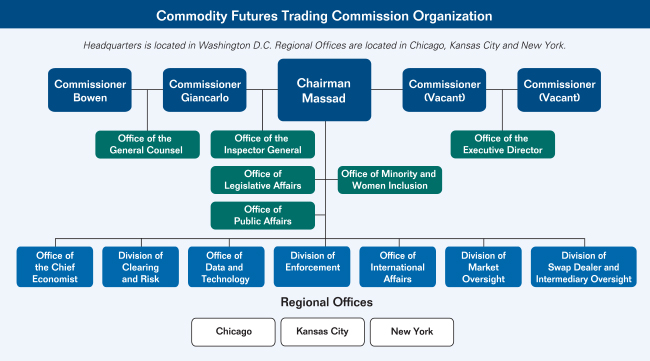
Regulatory Framework Evolution
The FTX Warning: Why Regulation May Be Necessary
CFTC leadership has explicitly warned that without clear rules, prediction markets risk a collapse similar to FTX.
The comparison is not superficial.
Both sectors share:
- Rapid growth without sufficient oversight
- Complex financial structures
- Retail-heavy participation
- Cross-border regulatory gaps
However, prediction markets introduce an additional layer of risk: information integrity.
If users begin to believe that outcomes are influenced by insiders rather than probability, the entire value proposition collapses.
Crypto Convergence: On-Chain Prediction Markets as Financial Primitives
From a blockchain perspective, prediction markets represent one of the most promising real-world applications:
- They tokenize uncertainty
- They aggregate distributed knowledge
- They provide real-time probability signals
Protocols built on networks like Ethereum or alternative L1s are increasingly integrating:
- Decentralized oracles
- Automated market makers (AMMs)
- Tokenized event contracts
This aligns closely with your XXI Network vision, where on-chain execution and transparency are core principles.
However, the regulatory shift suggests that decentralization alone is not sufficient protection.
Even if matching and settlement are on-chain:
- Frontend operators
- Liquidity providers
- Governance participants
may still fall within regulatory scope.
Strategic Implications for Builders and Investors
For builders:
- Embed compliance at the protocol and UI level
- Track and flag abnormal information-driven trades
- Design audit trails for regulatory review
For investors:
- Evaluate platforms based on compliance maturity
- Monitor regulatory exposure by jurisdiction
- Identify opportunities in “regulated prediction infrastructure”
For institutions:
- Prediction markets could become tools for:
- Risk hedging
- Policy forecasting
- Intelligence aggregation
Conclusion: The Institutionalization of Prediction Markets
Prediction markets are entering a decisive phase.
What began as experimental platforms are now evolving into regulated financial systems—where information itself becomes a tradable asset class.
The move by the U.S. Commodity Futures Trading Commission to enforce insider trading rules marks a turning point:
- It legitimizes the sector
- It imposes discipline
- It raises the barrier to entry
But most importantly, it sets the stage for institutional adoption.
The future of prediction markets will not be defined solely by decentralization or innovation—but by their ability to integrate trust, compliance, and transparency into a single coherent system.



