Main Points :
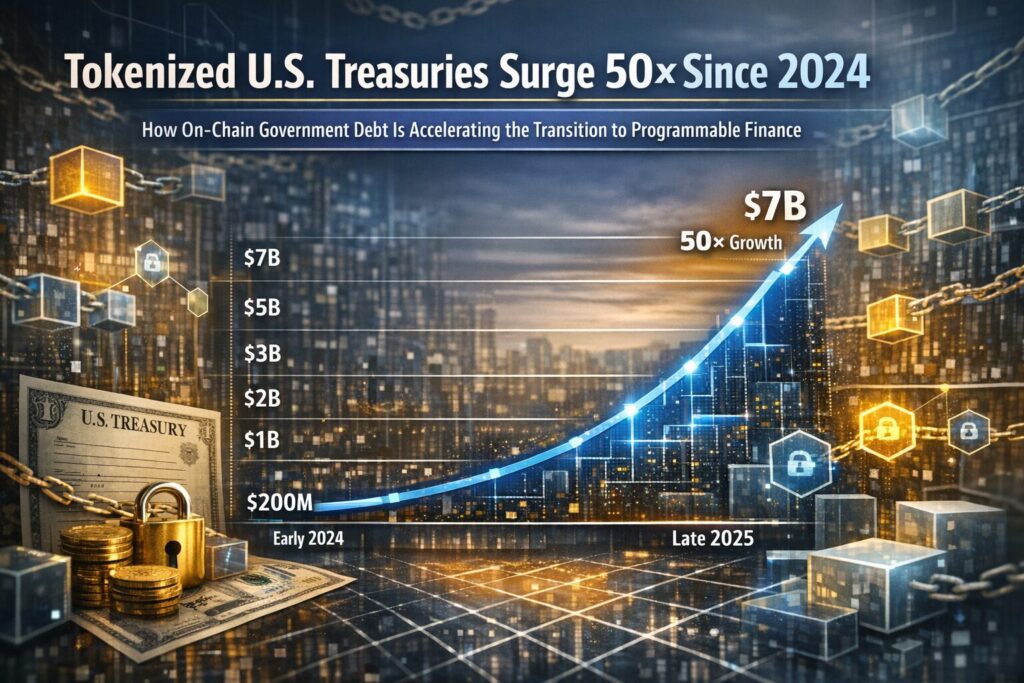
- Tokenized U.S. Treasuries have expanded nearly 50× in less than two years, rising from under $200 million in early 2024 to roughly $7 billion by late 2025.
- Institutional demand for on-chain yield, daily accrual, and programmable settlement is the primary growth driver.
- Flagship products—such as BlackRock’s BUIDL—demonstrate how regulated funds can deliver sovereign credit with blockchain-native efficiency.
- Tokenized T-bills are emerging as a regulated gateway to DeFi for institutions, used in settlement, margining, and collateral management.
- The trend signals a structural shift toward on-chain finance, where traditional assets become composable building blocks.
1. The Rapid Rise of Tokenized U.S. Treasuries
Tokenized U.S. Treasuries have quickly become one of the fastest-growing segments within the real-world asset (RWA) market. In less than two years, this niche expanded at a pace rarely seen in traditional finance, underscoring how blockchain infrastructure can reshape even the most conservative asset classes.
According to data compiled by Token Terminal, the combined market capitalization of tokenized U.S. Treasury products climbed from below $200 million in January 2024 to approximately $7 billion by late 2025. This roughly 50-fold increase reflects accelerating institutional appetite for on-chain yield instruments backed by U.S. government obligations.
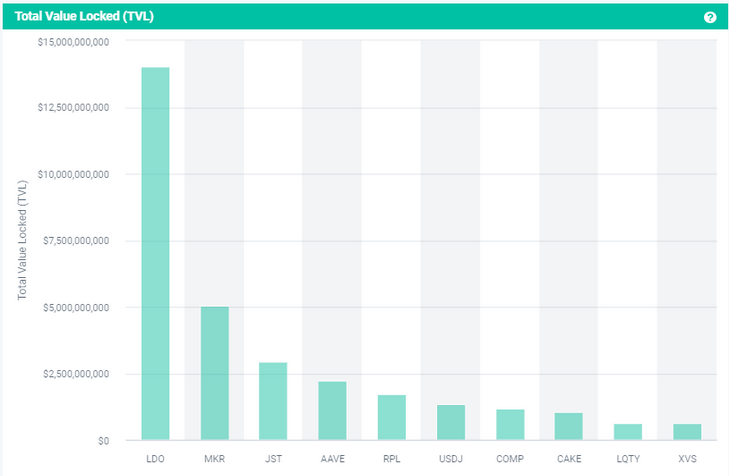
Growth of Tokenized U.S. Treasuries (2024–2025)
Unlike speculative crypto assets, tokenized Treasuries offer a familiar risk profile: sovereign credit backed by the U.S. government. What changes is the delivery mechanism. Instead of paper-based settlement cycles, custodial chains, and fragmented reporting, these instruments operate natively on blockchain rails—enabling real-time visibility, programmability, and settlement efficiency.
2. BlackRock’s BUIDL as the Market Anchor
At the center of this expansion stands BlackRock and its USD Institutional Digital Liquidity Fund (BUIDL). Widely regarded as the flagship tokenized Treasury product, BUIDL has become a benchmark for how large asset managers can bridge traditional finance and blockchain infrastructure.
BUIDL provides exposure to short-term U.S. Treasuries while offering daily yield accrual and on-chain settlement. This structure allows institutional investors to hold a low-risk, yield-bearing asset that can be moved, settled, or pledged within blockchain-based workflows. Industry estimates place BUIDL’s assets under management at approximately $2 billion, accounting for a substantial share of the overall tokenized Treasury market.
Crucially, BUIDL operates within a regulated fund framework, ensuring compliance with securities laws while leveraging blockchain rails for efficiency. This hybrid approach—traditional governance with digital-native execution—has become the template for subsequent products.
3. Expanding Ecosystem: USYC, USTB, and OUSG
Beyond BlackRock’s offering, several other products have gained traction:
- Circle’s USD Coin Yield (USYC)
- Superstate’s U.S. Treasury Bill Token (USTB)
- Ondo Finance’s Ondo Short-Term U.S. Government Bond Fund (OUSG)
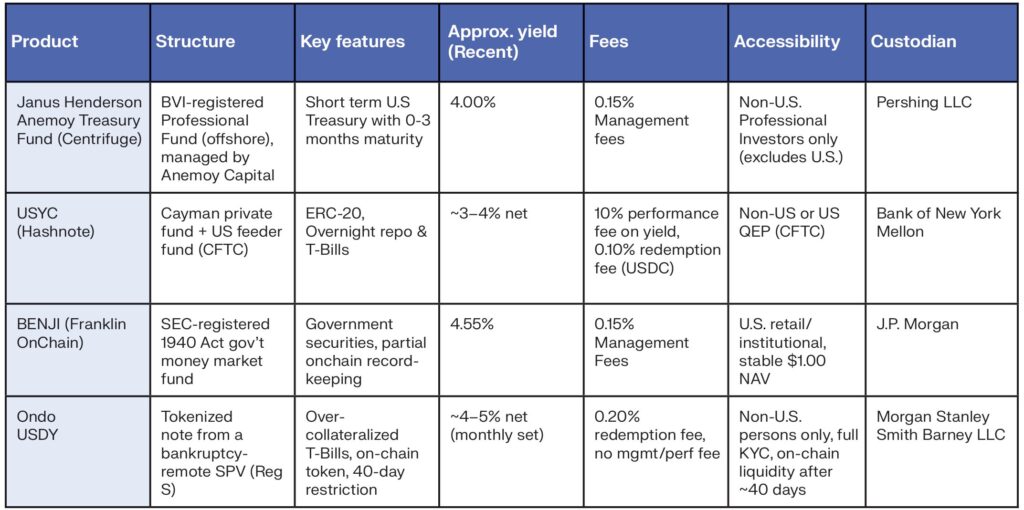
Each of these products offers tokenized exposure to U.S. government debt through regulated fund structures. While they differ in legal design, custody models, and blockchain integrations, they share a common goal: migrating fixed-income products onto programmable infrastructure.
Major Tokenized Treasury Products and Market Share
The proliferation of such products signals that tokenization is no longer an experiment. Instead, it is becoming an operational layer for distributing and managing traditional assets.
4. Why Short-Term Treasuries Are Ideal for Tokenization
Short-term U.S. Treasuries—such as T-bills—are uniquely suited for on-chain representation. They combine minimal credit risk with predictable cash flows, making them attractive collateral assets. When tokenized, these characteristics are enhanced by blockchain features:
- Instant settlement reduces counterparty risk.
- Programmability enables automated margining and interest distribution.
- Transparency provides real-time proof of reserves and holdings.
For institutions navigating regulatory constraints, tokenized Treasuries serve as a compliant bridge into decentralized finance (DeFi). Instead of holding volatile crypto assets, institutions can deploy sovereign-backed instruments within on-chain environments while maintaining conservative risk profiles.
5. Institutional Adoption and DeFi Integration
As reported by Cointelegraph and other industry outlets, institutional adoption of tokenized short-term Treasuries is expanding rapidly—particularly for settlement, margin, and collateral use cases. Financial institutions are discovering that on-chain Treasuries can improve capital efficiency without increasing risk exposure.
One notable example is DBS, Southeast Asia’s largest bank by assets. DBS has piloted tokenized funds, including blockchain-based money market funds and government securities, as part of its exploration into on-chain collateral management and settlement infrastructure.
By using tokenized government debt, institutions can:
- Reduce settlement times from days to minutes.
- Optimize balance sheet usage.
- Integrate seamlessly with emerging on-chain liquidity venues.
This shift marks a departure from the view of DeFi as purely speculative. Instead, DeFi increasingly resembles a financial operating system, capable of supporting regulated, institutional-grade assets.
6. On-Chain Yield and the Search for New Revenue Streams
For investors seeking new yield opportunities, tokenized Treasuries offer a compelling proposition. While yields track traditional short-term rates, the on-chain format unlocks additional strategies:
- Using tokenized T-bills as collateral to access liquidity.
- Automating reinvestment through smart contracts.
- Combining sovereign yield with other on-chain assets for structured products.
This composability transforms Treasuries from static holdings into active components of digital portfolios. For asset managers and fintech platforms, this opens the door to new revenue models, including yield optimization, liquidity provisioning, and cross-chain settlement services.
7. The Broader RWA Landscape and Private Credit Growth
Tokenized Treasuries are not growing in isolation. They are part of a broader RWA wave that includes private credit, commodities, and real estate. According to RedStone data, private credit has become one of the fastest-growing on-chain sectors, driven by yields that often exceed those of traditional products.
RWA Growth by Sector (Treasuries vs. Private Credit)
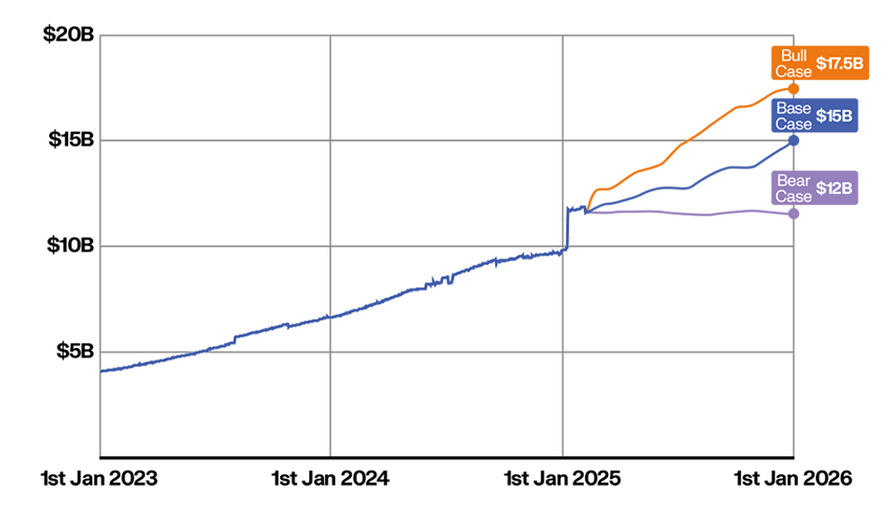
The coexistence of low-risk sovereign assets and higher-yield private credit on-chain suggests an emerging risk spectrum within DeFi—one that mirrors traditional markets but operates with greater transparency and efficiency.
8. Implications for the Future of Finance
The explosive growth of tokenized U.S. Treasuries signals more than a successful product category. It reflects a structural transition toward on-chain finance, where assets, payments, and settlements converge within programmable networks.
For regulators, this trend offers improved auditability and compliance monitoring. For institutions, it delivers operational efficiency. For investors, it expands access to yield-bearing assets with unprecedented flexibility.
Most importantly, tokenized Treasuries demonstrate that blockchain adoption does not require abandoning traditional finance. Instead, it enables a gradual migration, where familiar instruments evolve into digital-native forms.
9. Conclusion: From Experiment to Infrastructure
What began as an experiment in tokenizing government debt has rapidly matured into a foundational layer of on-chain finance. With market capitalization approaching $7 billion and institutional participation accelerating, tokenized U.S. Treasuries are poised to become a core component of the global financial system.
As asset managers, banks, and fintech platforms continue to adopt blockchain rails, the line between traditional and decentralized finance will blur. Tokenized Treasuries—safe, liquid, and programmable—are leading this convergence, offering a glimpse into a future where finance operates seamlessly on-chain.