

Main Points :
- Institutional investors are redefining Bitcoin’s downside risk, with a projected 2026 bottom near $65,000.
- Extreme bearish scenarios, including a collapse toward $10,000, imply a brutal but clarifying purge of altcoins.
- Liquidity evaporation is creating violent short-term volatility, rendering traditional technical analysis ineffective.
- The crypto market is entering a phase where survival, not speculation, determines long-term winners.
- What emerges after this winter may be a smaller, but far more resilient, digital financial ecosystem.
1. A $65,000 Bottom in 2026: Institutionalization as Bitcoin’s New Armor
The outlook presented by leadership at Fidelity Digital Assets has sent a mixed wave of hope and anxiety across global crypto markets. Their projection—that Bitcoin could experience another “crypto winter” yet hold a bottom near $65,000 by 2026—marks a decisive break from historical precedent.
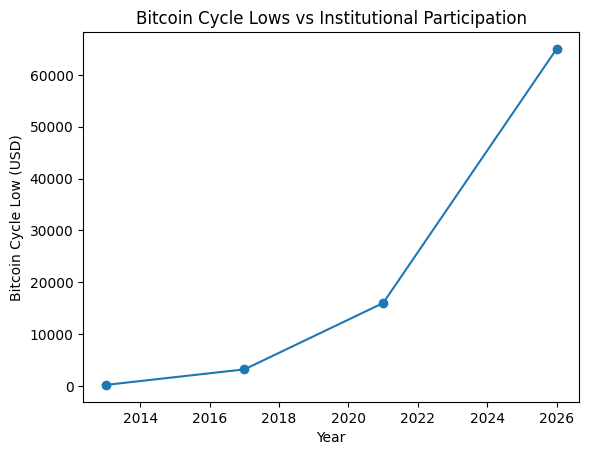
In previous cycles, Bitcoin collapses erased 70–85% of peak value, dragging prices back to the low thousands. This time, however, the suggested downside remains well above former all-time highs. That alone signals a structural transformation rather than a cyclical repetition.
Institutional capital has altered Bitcoin’s market geometry. Pension funds, asset managers, family offices, and regulated custodians now form a thick layer of demand that did not exist in earlier cycles. Their mandates are long-term, their allocations strategic, and their conviction grounded in macroeconomic realities—currency debasement, sovereign debt expansion, and declining trust in fiat systems.
Bitcoin’s scarcity, algorithmic issuance, and censorship resistance are no longer fringe narratives. They are increasingly embedded into portfolio theory as asymmetric hedges against systemic risk.
A winter with a $65,000 floor is not a sign of weakness. It is evidence of maturation. It implies that even during contraction, Bitcoin remains a globally recognized reserve-like digital asset.
Title: Bitcoin Cycle Lows vs Institutional Participation
Description: A line chart showing historical BTC cycle bottoms compared with the estimated institutional holdings over time.
2. The $10,000 Collapse Scenario: The End—and Rebirth—of Altcoins
At the opposite extreme lies a scenario so severe it feels almost unthinkable: Bitcoin collapsing toward $10,000. While improbable under current conditions, such forecasts persist—and their implications are devastating.
A decline of that magnitude would not merely hurt prices. It would annihilate the existing altcoin landscape.
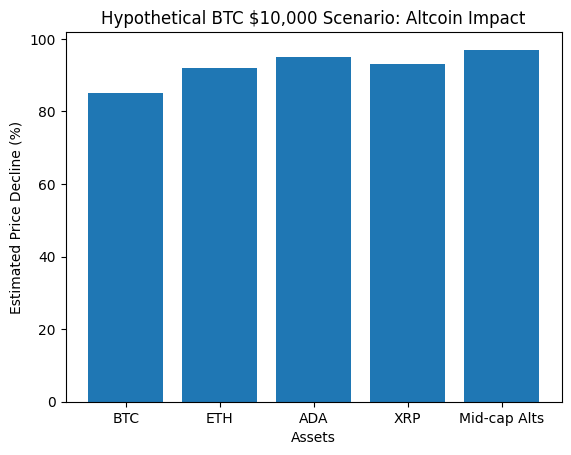
Assets such as Ethereum, Cardano, and XRP would likely suffer drawdowns exceeding 90%. Thousands of smaller projects—already surviving on thin liquidity and narrative momentum—would vanish entirely.
This is not just about valuation. It is about legitimacy.
A $10,000 Bitcoin would represent a systemic crisis of confidence. Venture funding would freeze. Infrastructure development would stall. Token-based business models reliant on speculative appreciation would collapse.
Yet history shows that such purges, while brutal, are also cleansing.
Speculation without utility is stripped away. Overleveraged structures implode. What survives is not hype, but function—networks with real users, real cash flows, and real-world integration.
Ethereum, even under such pressure, would not disappear—but its ecosystem would shrink violently, forcing consolidation around economically viable applications. ADA and XRP holders would face existential questions about long-term relevance rather than short-term recovery.
In this sense, the doomsday scenario is not merely destruction. It is forced honesty.
Title: Hypothetical BTC $10,000 Scenario: Altcoin Impact Simulation
Description: Bar chart showing estimated percentage declines across BTC, ETH, ADA, XRP, and mid-cap altcoins.
3. Liquidity Evaporation and the Coming Storm of Chaos
While long-term scenarios dominate headlines, the immediate danger is far quieter—and far more treacherous: liquidity disappearance.
Across major exchanges, order books are thinning. Trading volumes are declining. Capital is quietly leaving centralized platforms for cold storage, ETFs, or sidelines.
In such an environment, price discovery breaks down.
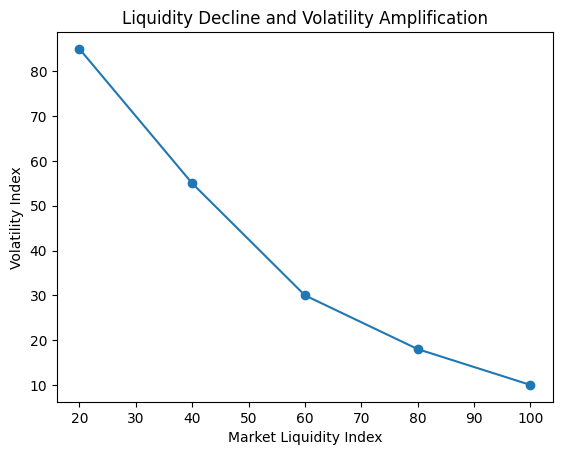
When liquidity dries up, small shocks become violent moves. A single large market order can push prices thousands of dollars within minutes. Stop-loss cascades trigger algorithmic selling. Volatility feeds on itself.
This is not a market driven by fundamentals. It is a mechanical storm driven by absence.
For leveraged traders, this environment is lethal. Strategies based on support, resistance, or momentum fail when price gaps over them entirely. Risk management systems designed for liquid markets malfunction.
The coming weeks—especially during periods of low participation—may feel less like trading and more like survival.
The rational response is not bravado, but restraint.
Holding cash, reducing leverage, and accepting inactivity as a position are not signs of weakness. They are signs of discipline.
Title: Liquidity Decline and Volatility Amplification Loop
Description: A flow diagram showing how reduced liquidity leads to volatility spikes and forced liquidations.
Conclusion: Beyond the Winter Lies a Harder, Stronger Market
Crypto winters are not accidents. They are mechanisms.
They compress excess, punish complacency, and reveal structural truths that bull markets obscure. Whether Bitcoin stabilizes near $65,000, plunges toward unimaginable lows, or oscillates violently in between, the direction of evolution is clear.
The future belongs to fewer assets, stronger foundations, and investors who understand that survival precedes growth.
This winter is not the end. It is the line of defense—where a new standard is being forged.
