
Key Takeaways :
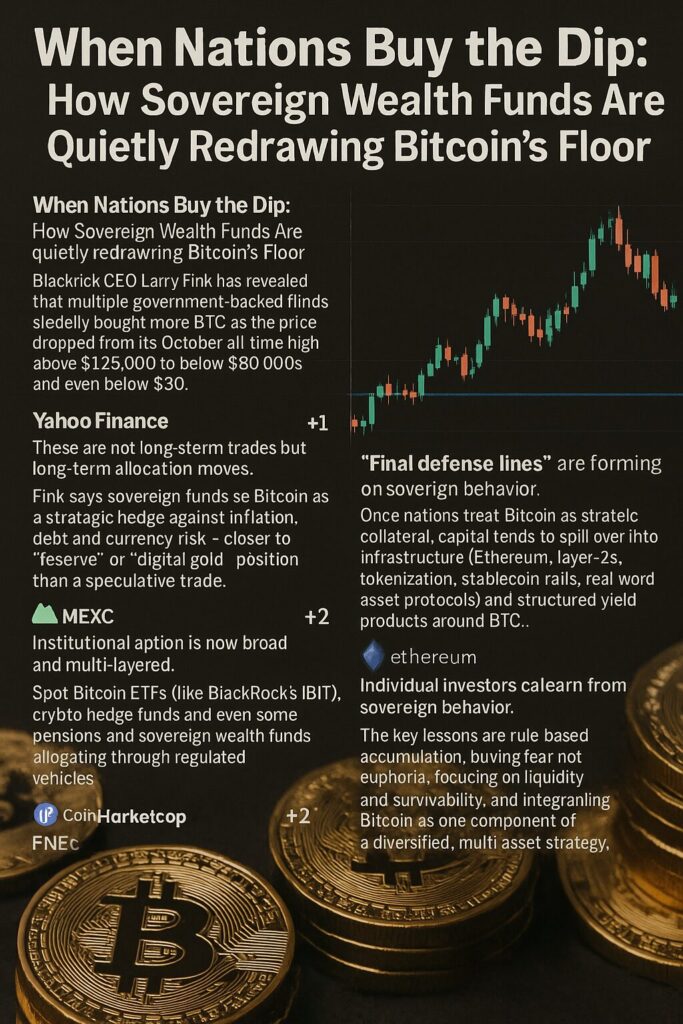
- Sovereign wealth funds (SWFs) are buying Bitcoin on sharp dips. BlackRock CEO Larry Fink has revealed that multiple government-backed funds steadily bought more BTC as the price dropped from its October all-time high above $126,000 to the low-$90,000s and even below $90,000.
- These are not short-term trades but long-term allocation moves. Fink says sovereign funds see Bitcoin as a strategic hedge against inflation, debt and currency risk – closer to a “reserve” or “digital gold” position than a speculative trade.
- Institutional adoption is now broad and multi-layered. Spot Bitcoin ETFs (like BlackRock’s IBIT), crypto hedge funds and even some pensions and sovereign wealth funds are allocating through regulated vehicles, helping to institutionalize Bitcoin as an asset class.
- “Final defense lines” are forming on the chart. When large, price-insensitive buyers step in during crashes, they create liquidity walls – price zones where sell-offs are absorbed. Recent dips below about $90,000 have been met with this kind of sovereign and institutional demand.
- This matters for altcoins and yield strategies. Once nations treat Bitcoin as strategic collateral, capital tends to spill over into infrastructure (Ethereum, layer-2s, tokenization, stablecoin rails, real-world-asset protocols) and structured yield products around BTC.
- Individual investors can learn from sovereign behavior. The key lessons are rule-based accumulation, buying fear not euphoria, focusing on liquidity and survivability, and integrating Bitcoin as one component of a diversified, multi-asset strategy.
1. From Fringe Asset to “Not a Bad Reserve”: How We Got Here
Just a few years ago, it was hard to imagine the chief executive of the world’s largest asset manager speaking positively about Bitcoin, let alone disclosing that sovereign wealth funds were quietly buying the dip. Today BlackRock manages about $13 trillion and runs the fastest-growing spot Bitcoin ETF in history, while its CEO Larry Fink now calls Bitcoin a legitimate alternative store of value, comparable in role (though not yet in size) to gold.
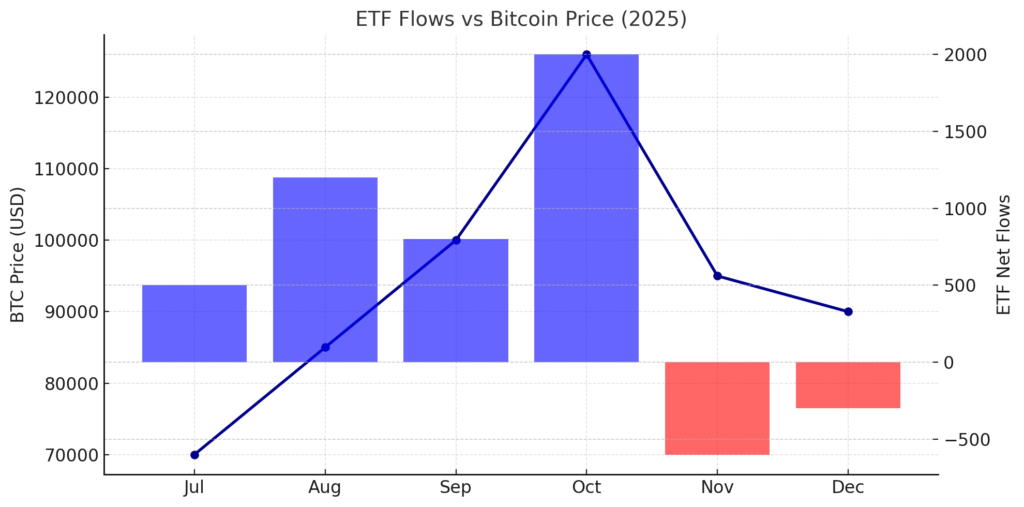
Regulated spot Bitcoin ETFs in the United States – approved in early 2024 – were the first big unlock. They let traditional asset allocators buy BTC exposure through familiar wrappers, with standard custody, reporting and compliance. Flows into these ETFs, including BlackRock’s IBIT, signaled that Bitcoin was no longer just an offshore, retail-driven phenomenon but a candidate for mainstream portfolio allocation.
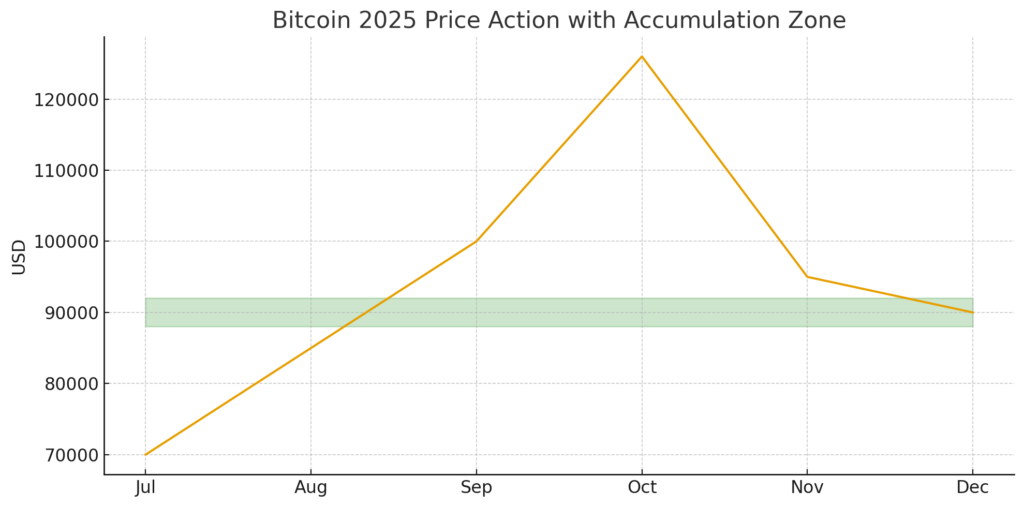
Through 2025, Bitcoin’s price action reflected this institutionalization. BTC surged to over $126,000 in early October 2025, then sold off almost 27% into the low-$90,000s as leverage unwound and macro fears returned. As of December 8, 2025, BTC is trading around $91,000–$92,000, still below its high but far above previous cycles.
What changed the narrative this month was not the volatility itself, but who was buying the volatility. Instead of capitulating, some of the world’s most conservative investors were stepping in.
2. What Larry Fink Actually Revealed About Sovereign Buying
In early December, Fink told media that sovereign wealth funds had been “buying more” Bitcoin as the price plunged from its October peak. He described unnamed government-backed investors that waited for the fall from above $126,000 and then started accumulating in “steady, small amounts” as BTC dropped into the $90,000 area and briefly below $90,000.
Several important points are buried inside this short comment:
- These are long-horizon allocators.
Sovereign wealth funds manage national reserves, often with 10–30-year horizons. They are not chasing short-term narratives – they buy when they believe the long-term risk-return profile is attractive relative to bonds, stocks, real estate and commodities. - They buy weakness, not euphoria.
Instead of buying near the October peak above $126,000, they waited for a double-digit percentage drawdown. This is exactly the behavior you see in traditional reserve management: accumulate strategic assets when liquidity is stressed and other participants are forced sellers. - They size Bitcoin as an option, not a core holding.
Reports from institutional surveys show that most sophisticated allocators still keep digital assets to single-digit percentages of total assets, often below 5%, even when they are bullish. That makes Bitcoin a high-conviction option on a new monetary and settlement layer, not a bet-the-farm position.
From an individual investor’s perspective, the message is not that “governments are all-in BTC.” It is that some governments now treat Bitcoin as serious enough to buy on 25–30% corrections and hold over many years. That is a very different world from 2018 or 2020.
3. Why Sovereign Wealth Funds Care About Bitcoin at All
Why would a fund that already owns prime real estate, blue-chip equities and government bonds allocate even 1–2% into Bitcoin?
Several structural forces are pushing in the same direction:
3.1 Long-Term Inflation and Debt Concerns
Global public debt levels remain elevated, while real yields on many government bonds are volatile and often low. SWFs and central-bank-adjacent investors are responsible for protecting national wealth over decades, not quarters. A provably scarce, globally traded asset with capped supply at 21 million coins offers a different risk profile from fiat bonds and even from gold.
Fink himself has shifted from skepticism to seeing Bitcoin as a “reserve-like” or “alternative to gold” asset for diversification.
3.2 Digital Infrastructure and Tokenization
BlackRock and other giants are explicit that they are not just interested in BTC price; they are also betting on tokenization of real-world assets – putting money-market funds, bonds and other instruments on blockchains. BlackRock’s tokenized money-market fund BUIDL, for example, has gathered several billion dollars.
For sovereign funds exploring tokenized treasuries, cross-border settlement, or digital bond markets, owning some BTC (and often some ETH) is a way to gain exposure to the rails and collateral layer of that future.
3.3 Optionality With Small Allocations
Studies like Invesco’s 2025 global sovereign asset management report note that direct allocations to digital assets remain small but are increasing, with many sovereigns treating them as high-conviction, asymmetric “optionality” exposures.
Even a 1% allocation to Bitcoin, if the asset significantly outperforms over a decade, can materially improve overall portfolio outcomes without jeopardizing stability if it fails.
4. The “Final Defense Line”: How Big Buyers Change Bitcoin’s Market Structure
When heavyweight buyers are known to accumulate at specific price zones, the market starts to perceive an implicit floor – a “final defense line” below which value investors, ETFs and sovereign allocators aggressively add.
In 2025 we saw:
- A run to over $126,000 in October, driven by ETF inflows, leverage and macro optimism.
- A sharp retracement towards and below $90,000 in late November and early December, triggered by profit-taking, liquidations and macro uncertainty.
- Evidence from Fink and others that sovereign funds were significant buyers in the high-$80,000 to low-$90,000 band, often via ETFs and institutional custodians.
Microstructurally, this does a few things:
- Deepens Liquidity in Panic Moments
When forced sellers hit the market – leveraged traders, over-extended funds, retail capitulation – they need someone to take the other side. Sovereign funds, pensions and ETF arbitrage desks become patient buyers, absorbing supply without needing immediate upside. - Narrows the Tail of Extreme Crashes
Bitcoin will likely stay volatile, but with large balance sheets waiting to buy meaningful dips, the probability of a “flash crash” to extremely low levels shrinks. - Reinforces the “Buy Fear, Sell Euphoria” Playbook
When the biggest, slowest money in the room is openly saying, “we buy the 25–30% spills,” it encourages other actors to adopt similar rule-based strategies.
- Rally to above $120,000–$126,000 (red “euphoria” band)
- Dips below $90,000 (green “sovereign accumulation” zones)
- Current level around $91,000–$92,000
This doesn’t mean Bitcoin “cannot” trade below those zones. But it does mean that every deep dip now faces serious, long-term demand, and that is a fundamental shift from earlier cycles.
5. Beyond Bitcoin: What This Signals for Altcoins and Yield Strategies
For your readers who are hunting new crypto assets, next revenue streams and practical blockchain use cases, the sovereign behavior around BTC is an important signal, not an endpoint.
5.1 Bitcoin as Base Collateral
Once nation-scale allocators accept Bitcoin as a macro hedge and reserve-like holding, it increasingly becomes:
- Collateral for structured yield products (covered call strategies, lending markets, basis trades)
- A base asset in on-chain and off-chain financial products (tokenized BTC, wrapped BTC in DeFi, BTC-backed stablecoins)
- A reference asset for derivatives and risk-transfer products (options, variance swaps, structured notes)
As these markets deepen, demand grows for the infrastructure layers that support them: Ethereum, leading layer-2 networks, high-throughput layer-1s, custodian chains and tokenization platforms. Those are exactly where many institutional players are now building.
5.2 ETF and ETP Expansion Beyond BTC
BlackRock and other issuers are already exploring additional crypto ETFs and ETPs beyond Bitcoin and Ethereum, considering baskets or single-asset products for more mature networks. While they remain cautious, the direction of travel is clear: when Bitcoin works as an ETF, other large-cap crypto assets start lining up behind it.
For builders and investors, that means:
- Tokens that plug into institutional rails – compliant stablecoins, KYC-capable DeFi, tokenization platforms – could see increasing demand.
- Infrastructure projects that reduce friction between traditional finance and crypto (on-ramps, custody, risk analytics, compliance tooling) become high-value picks and shovel plays.
5.3 Where Yield Opportunities May Emerge
Sovereign and institutional flows can indirectly create yield opportunities for smaller participants:
- Basis trades: When ETF demand is strong, futures and perpetuals can trade at premiums, generating yields for arbitrageurs.
- Lending and borrowing: Institutions willing to borrow BTC or stablecoins for hedging and market-making will pay for access, creating interest-rate markets.
- Real-world-asset (RWA) protocols: If sovereigns and funds move into tokenized treasuries and money-market funds, protocols that connect BTC-rich investors to on-chain dollar yield are well placed.
None of this removes risk – smart-contract risk, counterparty risk and regulatory risk all remain – but it does mean the opportunity set is broadening beyond pure price speculation.
Optional Figure (for designers):
A stacked bar chart showing a hypothetical institutional digital-asset allocation: Bitcoin, Ethereum, tokenized treasuries, infrastructure tokens, stablecoins. Insert near the end of this section.
6. How Individual Investors Can Learn From Sovereign Behavior
You don’t manage a trillion-dollar balance sheet, but you can still borrow the logic of sovereign wealth funds and large institutions.
6.1 Build Rules, Not Impulses
Sovereigns don’t wake up and market-buy based on headlines. They define rules like:
- “Accumulate X% of AUM in BTC over Y years.”
- “Only buy when BTC is down 20–30% from recent highs.”
- “Cap total allocation to 1–3% of the overall portfolio.”
Individual investors can mirror this by:
- Setting a maximum allocation to BTC (for example, 1–5% depending on risk tolerance).
- Using dollar-cost averaging (DCA) on a monthly or quarterly basis.
- Adding extra buy tranches only when BTC has dropped a defined percentage from recent peaks, instead of chasing new highs.
6.2 Focus on Liquidity and Survivability
SWFs prioritize assets that they can enter and exit in size. For individuals, this translates to:
- Favoring high-liquidity trading pairs (BTC, ETH and a small number of major altcoins) for the core portfolio.
- Limiting illiquid small-cap tokens to a speculative “venture” sleeve, not the bulk of capital.
- Being cautious with leverage – most sovereign funds avoid or tightly control leverage on Bitcoin exposure.
6.3 Integrate Bitcoin into a Broader Strategy
Sovereign funds are not “crypto funds” – they are multi-asset allocators. Bitcoin sits alongside:
- Equities and private equity
- Bonds and private credit
- Real estate and infrastructure
- Cash, gold and sometimes commodities
For individuals, the lesson is to treat Bitcoin as one component of a larger wealth strategy, not a single magic bullet. Pairing BTC with traditional assets, cash reserves and income streams (salary, business revenue) reduces the risk that crypto volatility destabilizes your entire financial life.
7. Conclusion: The Signal Behind the Sovereign Buying Spree
Larry Fink’s revelation that sovereign wealth funds were buyers, not sellers, during Bitcoin’s latest sharp correction is more than just a bullish headline. It is a milestone in the maturation of digital assets:
- It confirms that some of the most conservative institutions on earth are willing to allocate national capital into Bitcoin.
- It suggests that deep, rule-based demand exists in the high-$80,000 to low-$90,000 zone and similar drawdown regions in future cycles.
- It accelerates the narrative of Bitcoin as a strategic macro hedge, a complement – not a replacement – to gold and government bonds.
- It creates second-order opportunities in infrastructure, tokenization, stablecoins, alt-layer ecosystems and structured yield, where your readers may find the next sources of revenue and innovation.
The flip side is equally important: if sovereigns are buying on 25–30% dips, they are unlikely to chase parabolic moves at the top. For individual investors, the best takeaway is not “go all in,” but “build a process that buys fear, respects risk and thinks in decades, not days.”
The market will remain volatile. Macro conditions, regulation and technology can all shift abruptly. But with sovereign wealth funds now quietly standing in the order book, the future of Bitcoin – and by extension, the broader digital-asset ecosystem – looks more structurally anchored than ever before.
