
Main Points :
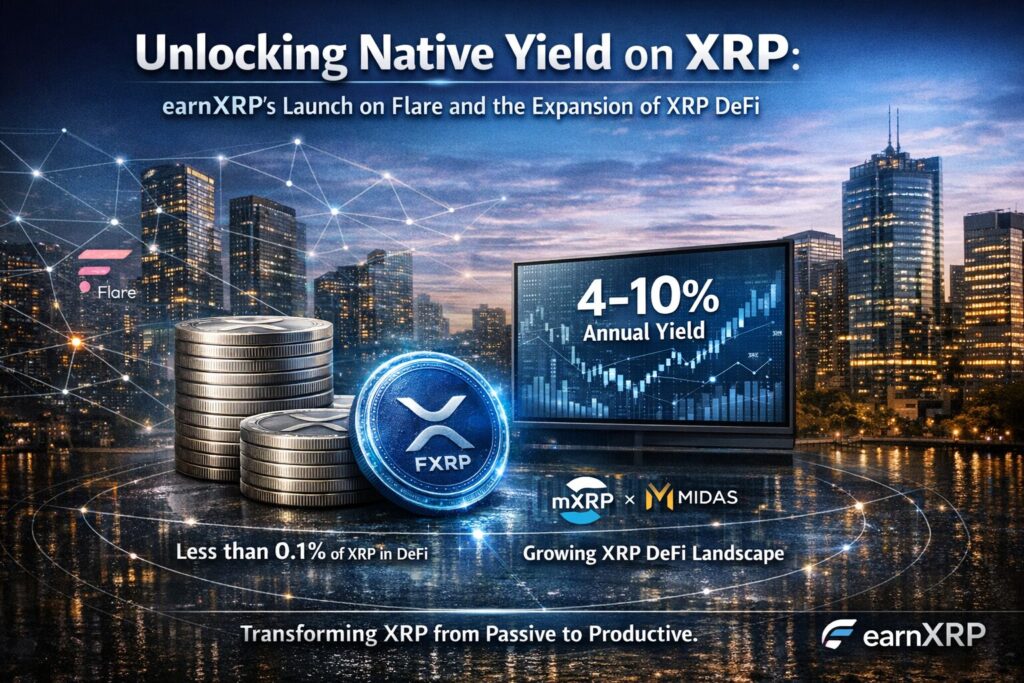
- earnXRP is a newly launched XRP-denominated yield vault on the Flare Network, designed to generate 4–10% annualized yield without requiring users to manage complex DeFi strategies.
- The product uses FXRP, a 1:1 representation of XRP on Flare, and automatically compounds returns back into XRP.
- The initiative aims to address a structural inefficiency: less than 0.1% of XRP’s circulating supply is currently used in DeFi, despite XRP being a top-five crypto asset by market capitalization.
- earnXRP enters a growing competitive landscape that includes mXRP by Midas, signaling accelerating institutional and semi-institutional interest in XRP-based yield products.
- For investors seeking new crypto income streams and practical blockchain applications, earnXRP represents a meaningful step in transforming XRP from a passive asset into a productive one.
1. Introduction: Why XRP Yield Products Matter Now
For much of its history, XRP has been positioned primarily as a payments and liquidity asset rather than a yield-generating one. While Ethereum, Solana, and other smart contract platforms rapidly developed DeFi ecosystems offering staking, lending, and structured yield, XRP largely remained idle in wallets and exchanges.
This imbalance has become increasingly difficult to justify. XRP consistently ranks among the largest cryptocurrencies by market capitalization, yet it contributes only marginally to decentralized finance activity. The launch of earnXRP directly addresses this gap by offering XRP holders a way to earn yield without abandoning XRP exposure or mastering complex DeFi operations.
The timing is notable. As crypto markets mature, investors are no longer satisfied with price appreciation alone. Yield, cash-flow-like returns, and capital efficiency are becoming central to digital asset allocation strategies—particularly for large holders, treasuries, and long-term investors.
2. What Is earnXRP? Structure and Core Mechanics
earnXRP is an XRP-denominated yield vault launched jointly by Upshift, Clearstar, and the Flare ecosystem. Its design philosophy is simple: abstract away DeFi complexity while preserving transparency and composability.
How It Works
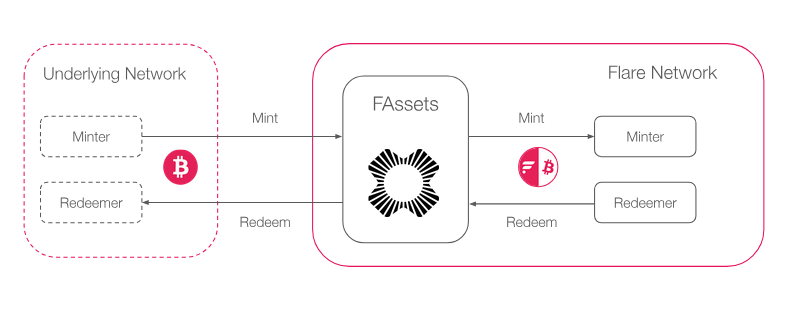
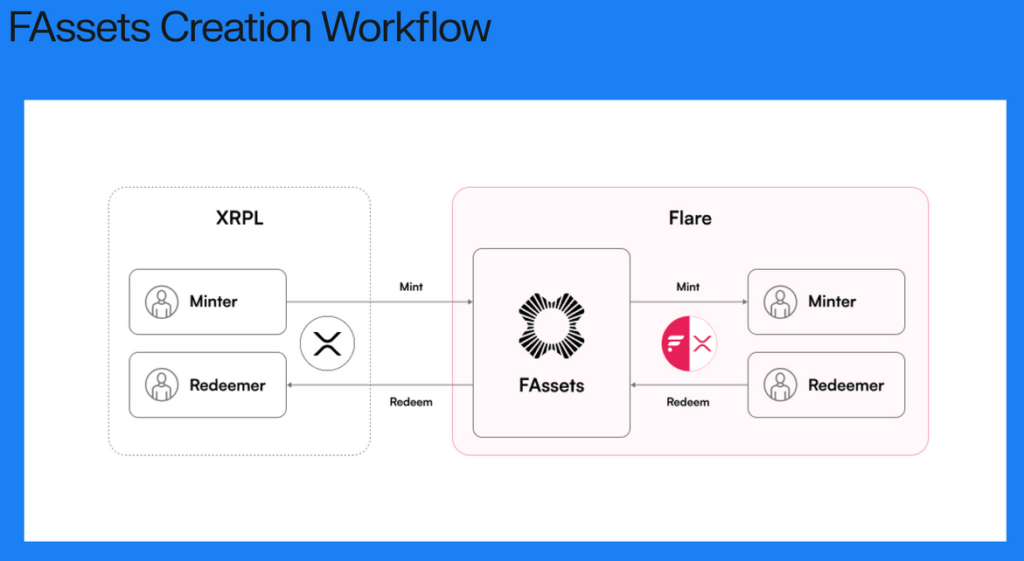
- Users convert XRP into FXRP, a 1:1 representation of XRP on Flare.
- FXRP is deposited into a single vault.
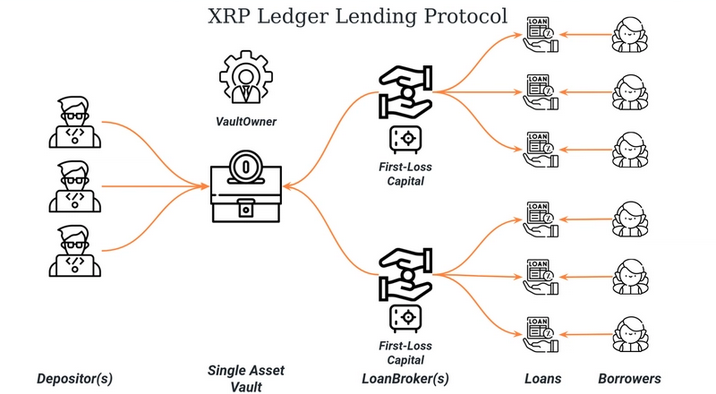
- The vault allocates funds across multiple yield strategies.
- All returns are automatically compounded back into XRP.
- Users receive a receipt token, earnXRP, representing their claim on the vault.
- Withdrawals are available at any time, subject to protocol conditions.
This model closely resembles structured yield vaults seen in Ethereum DeFi but is tailored specifically for XRP holders who want native exposure rather than synthetic substitutes.
3. FXRP and Flare: The Technical Foundation
The entire earnXRP system relies on FXRP, which is minted on Flare to mirror XRP at a strict 1:1 ratio. Flare’s architecture is designed to bring non-smart-contract assets—like XRP—into programmable environments without compromising decentralization.
Flare achieves this by combining:
- Decentralized oracles
- Native data availability
- Asset representations such as FXRP
This infrastructure enables XRP to participate in DeFi strategies such as staking, liquidity provision, and structured products—activities that are not natively possible on the XRP Ledger itself.
From a practical standpoint, Flare acts as a DeFi extension layer for XRP, similar to how Ethereum Layer-2s extend ETH usability.
4. Yield Strategies Behind earnXRP
At launch, earnXRP deploys a diversified set of strategies designed to balance return generation with risk management.
Key Strategies Include:
- Carry Trades: Capturing yield differentials across markets.
- Staking: Leveraging Flare-native or interoperable staking mechanisms.
- Covered Underwriting via Firelight: Structured exposure designed to earn premiums while managing downside risk.
- Concentrated Liquidity Provision (AMM): Optimized deployment of capital in automated market makers.
According to Clearstar’s research leadership, the target yield ranges from 4% to 10%, depending on vault size, market conditions, and strategy allocation. All yields are quoted in USD-equivalent terms ($), even though returns are paid in XRP.
5. Market Context: XRP’s DeFi Underutilization Problem
Despite XRP’s scale, data indicates that only about 0.1% of its circulating supply is currently deployed in DeFi. This contrasts sharply with assets like ETH, where a significant portion of supply is staked, lent, or used as collateral.
As Ethan Rook of Upshift notes, XRP holders historically lacked simple and sustainable yield options. earnXRP directly targets this inefficiency by lowering both technical and cognitive barriers to entry.
If even a small percentage of idle XRP migrates into yield products, the implications for XRP liquidity, velocity, and ecosystem depth could be substantial.
6. Competitive Landscape: earnXRP vs. mXRP
earnXRP is not launching in isolation. In September, Midas introduced mXRP, another XRP-denominated yield product developed in partnership with:
- Interop Labs (Axelar ecosystem)
- Hyperism
mXRP currently reports a Total Value Locked (TVL) of approximately $20 million and targets:
- 6–8% base yield
- Additional upside through DeFi strategies
The coexistence of earnXRP and mXRP suggests a broader trend: XRP is entering its DeFi phase, similar to ETH’s evolution in 2020–2021. Competition may ultimately benefit users through better risk-adjusted returns and improved transparency.
7. Implications for Investors and the XRP Ecosystem
For investors searching for new crypto assets, next income opportunities, or practical blockchain use cases, earnXRP represents a meaningful shift:
- From speculation to productivity: XRP transitions from a purely transactional asset to a yield-generating one.
- Treasury use cases: Corporates and DAOs holding XRP may now justify retaining balances rather than converting to yield-bearing stablecoins.
- Ecosystem expansion: Increased DeFi activity incentivizes tooling, analytics, and secondary markets around XRP.
Importantly, earnXRP does not attempt to replace XRP’s original payments thesis. Instead, it complements it, making XRP more capital-efficient in a multi-chain world.
8. Risk Considerations and Structural Limits
While earnXRP simplifies access, it does not eliminate risk. Users remain exposed to:
- Smart contract risk on Flare
- Strategy execution risk
- Oracle and bridge-related assumptions inherent in FXRP
- Market volatility affecting yield sustainability
For sophisticated users, these risks are familiar. For newcomers, the key advantage is that earnXRP packages these risks into a managed product, reducing the need for constant monitoring.
9. Future Outlook: Is This the Start of XRP DeFi?
If earnXRP succeeds in attracting meaningful capital, it could catalyze:
- More XRP-native DeFi products
- Institutional-grade structured products
- Cross-chain XRP liquidity strategies
- Regulatory-friendly yield models aligned with compliance-heavy markets
In this sense, earnXRP is less about a single vault and more about unlocking dormant capital at scale.
10. Conclusion
The launch of earnXRP on Flare marks a pivotal moment for XRP holders. By offering a 4–10% USD-equivalent yield, automatic compounding, and simplified DeFi exposure, earnXRP addresses a long-standing structural gap in the XRP ecosystem.
As competition intensifies with products like mXRP, the broader implication is clear: XRP is evolving from a passive liquidity asset into an active financial instrument. For investors focused on sustainable crypto income and real-world blockchain utility, this shift deserves close attention.
