
Main Points :
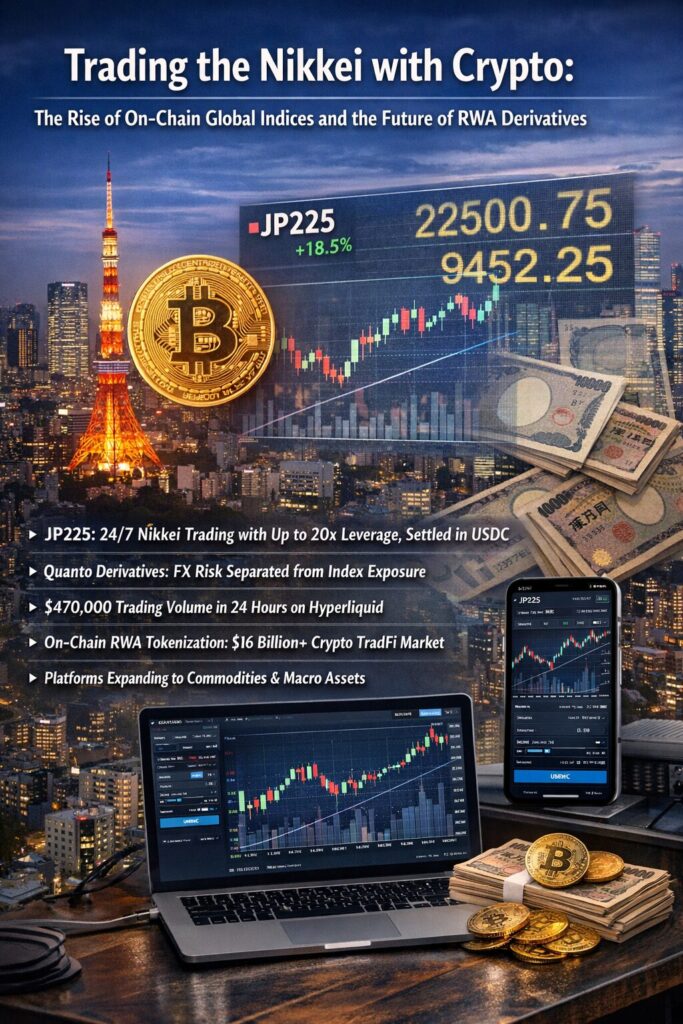
- Crypto derivatives platform trade.xyz launched JP225, a Nikkei 225-linked product
- Enables 24/7 trading with up to 20x leverage, settled in USDC
- Uses quanto derivative structure, separating FX risk from index exposure
- Achieved $470,000 trading volume in 24 hours
- Built on Hyperliquid, a non-custodial trading system
- Part of a broader trend: on-chain trading of TradFi assets (RWA tokenization)
- Market for crypto-based TradFi derivatives now exceeds $16 billion
- Platforms like Binance are expanding into commodities and macro assets
1. Introduction: A New Era of Global Market Access via Crypto
The launch of JP225 by trade.xyz marks a significant milestone in the ongoing convergence between cryptocurrency markets and traditional finance (TradFi). For the first time, traders across the globe can access the performance of Japan’s benchmark stock index—the Nikkei 225—without interacting with traditional brokers, FX markets, or even holding Japanese yen.
This development is not merely a product launch. It represents a structural shift in how financial exposure is created, distributed, and accessed. By leveraging blockchain infrastructure, platforms are now able to offer synthetic exposure to real-world assets (RWAs) with unprecedented flexibility.
For investors seeking new revenue streams, diversification, and global exposure, this is a powerful signal: the boundaries between crypto and traditional markets are dissolving rapidly.
2. What is JP225? A Crypto-Native Nikkei 225 Derivative

JP225 is a derivative product that tracks the Nikkei 225 index, Japan’s most widely recognized equity benchmark. What makes it unique is its structure and accessibility:
- 24/7 trading: Unlike traditional stock markets, which operate on fixed hours, JP225 can be traded continuously
- Up to 20x leverage: Traders can amplify exposure significantly
- USDC settlement: All margin and profit/loss calculations are denominated in USDC
- No custodial risk: Built on a decentralized, non-custodial infrastructure
The product is deployed on Hyperliquid, which provides the underlying execution engine and liquidity framework. This architecture ensures transparency, faster settlement, and reduced reliance on intermediaries.
3. Quanto Derivatives: Eliminating FX Friction
One of the most innovative aspects of JP225 is its use of a quanto derivative structure.
How It Works
- The underlying index (Nikkei 225) is denominated in Japanese yen
- Profit and loss are calculated based on yen price movements
- However, settlement occurs entirely in USDC
This structure allows traders to:
- Avoid direct exposure to JPY/USD exchange rate fluctuations
- Trade Japanese equities without opening a yen account
- Focus purely on index performance
For global investors—especially those already operating in crypto—this is a major usability improvement. It reduces complexity while maintaining precise exposure to the target asset.
4. Immediate Market Traction: $470K in 24 Hours
The market response to JP225 was swift and strong:
- Trading Volume (24h): ~$470,000
- Open Interest: ~$290,000
This level of activity indicates strong latent demand for:
- Global equity exposure via crypto
- Non-custodial leveraged trading
- Simplified cross-border financial access
While these numbers are modest compared to traditional derivatives markets, they are highly significant within the context of emerging on-chain financial products.
5. The Bigger Trend: On-Chain TradFi (RWA Tokenization)
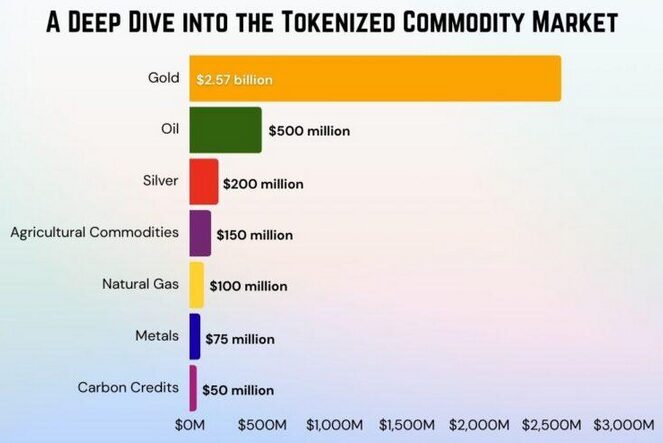
JP225 is part of a much larger movement: the tokenization and on-chain trading of real-world assets (RWA).
Key Developments Across the Industry
- On-chain trading of indices like the S&P 500 is gaining traction
- Crypto-based TradFi derivatives markets have surpassed $16 billion
- Binance has expanded into oil and natural gas futures
- Commodities such as gold and silver were already launched on platforms like trade.xyz
This trend reflects a fundamental shift:
Financial markets are becoming programmable, borderless, and continuously accessible
6. Why This Matters for Investors and Builders
For your audience—those seeking new crypto assets, income opportunities, and practical blockchain applications—this trend has several critical implications:
1. New Yield and Trading Opportunities
Leverage + global indices = new strategies:
- Macro trading via crypto
- Hedging traditional portfolios using DeFi tools
- Arbitrage between on-chain and off-chain markets
2. Reduced Barriers to Entry
No need for:
- Brokerage accounts
- FX conversions
- Regional restrictions
3. Composability
These assets can eventually integrate with:
- DeFi lending protocols
- Structured products
- Automated trading strategies
4. Institutional Convergence
Traditional finance players are increasingly exploring blockchain rails, suggesting that:
- Liquidity will deepen
- Regulation will evolve
- Hybrid systems will dominate
7. Risks and Considerations
Despite the innovation, there are important risks:
- Leverage risk (20x): High liquidation potential
- Oracle risk: Price feeds must be accurate
- Liquidity fragmentation: On-chain markets are still developing
- Regulatory uncertainty: Especially for synthetic equities
Investors should approach with a clear risk management framework.
8. Future Outlook: The Globalization of Financial Access
JP225 is not an isolated innovation—it is a preview of what’s coming:
- All major indices (NASDAQ, DAX, FTSE) will likely be tokenized
- Commodities and bonds will follow
- Retail and institutional users will converge on shared infrastructure
Ultimately, we are moving toward a system where:
Any asset, anywhere in the world, can be traded instantly via blockchain
Conclusion
The launch of JP225 by trade.xyz is more than just a new product—it is a glimpse into the future of finance.
By enabling seamless, leveraged, and continuous access to the Nikkei 225 via USDC, this innovation removes long-standing barriers between global markets. Combined with the rapid growth of RWA tokenization and platforms like Hyperliquid and Binance, the trajectory is clear:
Finance is becoming decentralized, global, and always-on.
For forward-looking investors and builders, the opportunity lies not just in trading these assets—but in building the infrastructure, strategies, and ecosystems around them.
