
Main Points :
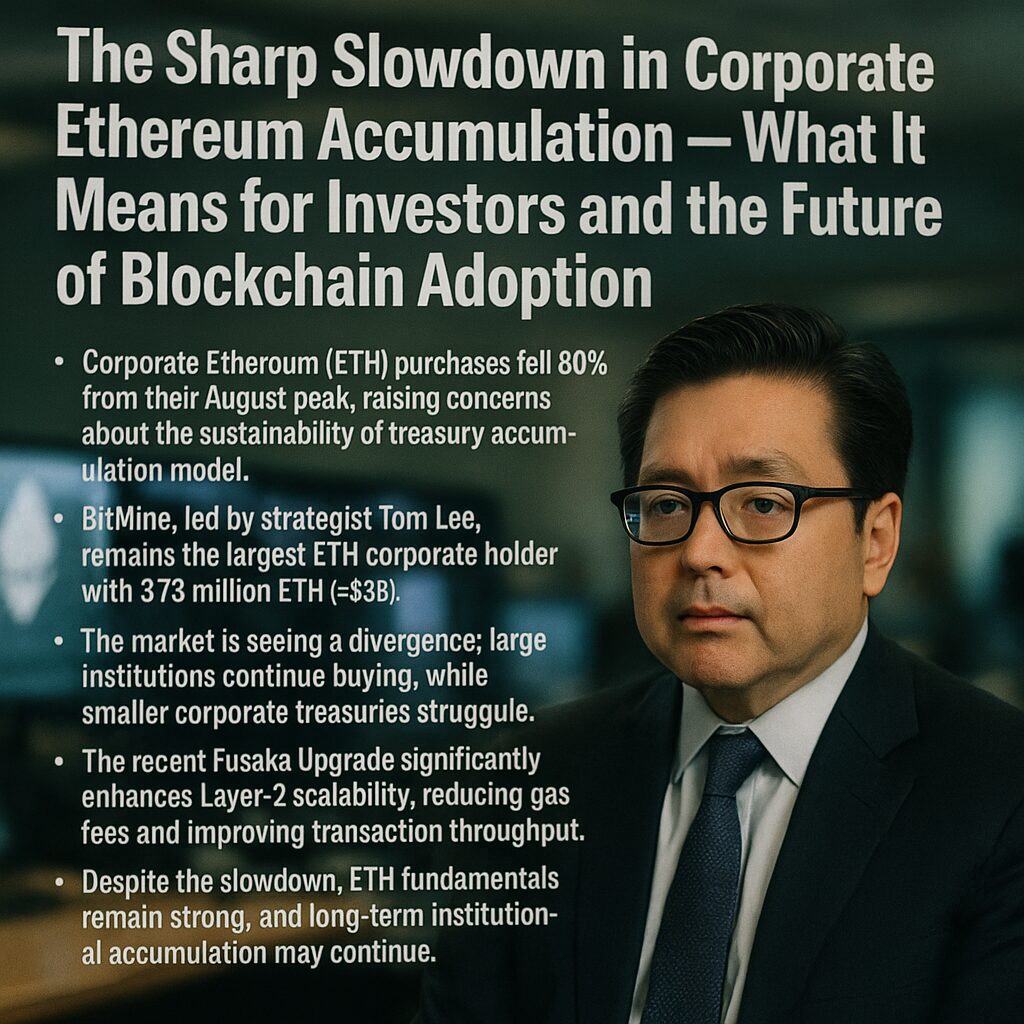
- Corporate Ethereum (ETH) purchases fell 80% from their August peak, raising concerns about the sustainability of the treasury accumulation model.
- BitMine, led by strategist Tom Lee, remains the largest ETH corporate holder with 3.73 million ETH (≈$13B).
- The market is seeing a divergence: large institutions continue buying, while smaller corporate treasuries struggle.
- The recent Fusaka Upgrade significantly enhances Layer-2 scalability, reducing gas fees and improving transaction throughput.
- Despite the slowdown, ETH fundamentals remain strong, and long-term institutional accumulation may continue.
Introduction
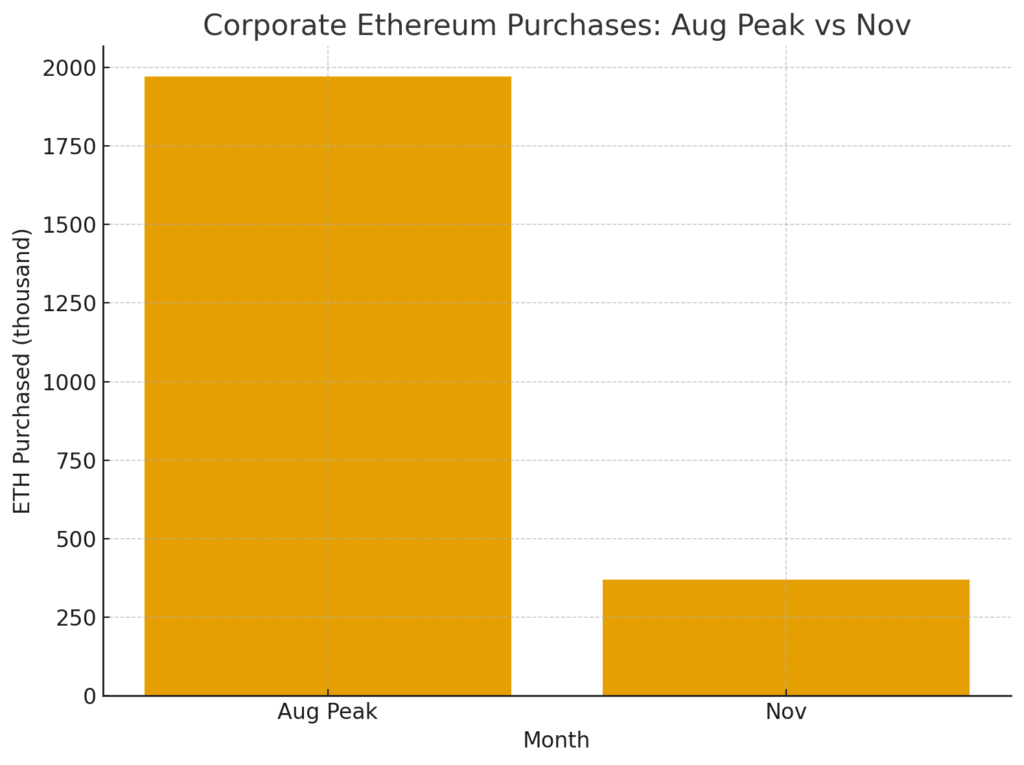
Ethereum has experienced a dramatic shift in corporate demand. According to new data released by Bitwise on December 2, aggregate corporate purchases of ETH in November plunged to 370,000 ETH, representing an 81% decline from the 1.97 million ETH peak in August.
This sharp contraction highlights both changing market conditions and the evolving behavior of institutional investors. For individuals seeking emerging crypto assets, yield opportunities, and practical blockchain use cases, understanding this trend is essential.
1. The Decline of Corporate Ethereum Accumulation
1.1 From Peak to Slowdown: What Happened?
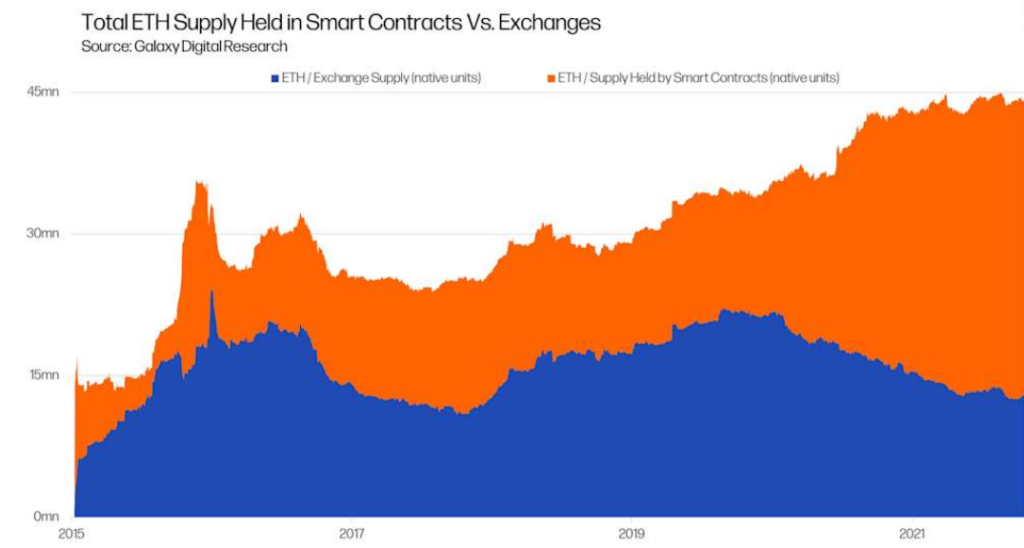
Corporate investors began aggressively accumulating ETH starting in July, emulating the long-established Bitcoin treasury model. At first, this strategy expanded rapidly, with institutions leveraging ETH’s increasing role in decentralized finance, staking, and Web3 infrastructure.
However, Bitwise’s senior research associate Max Shannon noted that the “treasury strategy acted as an alt-season version of corporate accumulation,” but ultimately fell into the same cyclical patterns seen in prior market eras.
1.2 Why Did Purchasing Decline by 80%?
Three core factors contributed to the collapse in corporate purchasing:
- Capital Pool Saturation
Many companies rely on the same institutional capital pools. As alternative assets grew more attractive, sustaining ETH demand became difficult. - Reduced Premiums & Shrinking Arbitrage Opportunities
ETH’s earlier surge offered attractive treasury expansion premiums. As the premium compressed, treasuries lost incentive. - Increasing Competition for Institutional Allocation
With tokenized assets, real-world asset (RWA) platforms, and AI-crypto hybrids emerging, ETH’s share of institutional flows naturally declined.
Despite the slowdown, corporate purchases in November (370,000 ETH) still exceeded ETH’s monthly supply issuance (~80,000 ETH) — but the margin has narrowed substantially.
2. The Role of BitMine: An Outlier Among Institutional Buyers
2.1 BitMine’s Massive Positioning
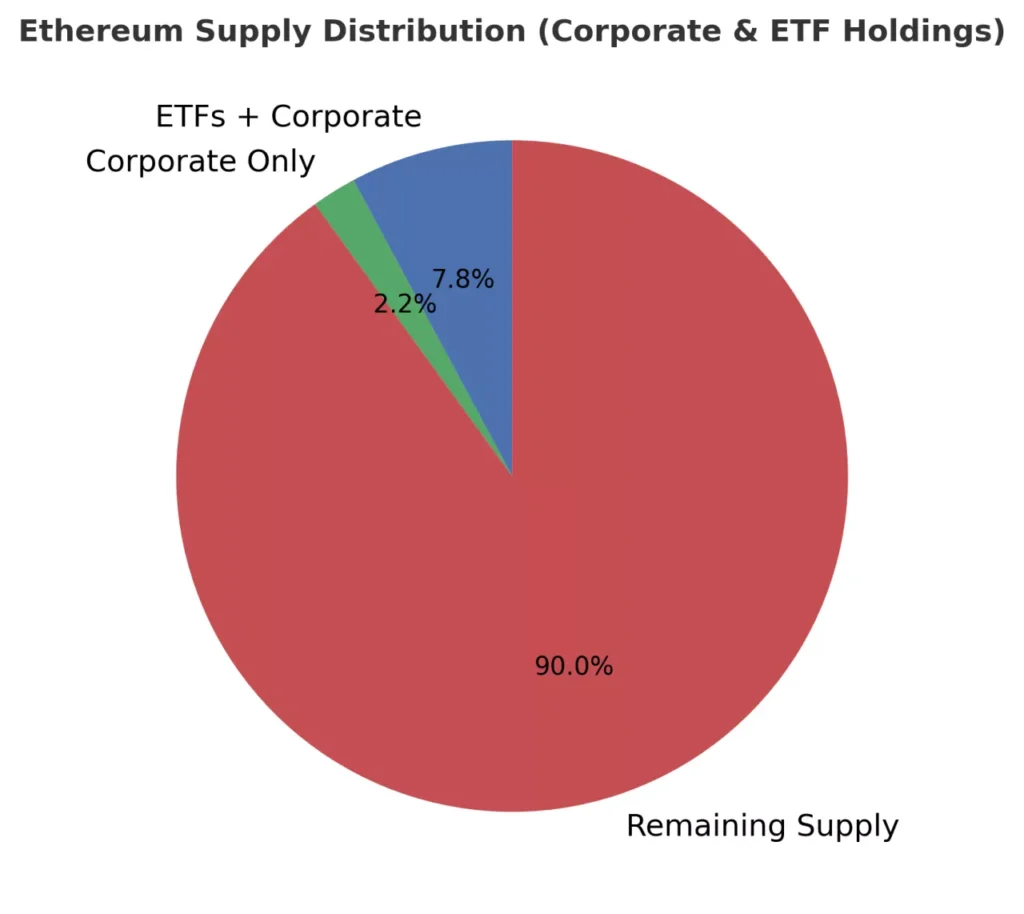
BitMine, led by well-known strategist Tom Lee, is now the largest corporate holder of ETH worldwide, with:
- 3.73 million ETH
- ≈ $13 billion USD at current valuations
This holding surpasses the combined total of all 68 other corporate treasury entities.
2.2 Continued Buying Despite Market Slowdown
Even as other institutions retreated, BitMine accelerated its acquisition strategy:
- On December 4, BitMine purchased an additional $150 million USD worth of ETH.
- Weekly accumulation pace increased by 39%, anticipating both macro and technical catalysts.
Tom Lee cited two drivers:
- U.S. Federal Reserve policy uncertainty, which tends to push investors toward alternative asset hedges.
- Ethereum’s Fusaka Upgrade, which fundamentally strengthens the network.
3. Fusaka Upgrade: A Catalyst for Institutional Confidence
3.1 What Is the Fusaka Upgrade?
The Fusaka Upgrade introduces PeerDAS, a technology designed to:
- Improve Layer-2 scalability
- Reduce gas fees
- Increase transaction throughput
- Support higher-bandwidth data availability
3.2 Why Corporates Care About PeerDAS
PeerDAS directly strengthens Ethereum’s utility for:
- Web3 applications handling millions of users
- High-frequency DeFi systems
- Settlement layers for fintechs and VASPs (like the user’s own infrastructure)
- Scalable NFT and gaming ecosystems
This upgrade dramatically reduces operational costs for any business integrating or settling on Ethereum.
4. Market Comparison and Broader Industry Trends
Even as ETH treasury growth slowed, several macro trends shape investor behavior:
4.1 Bitcoin Treasury Selling Pressure
Several BTC treasury entities have reduced exposure due to:
- Anticipation of interest rate shifts
- Profit realization near cycle highs
- Declining treasury yield premiums
This contributed to overall negative sentiment, which carried over into ETH markets.
4.2 Emergence of Competing Blockchain Investment Themes
Institutional interest has recently shifted toward:
- RWAs (Real-World Asset tokenization)
- AI-crypto hybrid models
- Layer-2 projects with enterprise adoption
- High-yield staking solutions
- On-chain credit markets
These sectors compete for the same capital that once aggressively supported ETH accumulation.
5. What This Means for Investors Seeking New Crypto Opportunities
For readers searching for new assets and revenue sources, three conclusions stand out:
5.1 Short-Term Pullback ≠ Weak Long-Term Outlook
The slowdown reflects cyclical capital rotation rather than structural deterioration.
5.2 Ethereum’s Upgrades Strengthen Its Position
The Fusaka Upgrade dramatically enhances Ethereum’s competitiveness, especially against Solana and other high-performance chains.
5.3 Institutional Divergence Creates Asymmetrical Opportunities
Large players like BitMine increase accumulation during weakness — historically a bullish signal.
6. Practical Business and Blockchain Use Cases Strengthened by These Trends
6.1 Treasury Management for VASPs & EMIs
Corporate behavior toward ETH treasuries offers insights for regulated entities:
- Diversified token reserves
- On-chain liquidity commitments
- Hedging strategies tied to network upgrades
6.2 Infrastructure Builders Benefit From PeerDAS
Non-custodial wallet developers, exchanges, and fintech companies can expect:
- Lower operating costs
- Faster transaction finality
- More predictable fee environments
6.3 Opportunities for New Crypto Asset Discovery
Emerging areas poised for growth include:
- Layer-2 governance tokens
- ETH-aligned staking derivatives (LSTs & LRTs)
- RWA yield tokens
- Compliance-compatible institutional assets
- Interoperability middleware (bridges, settlement layers)
Conclusion
Corporate Ethereum accumulation has entered a new phase. While the initial treasury boom has cooled, the underlying fundamental improvements — especially the Fusaka Upgrade — strengthen Ethereum’s long-term value proposition.
Large institutions like BitMine continue to expand their holdings, signaling that the decline in smaller corporate purchases may simply reflect capital concentration rather than weakening market confidence.
For investors and builders, this era presents new opportunities:
- Align with long-term institutional flows
- Capitalize on reduced gas and improved scalability
- Explore emerging sectors competing for corporate capital
In short: the corporate ETH slowdown marks a rotation, not a reversal — and informed investors can take advantage of this transition.
