
Main Points :
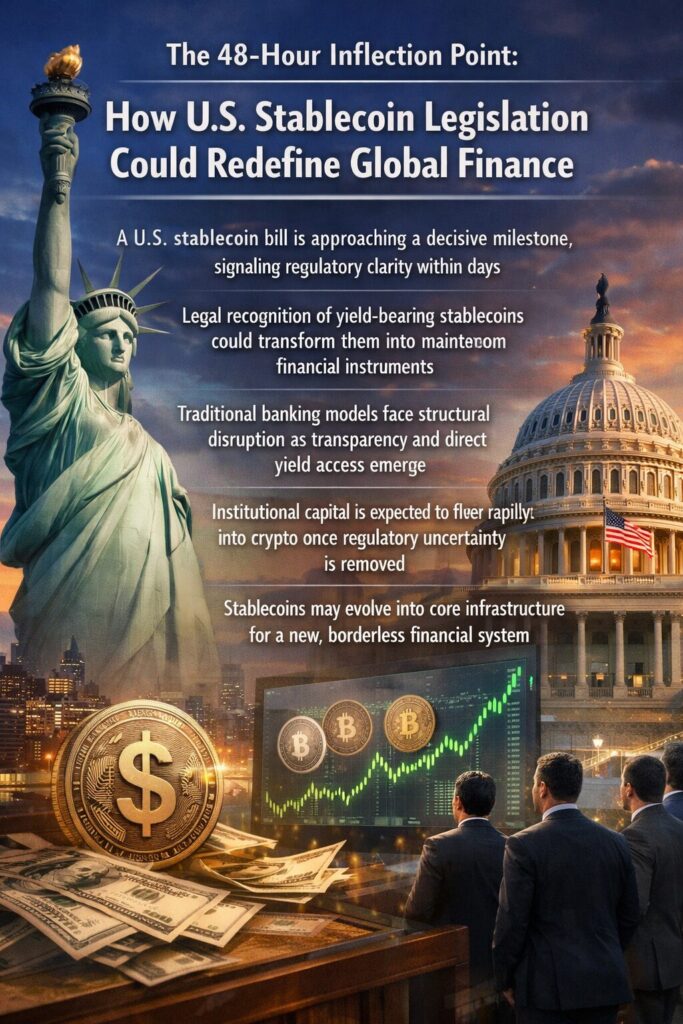
- A U.S. stablecoin bill is approaching a decisive milestone, signaling regulatory clarity within days
- Legal recognition of yield-bearing stablecoins could transform them into mainstream financial instruments
- Traditional banking models face structural disruption as transparency and direct yield access emerge
- Institutional capital is expected to flow rapidly into crypto once regulatory uncertainty is removed
- Stablecoins may evolve into core infrastructure for a new, borderless financial system
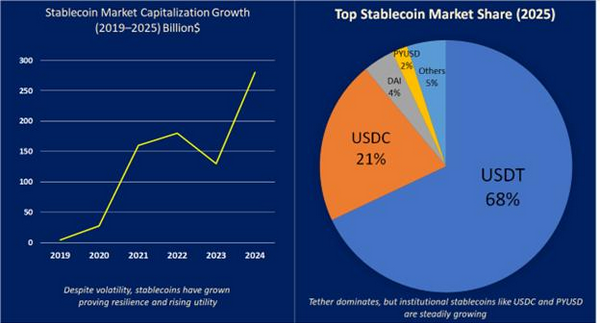
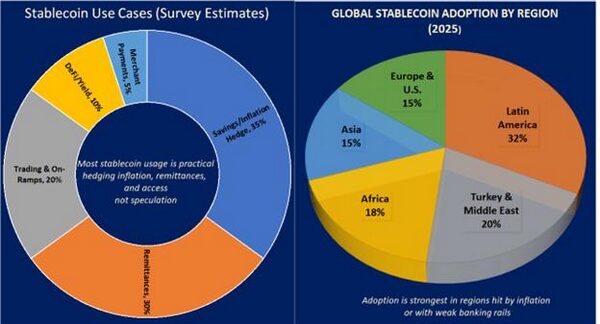
Stablecoin Market Growth vs Traditional Banking Deposits (Illustrative)
Introduction: A Countdown That Signals More Than Regulation
The announcement that U.S. stablecoin legislation could reach a decisive stage within 48 hours has sent shockwaves across the crypto industry. While such deadlines are often symbolic, this moment represents something fundamentally different: the transition from regulatory ambiguity to enforceable clarity.
For years, stablecoins have operated in a gray zone—widely used, yet loosely governed. This ambiguity has constrained institutional participation and limited the full potential of blockchain-based financial systems. Now, that constraint appears to be dissolving.
This is not merely about passing a law. It is about aligning legal frameworks with programmable finance—where code, compliance, and capital operate in synchronization. If realized, this shift could redefine not only crypto markets but the very structure of global finance.
1. Regulatory Clarity: The Missing Piece of Crypto’s Evolution
From Legal Uncertainty to Structured Legitimacy
Stablecoins, particularly those pegged to the U.S. dollar, have become essential tools in the crypto ecosystem. They facilitate trading, remittances, and decentralized finance (DeFi) applications. Yet their legal status has remained inconsistent across jurisdictions.
The proposed U.S. legislation aims to establish clear rules regarding:
- Reserve backing requirements
- Issuance standards
- Transparency and auditing obligations
- Yield generation mechanisms
Such clarity is critical. Institutional investors—ranging from asset managers to banks—require legal certainty before deploying significant capital. Without it, even the most promising financial innovation remains sidelined.
Global Ripple Effects
The United States has historically set financial standards that ripple across the globe. If it establishes a clear regulatory framework for stablecoins, other jurisdictions are likely to follow.
This creates a cascading effect:
- Regulatory harmonization across markets
- Increased interoperability between financial systems
- Accelerated adoption of blockchain infrastructure
In this sense, the legislation is not just national policy—it is a global signal.
2. The Rise of Yield-Bearing Stablecoins
From Passive Storage to Active Income
Traditionally, stablecoins have functioned as digital cash equivalents—tools for preserving value rather than generating it. However, recent developments suggest a shift toward yield-bearing models.
Under a clear legal framework, stablecoin issuers may be able to:
- Generate yield from underlying reserves (e.g., U.S. Treasury bills)
- Share a portion of that yield with holders
- Offer transparent, on-chain accounting of returns
This transforms stablecoins into income-generating assets.
Yield Comparison: Banks vs Stablecoins
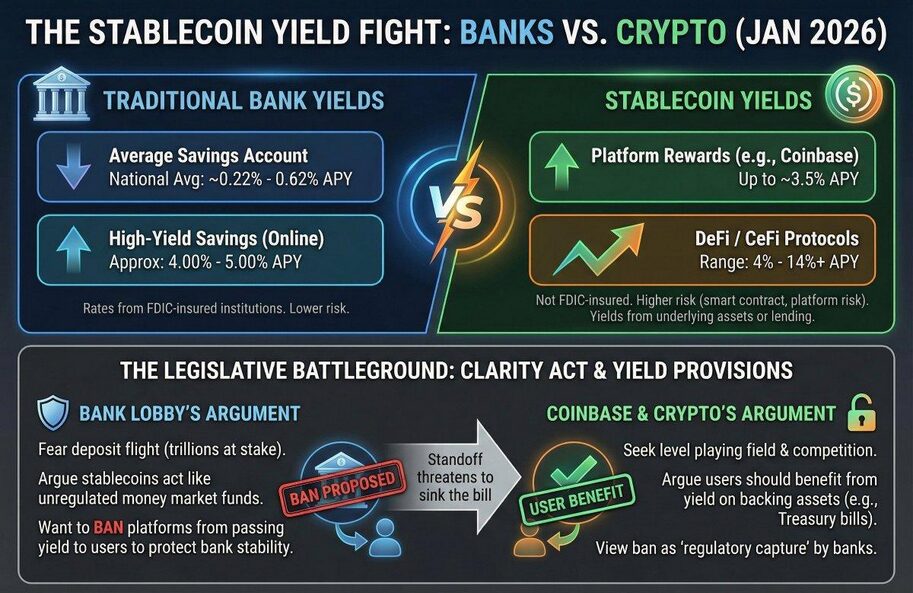
In contrast to traditional banks—where depositors often receive minimal interest while institutions capture the majority of returns—stablecoins could democratize yield distribution.
This is a structural shift. It challenges one of the core assumptions of modern banking: that intermediaries control access to financial returns.
3. Disrupting Traditional Banking Models
Transparency vs Opacity
Traditional banking systems rely on layered intermediation. Deposits are pooled, leveraged, and allocated across opaque financial structures. While regulated, these processes often lack real-time transparency.
Stablecoins introduce a different paradigm:
- On-chain verification of reserves
- Real-time settlement
- Programmable financial logic
This reduces the need for intermediaries and increases user control.
Direct Ownership and Control
With stablecoins, users can:
- Hold assets directly in digital wallets
- Transfer value globally without banking infrastructure
- Access yield without relying on centralized institutions
This model aligns with broader trends in decentralized finance, where users increasingly demand autonomy and transparency.
4. Institutional Capital: The Floodgates Open
From Hesitation to Acceleration
Institutional investors have long expressed interest in crypto—but regulatory uncertainty has been a major barrier. Once that barrier is removed, capital inflows could accelerate dramatically.
Key drivers include:
- Compliance-ready investment vehicles
- Reduced legal risk
- Integration with existing financial systems
Major players—including asset managers, hedge funds, and even sovereign entities—are likely to increase exposure to stablecoins and related infrastructure.
Market Impact
The influx of institutional capital could lead to:
- Increased market liquidity
- Reduced volatility in stablecoin ecosystems
- Expansion of DeFi and tokenized asset markets
This is not speculative—it mirrors patterns seen in previous financial innovations once regulatory clarity was achieved.
5. A New Financial Infrastructure Emerges
Code Meets Law
The convergence of legal frameworks and blockchain technology creates a powerful synergy. In this model:
- Smart contracts enforce financial logic
- Regulations define permissible structures
- Transparency ensures accountability
This hybrid system could outperform traditional finance in efficiency, scalability, and accessibility.
Borderless Capital Flows
Stablecoins inherently operate without geographic constraints. When combined with legal recognition, they enable:
- Seamless cross-border transactions
- Reduced reliance on correspondent banking networks
- Faster and cheaper global payments
This has profound implications for emerging markets and global trade.
6. Strategic Implications for Investors and Builders
For Investors
The shift toward regulated, yield-bearing stablecoins presents new opportunities:
- Stable, low-volatility income streams
- Exposure to blockchain infrastructure growth
- Participation in early-stage financial transformation
However, risks remain, including regulatory changes, issuer reliability, and market dynamics.
For Builders
Developers and entrepreneurs can leverage this transition to:
- Build compliant financial applications
- Integrate stablecoin payments into existing systems
- Create new business models around yield distribution
This is particularly relevant for platforms like non-custodial wallets, payment systems, and cross-border services.
Conclusion: Beyond 48 Hours—A Structural Shift in Finance
The 48-hour countdown is not just a regulatory milestone—it is a symbolic moment marking the convergence of law, technology, and capital.
If the U.S. successfully establishes a clear framework for stablecoins, the implications will extend far beyond its borders. We may witness:
- The transformation of stablecoins into core financial infrastructure
- The erosion of traditional banking monopolies
- The emergence of a more transparent, efficient, and inclusive financial system
For those seeking new crypto assets, income opportunities, and practical blockchain applications, this is not a moment to observe passively. It is a moment to engage, analyze, and position strategically.
The future of finance is not being debated—it is being built. And this time, it may be codified in both law and code.
