
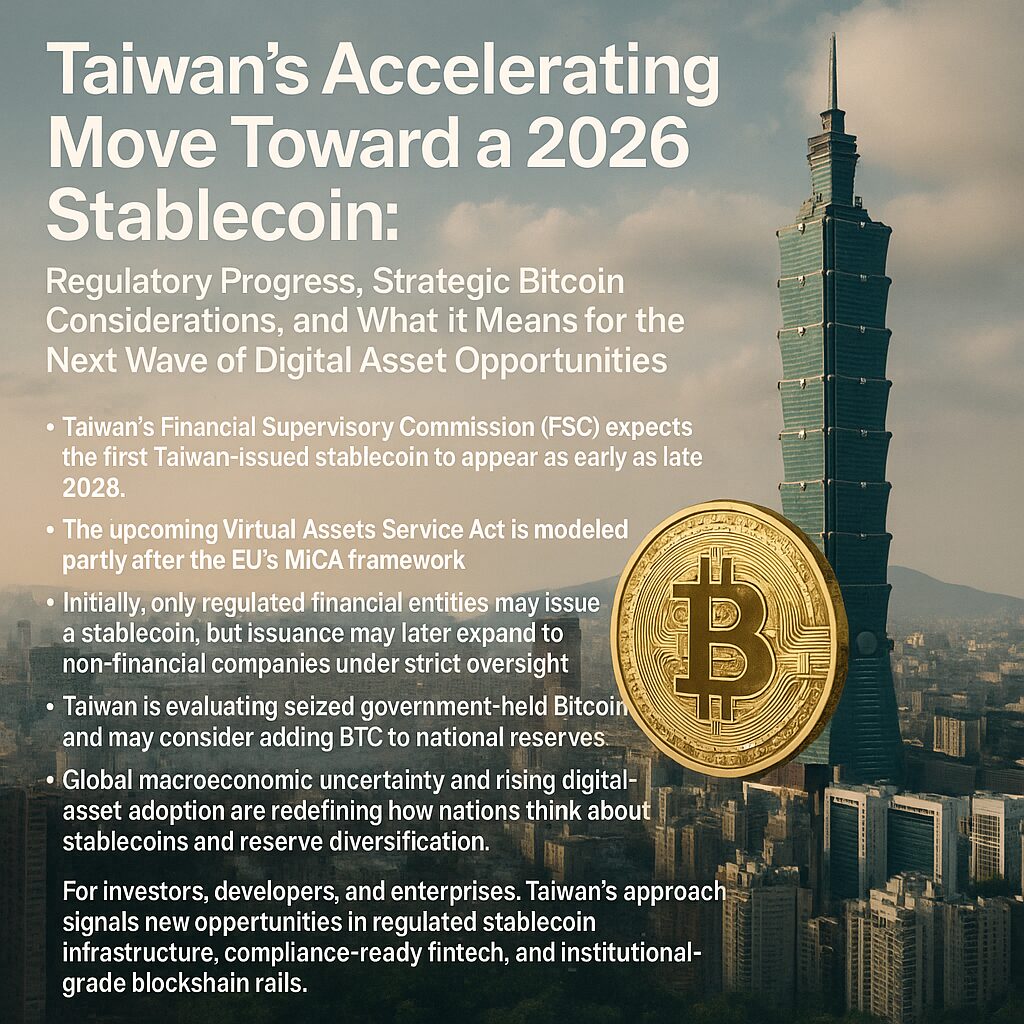
Main Points :
- Taiwan’s Financial Supervisory Commission (FSC) expects the first Taiwan-issued stablecoin to appear as early as late 2026.
- The upcoming Virtual Assets Service Act is modeled partly after the EU’s MiCA framework.
- Initially, only regulated financial entities may issue a stablecoin, but issuance may later expand to non-financial companies under strict oversight.
- Taiwan is evaluating seized government-held Bitcoin and may consider adding BTC to national reserves.
- Global macroeconomic uncertainty and rising digital-asset adoption are redefining how nations think about stablecoins and reserve diversification.
- For investors, developers, and enterprises, Taiwan’s approach signals new opportunities in regulated stablecoin infrastructure, compliance-ready fintech, and institutional-grade blockchain rails.
1. Introduction: Taiwan Steps Into the Regulated Stablecoin Era
Over the past several years, Taiwan has taken a cautious approach toward cryptocurrency activity, largely focusing on anti–money laundering enforcement and consumer protection. Yet 2024–2026 marks a noticeable shift: regulators are preparing a comprehensive legal foundation for virtual assets, and for the first time, the country is openly considering issuing a domestically regulated stablecoin.
According to statements from FSC Chairman Peng Jin-long, the legislative timeline suggests that late 2026 may become the earliest window for a Taiwanese stablecoin to enter the market. This aligns with a broader global trend—Japan, Hong Kong, Singapore, the UAE, the EU, and the US are all finalizing frameworks for regulated stablecoins that integrate seamlessly with traditional banking systems.
2. Taiwan’s Legislative Roadmap Toward a Regulated Stablecoin
The key legislative instrument enabling Taiwan’s stablecoin ambitions is the Virtual Assets Service Act, scheduled for passage in the upcoming legislative session. After passage, the law includes a six-month transition period for industry compliance.
Under this framework, Taiwan will create a licensing and supervisory regime that mirrors MiCA, Europe’s landmark crypto regulatory package. This is a critical distinction: MiCA is designed to ensure high-quality reserves, strict governance, operational transparency, and consumer protection for any asset-referenced token or e-money token (stablecoin).
Taiwan intends to import this logic, meaning the resulting stablecoin ecosystem will likely feature:
- Fully disclosed and audited reserves
- Clear redemption rights for users
- Issuer governance rules
- Capital adequacy and liquidity requirements
- Segregated custodial arrangements
Although Chairman Peng suggested that the law may eventually allow non-financial institutions to issue stablecoins, the initial system will limit issuance to regulated entities supervised by the FSC and Taiwan’s Central Bank. This conservative stance is consistent with MiCA’s tiered approach, where issuance privileges expand only after supervisory confidence is established.
3. Taiwan’s Stablecoin Vision: TWD-Pegged, USD-Pegged, or Multi-Currency?
As of December 2024, no regulated institution in Taiwan has issued a stablecoin pegged to either USD or TWD. Yet Taiwan’s future model could include:
(1) A TWD-pegged domestic stablecoin
- Enables merchant payments
- Facilitates Web3 remittances and digital banking
- Supports tokenized asset settlement
- Reduces dependency on foreign stablecoins, especially USDC and USDT
(2) A USD-backed stablecoin issued under Taiwanese regulation
- Aligns with Taiwan’s significant USD flows and export-driven economy
- Creates competition with offshore issuers such as Circle and Tether
(3) Institutional-grade stablecoins for cross-border B2B flows
This reflects global demand for programmable money in:
- Trade finance
- Treasury management
- On-chain FX
- Digital securities settlement
For Web3 builders, exchanges, remittance services, and enterprise platforms (such as your EMI + VASP ecosystem), these developments point directly to new integration opportunities, especially in FX markets, tokenized deposits, and compliance-ready payment rails.
4. Taiwan Also Evaluates Bitcoin for National Reserves: A Strategic Shift
One of the most surprising developments in 2024 was the announcement that Taiwanese officials are evaluating all government-seized BTC holdings. This immediately triggered speculation: Is Taiwan preparing to add Bitcoin to its official reserve portfolio?
Why This Matters
Taiwan’s foreign exchange reserves exceed $560 billion USD, heavily concentrated in:
- US Treasuries
- Gold
- Foreign currency securities
At a time when central banks around the world are reassessing geopolitical and macroeconomic risks, diversifying reserves with a non-sovereign digital asset like Bitcoin has become a legitimate policy discussion—not only in Taiwan but also in the US, El Salvador, and several EU nations.
Legislator Chiu Shu-wei publicly urged the government to add BTC as a hedge against uncertainty, illustrating that this debate is moving from the fringes to mainstream policymaking.
5. Global Context: Why Stablecoins and BTC Reserves Matter in 2025–2026
The last two years have produced multiple signals:
1. Institutional adoption is accelerating
- BlackRock, Fidelity, and major asset managers have launched Bitcoin ETFs.
- Banking institutions are piloting tokenized deposits.
- The EU implemented MiCA; Singapore and Hong Kong introduced stablecoin rules.
2. US crypto policy is evolving rapidly
The US Treasury and Federal Reserve are preparing a more structured approach to stablecoin regulation, inevitably influencing Asian markets such as Taiwan.
3. Stablecoins dominate real crypto use cases
Over $120 billion USD circulates in global stablecoins, outperforming DeFi, gaming, and NFTs in transaction volume.
4. Bitcoin is increasingly seen as macro infrastructure
- A hedge against inflation
- A geopolitical diversification tool
- A digital native reserve asset for the 21st century
Taiwan’s consideration of both stablecoin issuance and BTC reserves places the nation squarely within this global movement.
6. Market Implications for Crypto Investors and Builders
Taiwan’s entry into regulated stablecoin issuance is not merely a domestic policy story—it changes the competitive dynamics across Asia.
Opportunities for Investors
- A regulated TWD-stablecoin creates cross-border arbitrage and FX-hedged yield opportunities.
- Taiwan’s potential BTC reserve strategy may increase regional institutional demand.
- Enterprise adoption of compliant stablecoins will expand the market for B2B blockchain solutions.
Opportunities for Exchanges, Wallets, and VASPs
- New listing demand for TWD-backed or Taiwan-regulated stablecoins
- API-driven settlement solutions for merchants and fintechs
- Regulated custody integration and on-chain proof-of-reserves requirements
Opportunities for Developers
- Smart-contract payment rails
- Tokenized assets (bonds, deposits, trade receivables)
- Cross-chain stablecoin bridges
- Compliance modules (Travel Rule, VASP supervision, AML risk scoring)
Your ecosystem—involving EMI, VASP, XXI token, and multi-asset payment infrastructure—aligns naturally with these coming developments.
7. Conceptual Chart Illustration

This timeline visualizes the projected stages: drafting → legislation → industry preparation → potential stablecoin launch in late 2026.
8. Conclusion: Taiwan Is Preparing for a Regulated Digital Currency Future
Taiwan’s emerging regulatory framework—modeled after MiCA and reinforced through the Virtual Assets Service Act—marks a serious commitment to shaping the future of digital finance. A domestically issued stablecoin, combined with discussions around Bitcoin reserve strategies, positions the nation to integrate blockchain into mainstream financial infrastructure.
For investors, builders, and enterprises across Asia, the message is clear:
Regulated digital assets are becoming national-level infrastructure.
Taiwan’s 2026 stablecoin initiative is not an isolated event but a strategic step in the global transformation of money, payments, and sovereign economic resilience. Those preparing now—across compliance, technical, and product layers—will capture the earliest and strongest opportunities as the Taiwanese market opens.
