

Key Takeaways :
- Standard Chartered is preparing to launch a crypto prime brokerage service for institutional investors, signaling a new phase of bank-led crypto infrastructure.
- By placing the business under its venture arm, SC Ventures, the bank can significantly reduce Basel III capital burdens.
- Prime brokerage for crypto goes far beyond custody, combining financing, execution, clearing, and balance-sheet efficiency.
- The move aligns with Standard Chartered’s bullish outlook on Ethereum, tokenized real-world assets (RWA), and stablecoins.
- This development reflects a broader trend: traditional global banks are quietly rebuilding crypto markets from the institutional core.
Introduction: A Quiet but Structural Shift
In mid-January 2026, Bloomberg reported that Standard Chartered, one of the world’s largest international banks with approximately $850 billion in total assets, is preparing to enter the crypto prime brokerage business for institutional clients. While the announcement itself was cautious and still at an early planning stage, its implications are anything but minor.
Prime brokerage is not a retail-facing service. It is the backbone of institutional trading, enabling hedge funds, asset managers, and proprietary trading firms to operate efficiently at scale. When a global bank like Standard Chartered moves into this domain, it suggests that digital assets are no longer being treated as an experimental side business, but as a permanent part of global financial infrastructure.
This article examines why this move matters, how regulatory capital constraints shape the strategy, and what it means for investors, market structure, and the future of blockchain-based finance.
What Is Crypto Prime Brokerage?
Prime brokerage traditionally refers to a bundled set of financial services offered by large banks to institutional investors. These services include:
- Asset custody
- Securities lending and financing
- Trade execution and clearing
- Collateral management
- Risk reporting and operational support
In the crypto context, prime brokerage performs a similar role but with added complexity. Digital assets trade 24/7, settle on-chain, and span multiple blockchains and venues. Institutional investors need a single counterparty that can abstract this complexity while maintaining regulatory-grade compliance and risk controls.
Crypto prime brokers effectively become the operating system for institutional crypto trading.
Why Standard Chartered Is Using SC Ventures
One of the most important details in Bloomberg’s report is that the new business will be housed under SC Ventures, Standard Chartered’s venture and innovation subsidiary.
This is not a branding choice. It is a regulatory optimization.
Basel III Capital Constraints
Under current Basel III rules:
- Direct holdings of cryptocurrencies such as Bitcoin or Ethereum carry a 1,250% risk weight.
- This means banks must set aside capital equal to the full value of the exposure, making balance-sheet usage extremely inefficient.
- By contrast, venture investments typically carry risk weights closer to 400%.
By placing crypto-related activities under a venture structure, Standard Chartered can dramatically improve capital efficiency without violating regulatory frameworks.
【Basel III Risk Weight Comparison】
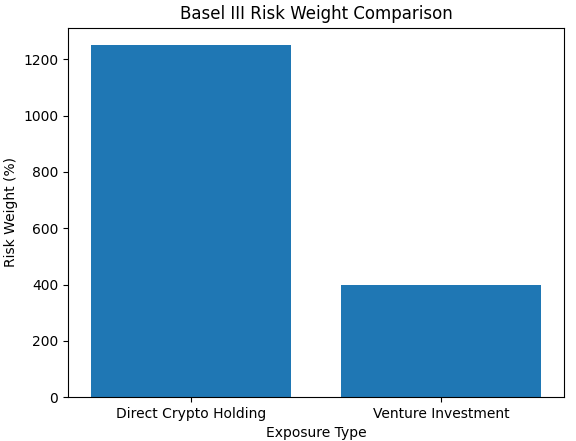
This structural workaround illustrates a broader reality: regulation is not preventing banks from entering crypto—it is shaping how they do it.
Strategic Context: Not Standard Chartered’s First Crypto Move
This initiative does not come out of nowhere. Standard Chartered has been systematically building digital asset exposure over several years.
The bank has:
- Participated in crypto custody initiatives.
- Been selected as a custodian partner for institutional crypto products, including those linked to firms like 21Shares.
- Published some of the most aggressive institutional crypto forecasts among global banks.
This prime brokerage plan is best understood as the missing middle layer—connecting custody, trading, and financing into a single institutional service stack.
A Bullish View on Ethereum and Tokenization
Standard Chartered’s digital asset research team, led by Geoff Kendrick, has been notably optimistic about Ethereum and blockchain-based financial infrastructure.
According to Kendrick:
- Ethereum could reach $7,500 by the end of 2026.
- Longer term, Ethereum could approach $40,000 by 2030, driven by its role as the settlement layer for tokenized finance.
More importantly, the bank forecasts explosive growth in real-world asset (RWA) tokenization.
- Current RWA market size: approximately $35 billion
- Projected by 2028: $2 trillion
【Projected Growth of Tokenized Real-World Assets (RWA)】
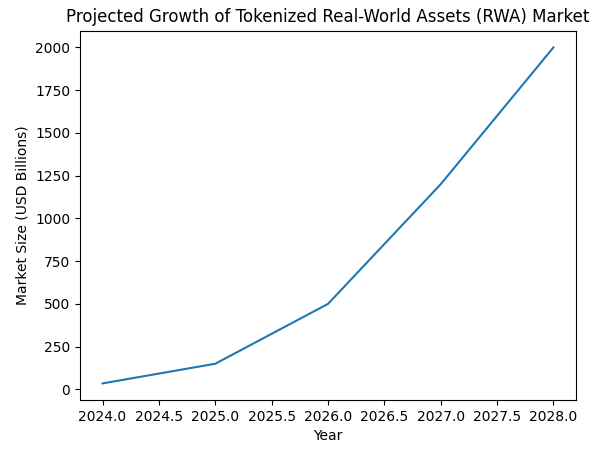
This is not speculation-driven growth. It is based on:
- Tokenized bonds and funds
- On-chain collateralized lending
- Institutional settlement using blockchain rails
Crypto prime brokerage is a necessary infrastructure layer to support this expansion.
Stablecoins: The Liquidity Layer Banks Actually Want
In parallel, Standard Chartered projects that the stablecoin market could also reach $2 trillion by 2028.
Stablecoins serve as:
- Settlement currency for on-chain trading
- Liquidity bridges between fiat and crypto
- Collateral for derivatives and structured products
【Projected Growth of the Stablecoin Market】
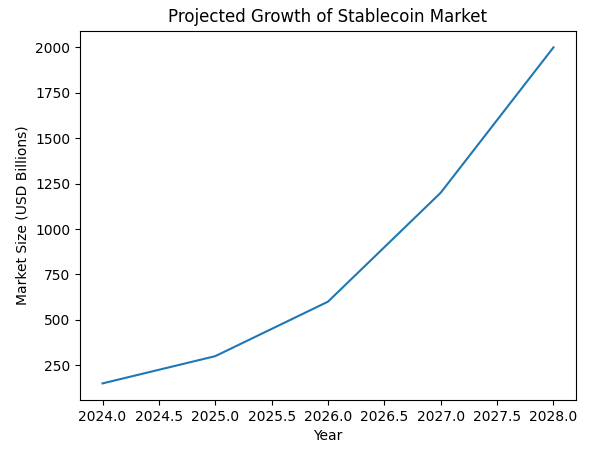
For banks, stablecoins are far more attractive than volatile assets. They resemble programmable cash and fit naturally into treasury, payments, and clearing systems. A crypto prime broker without stablecoin integration would be operationally incomplete.
Why This Matters for Investors and Builders
For readers looking for new crypto assets, next revenue opportunities, or practical blockchain use cases, this development carries several implications:
- Institutional demand is infrastructure-driven
The next wave of capital flows will prioritize custody, liquidity, and compliance—not hype. - Ethereum and RWA ecosystems benefit structurally
Banks are building around Ethereum because it already functions as a financial settlement layer. - Opportunities shift from tokens to services
Prime brokerage, custody tech, compliance tooling, and liquidity management become high-value businesses. - Regulation is becoming a moat
Firms that can operate within Basel III and banking-grade controls gain a durable advantage.
A Broader Industry Trend
Standard Chartered is not alone. Other global banks are quietly exploring similar structures:
- Separating crypto activities into subsidiaries or ventures
- Focusing on prime services rather than retail trading
- Integrating blockchain rails without holding volatile assets directly
This marks a transition from the “crypto vs banks” narrative to a layered coexistence model, where traditional finance adopts blockchain infrastructure on its own terms.
Conclusion: Crypto’s Institutional Phase Has Begun
Standard Chartered’s planned entry into crypto prime brokerage is not about chasing short-term trading volume. It is about owning infrastructure at a time when digital assets are converging with global finance.
By leveraging SC Ventures, navigating Basel III constraints, and aligning with long-term theses around Ethereum, RWA, and stablecoins, the bank is positioning itself for a future where blockchain is not an alternative system—but a core one.
For investors, builders, and institutions, the message is clear:
The next phase of crypto growth will be quieter, more regulated, and far more structural than anything that came before.
