
Key Points :
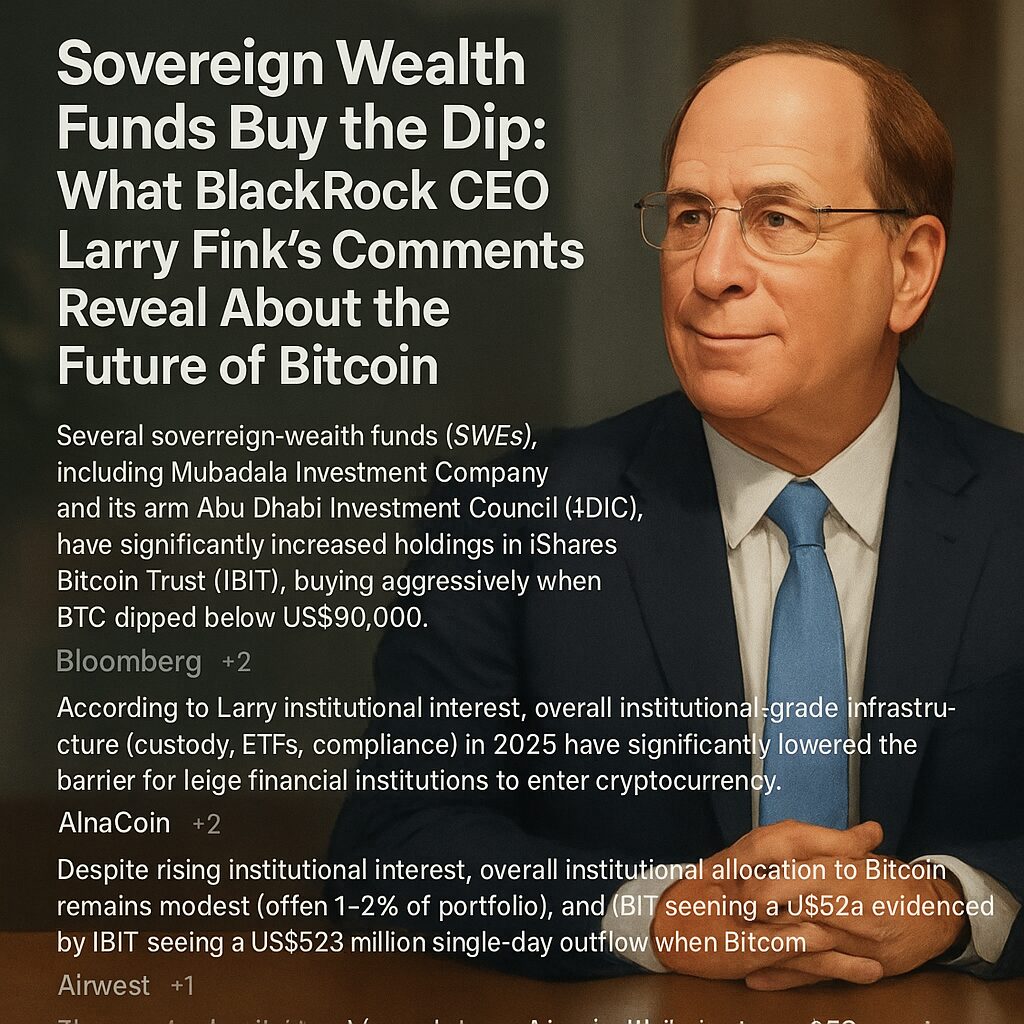
- Several sovereign-wealth funds (SWFs), including Mubadala Investment Company and its arm Abu Dhabi Investment Council (ADIC), have significantly increased holdings in iShares Bitcoin Trust (IBIT), buying aggressively when BTC dipped below US$90,000.
- According to Larry Fink (CEO of BlackRock), these purchases were not short-term trades but long-term strategic investments — a sign institutional sentiment toward BTC is shifting from speculation to strategic allocation.
- Regulatory clarity and matured institutional-grade infrastructure (custody, ETFs, compliance) in 2025 have significantly lowered the barrier for large financial institutions to enter cryptocurrency.
- Despite rising institutional interest, overall institutional allocation to Bitcoin remains modest (often 1–2% of portfolio), and volatility remains a risk — evidenced by IBIT seeing a US$523 million single-day outflow when Bitcoin dipped below US$90,000.
- The growing institutional footprint, combined with limited new BTC supply (due to halving cycles), suggests potential for future Bitcoin price appreciation — but also underscores that timing and volatility remain critical for investors.
Institutional Bitcoin Buying: From the Shadows to Center Stage
In a recent public statement at the DealBook Summit on December 3, 2025, BlackRock’s CEO Larry Fink highlighted a remarkable shift in the behavior of sovereign-wealth funds. According to Fink, several state-backed funds had stepped in to buy Bitcoin — not as speculative trades, but as long-term positions. He stated that these funds had purchased Bitcoin when its price fell below US$120,000, US$100,000 and even around US$80,000 — essentially “buying the dip.” This is a departure from the common narrative that sovereign funds, being conservative by nature, would avoid highly volatile assets like cryptocurrencies.
Fink’s comments reflect a broader transformation: Bitcoin is being increasingly viewed not as a volatile speculation, but as a potential inflation hedge and store-of-value — similar to gold. That framing, combined with the growing institutional acceptance, underscores a changing mindset among large, risk-aware investors.
What the Data Shows: Growing Institutional Exposure via ETFs
Mubadala and ADIC’s Aggressive Accumulation
Throughout 2025, Mubadala (and by extension ADIC) has repeatedly increased its holdings in BlackRock’s iShares Bitcoin Trust (IBIT). According to SEC filings and public reports: as of March 31, 2025, Mubadala held 8.7269 million shares of IBIT — up from 8.2355 million at the end of 2024.
By the end of the third quarter, ADIC’s holdings had swelled to nearly 8 million shares — worth about US$518 million as of September 30, 2025.
These purchases took place just months before a major rally (Bitcoin reaching roughly US$126,000 in early October) and subsequent drawdowns. That timing suggests these are not tactical trades, but committed long-term allocations.
Institutional Flows + ETF Growth
As of mid-2025, IBIT had become the largest spot-Bitcoin ETF in the world, controlling tens of billions in assets.
ETFs like IBIT provide regulated — and thus institutionally palatable — exposure to Bitcoin, wrapping the underlying crypto in familiar financial instruments. This helps circumvent many of the barriers (custody, compliance, accounting) that previously deterred asset managers from holding crypto directly.
However, institutional activity has not been universally bullish. Some hedge funds and asset managers trimmed their ETF holdings during Q1 2025 amid a roughly 12% drop in Bitcoin’s price. For instance, one well-known manager slashed its IBIT position by 41%.
This divergence underscores that while a growing number of institutions see long-term value in Bitcoin, many still treat it as a tactical, risk-managed investment.
Why 2025 Is a Turning Point for Institutional Crypto
Several converging factors have turned 2025 into an inflection point for broad institutional crypto adoption:
- Regulatory Clarity
With landmark regulatory developments in both the U.S. and Europe, institutional investors now face fewer legal/compliance uncertainties. This shift allows them to treat Bitcoin not as a speculative fringe asset, but as a legitimate allocation in diversified portfolios. - Mature Crypto Infrastructure
Institutional-grade custody solutions, compliance frameworks, and ETF vehicles have matured — enabling secure, compliant, and scalable entry into crypto. That infrastructure reduces the “operational friction” that previously kept many traditional asset managers away. - Supply Constraints + Demand Potential
With Bitcoin’s fixed supply (capped at 21 million coins) and halving cycles reducing new issuance, there is growing scarcity — even as institutional demand begins to rise. Some forecasts suggest that modest allocations (e.g., 2–3% of global institutional portfolios) could result in US$3–4 trillion flowing into crypto over the next several years.
This supply-demand imbalance could materially support future price appreciation, especially if institutions continue accumulating. - Portfolio Diversification and Inflation Hedging
Inflation, government debt, currency debasement — all macroeconomic pressures that many institutional investors now face — make Bitcoin an increasingly attractive “digital gold.” That framing resonates with conservative investors seeking to hedge macro risks over the long term. Fink emphasized this narrative in his remarks.
The Risks and Realities: Why Caution Still Applies
Despite growing institutional adoption, several important caveats remain:
- Volatility remains high. Even when invested through regulated ETFs like IBIT, Bitcoin’s price remains subject to dramatic swings. For example, a single-day institutional outflow of US$523 million occurred when BTC dipped below US$90,000.
- Allocation limits. Many sovereign-wealth funds appear to cap Bitcoin exposure at a small fraction of their total portfolio (commonly 1–2%). This suggests they view Bitcoin as a hedge or diversifier — not a core holding.
- Regulatory and custody risks persist. While infrastructure has improved, regulatory fragmentation (different jurisdictions, varying policies) and potential custody issues remain a concern among conservative investors.
- Correlation with risk assets. As more institutional money enters crypto, Bitcoin’s behavior is becoming more correlated with traditional risk assets (e.g., equities), which may reduce its effectiveness as a “safe haven.”
What This Means for Investors, Crypto-Hunters, and Web3 Practitioners
For those hunting new crypto opportunities, seeking yield, or building real-world blockchain applications, the current environment presents both opportunity and caveats:
- The growing participation of SWFs and asset managers — via regulated ETFs — reinforces Bitcoin’s status as a legitimate, long-term asset. For investors, that could increase confidence in holding BTC or related instruments.
- At the same time, volatility and concentration risk remain — so careful sizing, risk management, and long-term perspective are crucial.
- For builders in Web3, the influx of institutional capital may accelerate infrastructure development (custody, compliance, tokenization), which could improve liquidity, stability, and adoption of crypto-native applications.
- However, increased institutional linking also means Bitcoin’s behavior may become more “mainstream” — perhaps more correlated with equities and broader macro trends — which could reduce some of its diversification benefits.
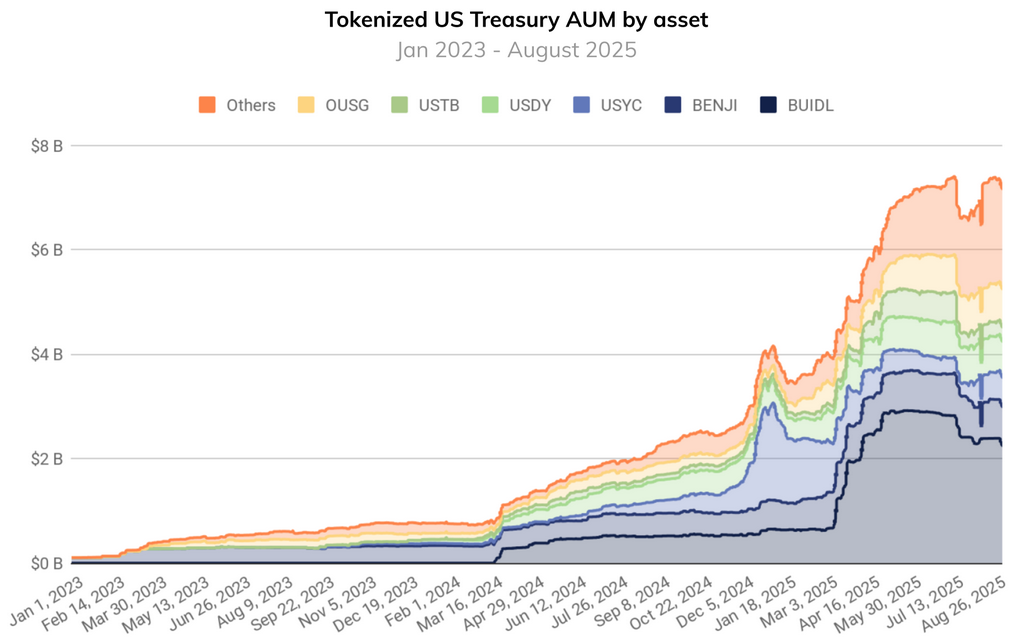
This visual illustrates Bitcoin’s price movement through 2025 — including the dips below US$90,000 (buy zones), the rally to over US$126,000 in early October, and the growing institutional holdings of Bitcoin ETFs like IBIT over the same period. It helps frame the narrative that major funds were accumulating during dips, not chasing the hype at peaks.
Conclusion
The remarks from BlackRock’s Larry Fink, coupled with real-world data showing significant accumulation by sovereign-wealth funds, signal a turning point: Bitcoin is evolving from a speculative fringe asset into a component of diversified, long-term institutional portfolios.
That said, this transition is still in its early innings. Institutional allocations remain modest, volatility remains high, and the long-term path depends on regulatory clarity, macroeconomic conditions, and infrastructure maturity.
For investors and practitioners in the crypto and Web3 space, this moment presents a unique window of opportunity — but one that demands discipline, long-term thinking, and careful risk management. As Bitcoin becomes more mainstream, its role may shift from a speculative rocket fuel to a strategic building block — potentially forming the backbone of a broader, regulated, institutional-grade crypto economy.
