
Main Points :
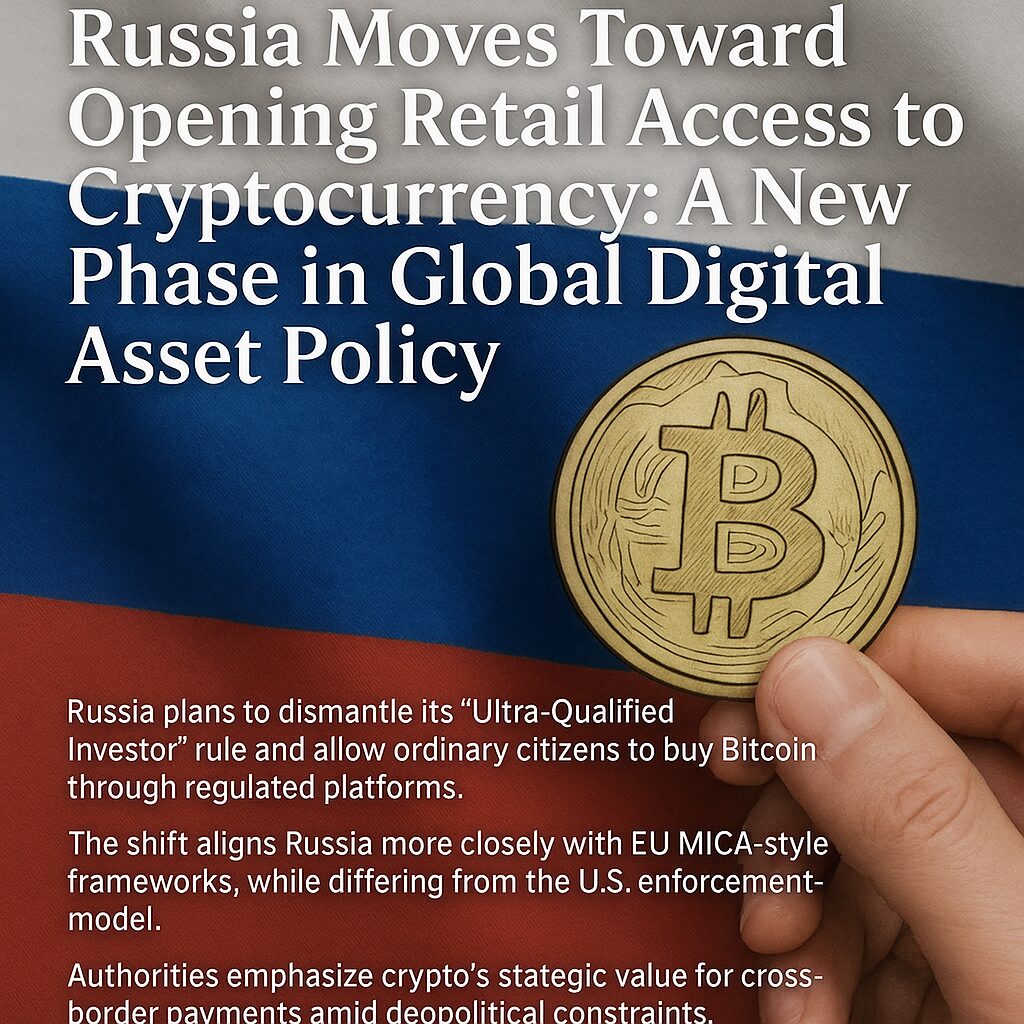
- Russia plans to dismantle its “Ultra-Qualified Investor” rule and allow ordinary citizens to buy Bitcoin through regulated platforms.
- The shift aligns Russia more closely with EU MiCA-style frameworks, while differing from the U.S. enforcement-driven model.
- Authorities emphasize crypto’s strategic value for cross-border payments amid geopolitical constraints.
- A tiered-access model based on experience and financial knowledge is under consideration, replacing the current wealth-based barrier.
- The move could unlock new investment flow and expand crypto adoption within Russia’s retail market.
1. Introduction: A Turning Point for Russian Retail Crypto Investors
Russia is preparing to make one of its most significant shifts in cryptocurrency policy since digital assets first emerged. According to statements from First Deputy Governor Vladimir Chistyukhin, the Bank of Russia is considering the removal of its strict “Ultra-Qualified Investor” (UQI) requirement—rules that currently restrict spot cryptocurrency purchases to only the wealthiest segment of the population.
If implemented, this change could reshape Russia’s domestic crypto market and align the country with global trends that increasingly acknowledge digital assets as part of the financial mainstream.
The timing is notable: geopolitical tensions, sanctions pressure, and the need for alternative cross-border payment mechanisms have accelerated Russia’s exploration of regulated digital asset channels. The proposed framework would shift crypto from a tool accessible only through informal offshore exchanges into a regulated, government-supervised investment pathway.
2. Understanding the Ultra-Qualified Investor Rule
Russia introduced the UQI classification in early 2025, requiring:
- Net assets of at least ₽100 million (approximately $1.1 million)
- Annual income of at least ₽50 million (around $550,000)
These thresholds limited cryptocurrency access to a small elite, excluding the vast majority of retail investors. In contrast, most developed markets allow crypto transactions under regulated conditions without such extreme wealth requirements.
Russia’s new direction is rooted in the recognition that digital assets, particularly Bitcoin, have become increasingly relevant for both private investment and international banking alternatives. Removing the UQI restriction would finally allow everyday Russian citizens to use licensed, regulated platforms rather than unofficial peer-to-peer markets.
3. Why Russia Is Shifting: Cross-Border Payments and Economic Strategy
Deputy Governor Chistyukhin emphasized that crypto’s role in international settlement frameworks is becoming strategically important.
Russia faces constraints on traditional financial rails due to sanctions and geopolitical pressures. Crypto, while volatile, offers an alternative mechanism that is:
- Borderless
- Resistant to external political controls
- Flexible for bilateral or multilateral settlement structures
By integrating crypto more deeply into regulated finance, Russia aims to develop secure rails for cross-border transactions while maintaining its supervisory authority.
The Central Bank expects to reach an agreement with the Ministry of Finance by the end of December, signaling that the regulatory shift is rapidly moving toward finalization.
4. A Tiered Access Model: From Wealth Test to Knowledge Test
The Russian government has indicated that the new system will not simply open the doors without restrictions. Instead, it will likely introduce tiered market-entry levels, based on:
- Investment experience
- Risk tolerance
- Financial literacy
This approach resembles regulatory systems in jurisdictions that categorize investors by competency rather than wealth. It ensures that individuals understand the risks associated with digital asset markets before participating at higher levels of exposure.
If adopted, Russia’s model would resemble a hybrid between Europe’s MiCA transparency framework and Asia’s tier-based investor protection standards, while avoiding the U.S. model’s dependence on complex securities categorization.
5. Comparing Russia With the EU and the U.S.
EU (MiCA Framework)
MiCA provides a unified licensing standard for exchanges and custodians. Requirements include:
- AML/KYC compliance
- Clear consumer disclosures
- Operational risk frameworks
- Capital adequacy standards
Retail investors in the EU are allowed to buy Bitcoin freely, provided the service provider is licensed.
United States (SEC/CFTC Enforcement Model)
The U.S. lacks a dedicated crypto law and instead relies on:
- Securities Act
- Commodity Exchange Act
- Enforcement actions and legal interpretations
Retail access exists, but uncertainty persists due to inconsistent asset classification and platform compliance obligations.
Russia’s Position
Russia appears to be aiming for:
- More openness than the U.S.
- More control and strategic oversight than the EU
- A shift away from elite-only access toward regulated democratization
If implemented, Russia could create one of the world’s most interesting hybrid regulatory environments—mixing accessibility with state oversight.
6. Potential Market Impact: Investment Expansion and New Opportunities
Allowing retail crypto access within a regulated environment may trigger several economic effects:
1. Growth of Domestic Crypto Demand
Russia has one of the world’s largest populations of technologically literate retail investors.
Opening the market could dramatically increase Bitcoin and altcoin adoption, similar to what occurred in emerging European markets after regulation matured.
2. Reduced Reliance on Offshore Exchanges
Many Russian users currently trade through informal or foreign platforms—often without adequate consumer protection.
Regulated domestic options could redirect billions of dollars in annual trading volume back into Russia’s financial ecosystem.
3. Expansion of Crypto-Based Payment Mechanisms
Businesses engaged in international trade may leverage digital assets to mitigate cross-border restrictions.
4. Increased Interest in New Tokens and Blockchain Use Cases
For readers seeking new opportunities, Russia’s regulatory liberalization could stimulate:
- New exchange listings
- Domestic blockchain startups
- Tokenization of real-world assets
- Infrastructure-level innovation
7. Recent Market Trends Relevant to Russia’s Shift
Drawing from global news sources and recent economic data:
Bitcoin as a Geopolitical Asset
BTC’s correlation with macroeconomic liquidity has increased, and nations facing monetary restrictions have shown elevated levels of adoption. Russia’s move fits this pattern.
Growth in Tokenization Ecosystems
Real-world asset (RWA) tokenization surpassed $5 billion in circulating value globally in 2024–2025.
If Russia liberalizes crypto access, RWA platforms could see expansion as banks explore blockchain-based settlement.
Regulated Stablecoin Models Rising
Countries like Singapore, Japan, and UAE have already legalized fiat-backed stablecoins.
Russia may adopt similar standards to facilitate international settlements.
Mining and Hashrate Developments
Russia remains one of the world’s top Bitcoin mining regions.
Retail access could increase local interest in mining-related financial products or hash-rate futures.
8. First Graph
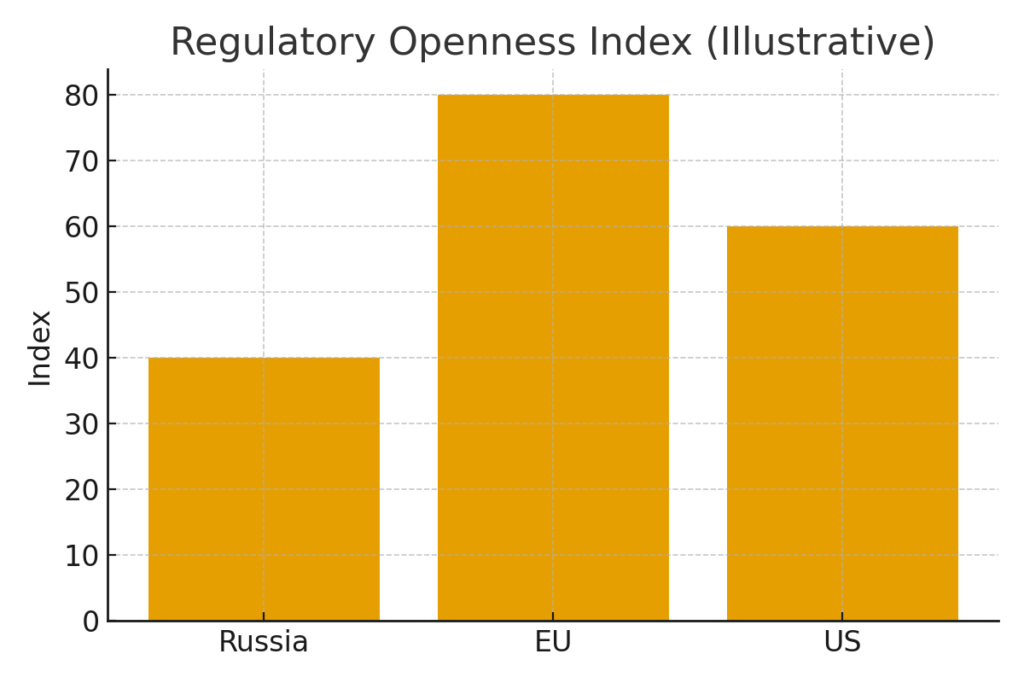
This graph illustrates an “Regulatory Openness Index” (illustrative), comparing Russia with the EU and U.S. to show relative accessibility.
9. Second Graph
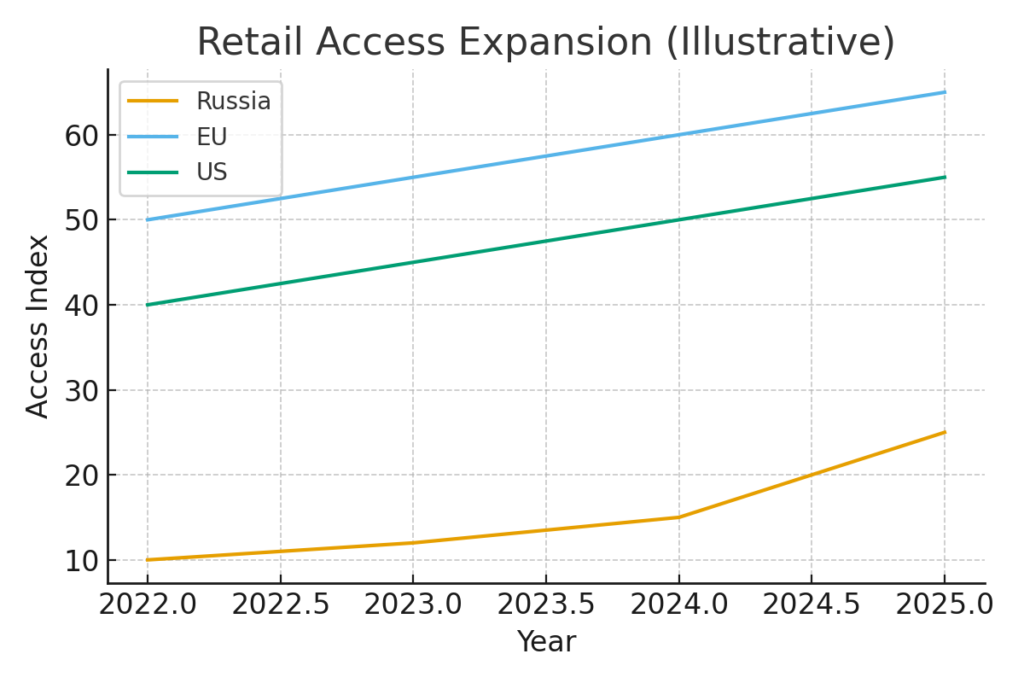
This graph visualizes the growth trajectory of retail crypto access under Russia’s new policy direction.
10. Conclusion: Russia’s Regulatory Pivot and Global Crypto Evolution
Russia’s plan to open retail access to Bitcoin represents far more than a domestic policy adjustment. It signals a strategic recognition of cryptocurrency’s role in global finance and an acknowledgment that restrictive wealth-based barriers are outdated.
By moving toward a tiered, knowledge-based regulatory structure, Russia positions itself to:
- Enhance financial inclusion
- Encourage investment innovation
- Integrate digital assets into cross-border settlement frameworks
- Align with global standards while maintaining strong oversight
For investors seeking new opportunities, Russia’s shift could unlock a wave of demand for Bitcoin, altcoins, tokenized assets, and blockchain-based payment systems.
As global digital-asset regulation continues to evolve, Russia’s transformation may serve as a model for other countries balancing innovation and control.
