
Main Points :
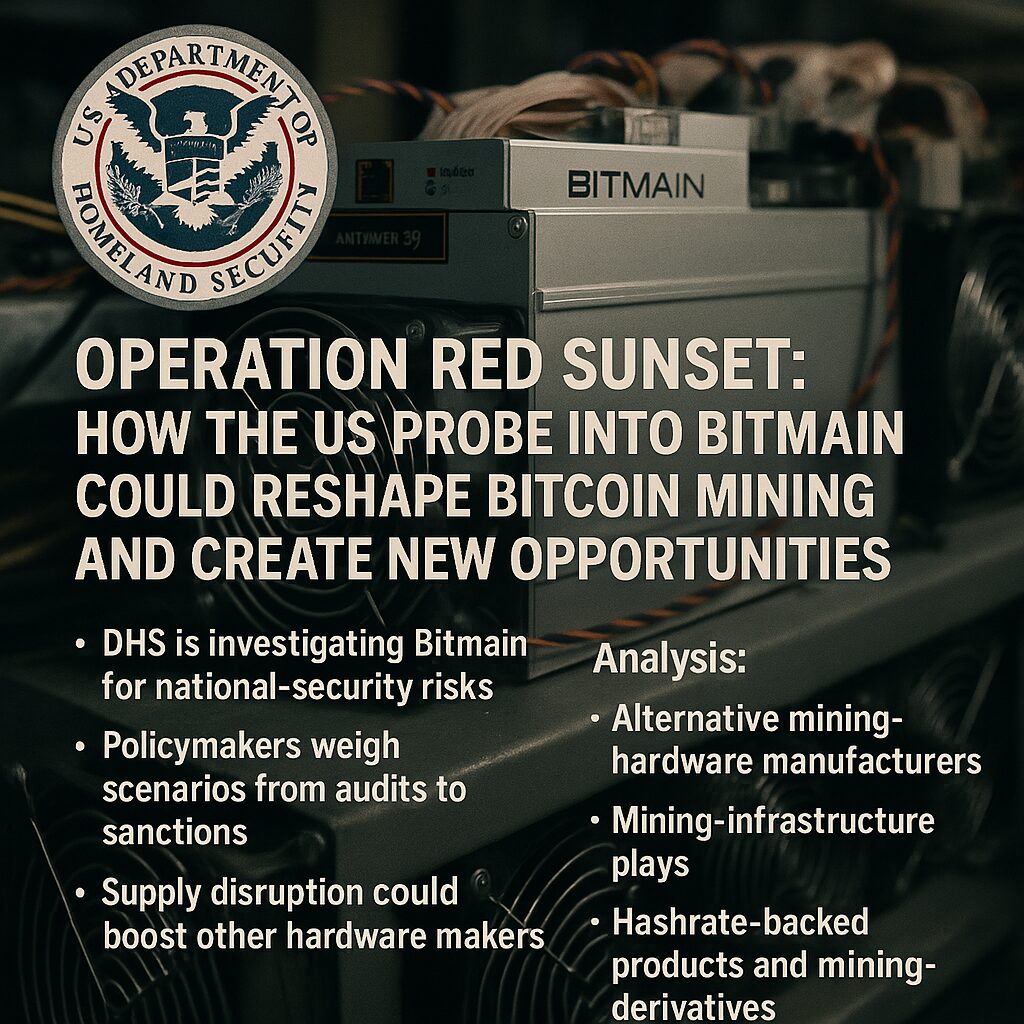
- The US Department of Homeland Security (DHS) is running a national-security investigation, “Operation Red Sunset,” into Chinese mining giant Bitmain, focusing on whether its Bitcoin mining rigs could be remotely controlled for espionage or power-grid sabotage.
- Because Bitmain dominates global ASIC supply, any sanctions or tight restrictions would hit US mining farms first via spare-parts shortages and delayed deliveries, not Wall Street.
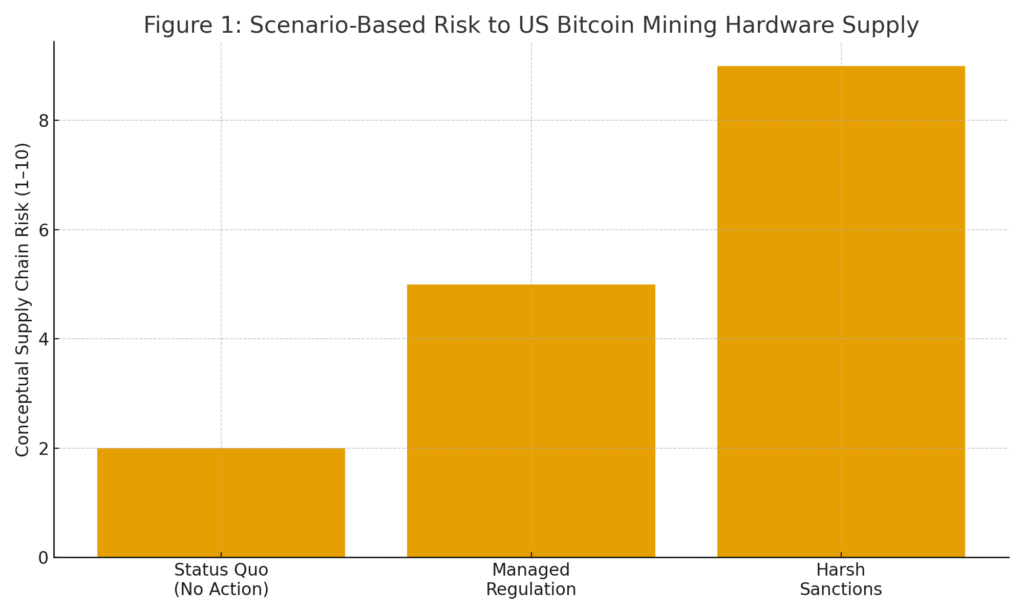
- Policymakers are effectively weighing three scenarios:
- Status quo (no major action)
- Managed regulation and third-party audits
- Harsh sanctions and near-blockade of Bitmain hardware in the US
- If supply from Bitmain is disrupted, competitors like MicroBT and Canaan, as well as emerging North American and European hardware makers, could see a demand surge.
- For investors looking for new crypto assets and income streams, this shift opens opportunities in:
- Alternative mining-hardware manufacturers (equity, tokens if any)
- Mining-infrastructure plays (data-center REIT-style tokens, power-optimization platforms)
- Hashrate-backed products and mining-derivatives
- For builders, the case is a reminder that Bitcoin’s “trustless” protocol still sits on very physical, very political infrastructure—from chips and firmwares to power contracts and land-use politics.
1. What Is “Operation Red Sunset”?
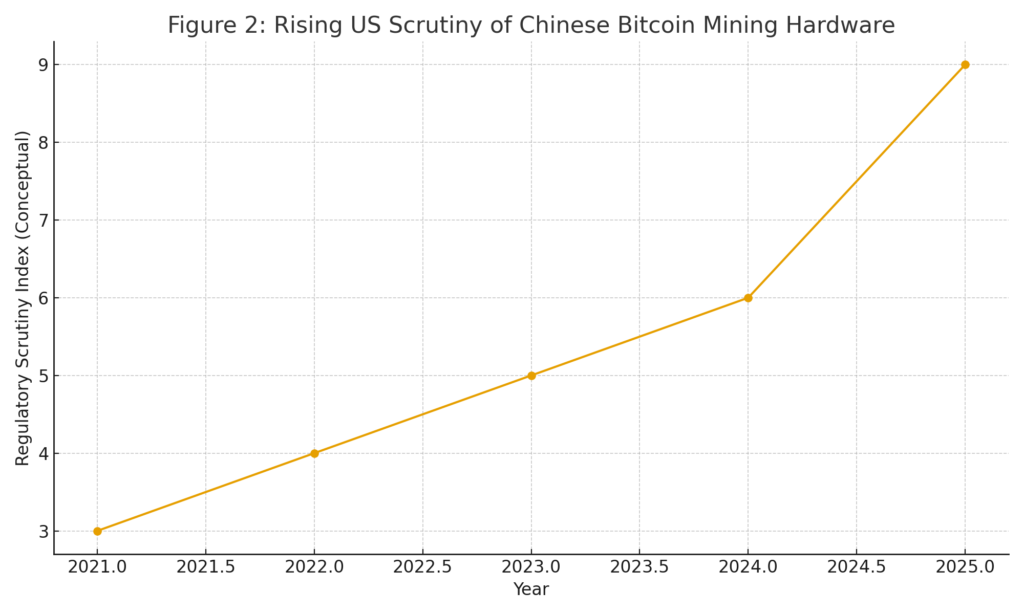
In late 2025, US media revealed that the Department of Homeland Security (DHS) has been running a months-long federal investigation into Bitmain, the Beijing-based company that sells a large share of the world’s Bitcoin mining rigs. The probe is internally code-named “Operation Red Sunset.”
The key questions US officials are asking:
- Can Bitmain machines be remotely steered from China?
- For espionage (data exfiltration, network mapping)
- For sabotage (for example, coordinated shutdowns that destabilize regional power grids)
- Are there hidden backdoors in chips or firmware?
Reports describe devices being seized at ports, opened and forensically inspected, and some shipments temporarily held. - What happens when large clusters of foreign-made rigs sit near sensitive sites?
Some machines were reportedly installed close to military bases, government-linked facilities, or critical data centers.
Bitmain, for its part, has categorically denied any ability to remotely control its machines and calls the allegations “unequivocally false.” The company insists it complies with US law and says any past detentions were routine regulatory checks, not national-security red flags.
At this stage, there is no public evidence that a backdoor has been confirmed. But the investigation alone is enough to jolt miners and hardware investors, because it shines a spotlight on a risk many tried not to think about: Bitcoin’s hardware monoculture.
2. Why Bitmain Matters So Much to Bitcoin Mining
Bitmain is not just “another vendor.” It is:
- A top global supplier of Bitcoin ASIC rigs under the Antminer brand
- A long-time price-setter for each new generation of efficient SHA-256 hardware
- A key player in large-scale hosting and mining deals, including multi-hundred-million-dollar purchases by North American firms
In practice, this means:
- A huge share of US hashrate sits on Bitmain hardware.
- Many farms rely on Bitmain spare parts, repair centers, and firmware updates.
- Contracts for new capacity expansions—especially those targeting cheap power in places like North Dakota, Oklahoma, and Texas—often assume continued Bitmain supply.
So, when US authorities focus on Bitmain rather than on Bitcoin itself, they are targeting the hardware chokepoint rather than the protocol. From a miner’s point of view, this is almost more dangerous:
- You can’t fork your way out of a shortage of hashboards and control boards.
- If your Antminer fleet breaks and you can’t import parts, your cashflow stops long before any macro event hits BTC price.
3. Three Realistic Policy Scenarios
The Japanese article you shared already outlined three basic scenarios, which align well with how Washington tends to act in tech-security cases. Let’s detail them in an investor-oriented way.
3.1 Scenario 1 – Status Quo: “Investigation Quietly Fades”
- DHS completes its analysis, finds no conclusive backdoor, and no major public action is taken.
- Perhaps some minor additional customs checks and paperwork remain.
- Market reaction: a relief rally for listed mining companies that rely on Bitmain; hardware prices remain roughly where they are.
Risk profile in our conceptual chart (Figure 1): low to moderate supply risk (2/10).
For miners, this is the easiest outcome:
- Keep sourcing from Bitmain, maybe diversify a little into alternatives like MicroBT for political optics.
- Focus remains on halving cycles, energy costs, and maybe AI-mining hybrid workloads, not national security.
3.2 Scenario 2 – Managed Regulation: “Audits, Licenses, and White-Listed Firmware”
In this world, US authorities decide that “Chinese hardware is acceptable, but only under supervision.” We might see:
- Mandatory third-party security audits of firmware and chips
- Approved “US-compliant” firmware images, digitally signed and monitored
- Import licenses for large orders and disclosure of ultimate customers
This is similar to how telecom gear or certain networking equipment is treated.
In our Figure 1, supply risk rises to medium (5/10):
- Bitmain can still sell into the US, but costs go up—for compliance, audits, and delays.
- Smaller miners or those with weaker legal/compliance teams might struggle to navigate the new rules.
- Some buyers accelerate a gradual rotation into non-Chinese vendors to de-risk.
For investors and builders, this scenario is fertile ground for:
- Security-focused hardware auditors and firmware labs
- Insurance products that cover “regulatory outage risk” for mining fleets
- Middleware that proves attested firmware and device integrity on-chain, for hashrate-backed tokens or collateralized loans
3.3 Scenario 3 – Harsh Sanctions: “Bitmain as the Next Huawei”
The worst-case (for Bitmain) is that the company or specific subsidiaries end up effectively blacklisted for US persons, similar to how Huawei was treated in telecoms. That could include:
- Adding Bitmain or related entities to US sanctions or export-control lists
- Barring US miners from buying new Bitmain rigs
- Blocking or severely restricting spare-parts imports and firmware updates
In our Figure 1, this pushes supply risk up to 9/10:
- The first thing to break is maintenance—without fans, hashboards, and control boards, large farms watch their fleet availability sink.
- New capacity expansions based on Bitmain roadmaps get pushed back or cancelled.
- Miners scramble to source MicroBT, Canaan, or emerging Western hardware, often at a premium and with long lead times.
From a macro-Bitcoin point of view:
- Global hashrate growth could slow or even dip temporarily.
- If the shock is strong enough, some high-cost US miners might capitulate, pushing more hashrate to regions still willing to buy Bitmain gear.
- However, over a 2–3 year horizon, new supply chains will evolve—just as telecoms eventually diversified away from Huawei.
4. Who Stands to Gain? Competitors and New Geographies
If the US clamps down on Bitmain, the most immediate beneficiaries are competitors in the ASIC market:
- MicroBT (WhatsMiner series), already a favorite among some large US miners, would likely see order books swell.
- Canaan and a cluster of smaller manufacturers could gain share in niche segments (high-temp operations, immersion-optimized rigs, etc.).
Beyond China, there is space for:
- US and European chip designers to target the SHA-256 space, especially if they can secure access to advanced fabs.
- Emerging-market assembly hubs (for example, in Southeast Asia or Latin America) that can label hardware as non-Chinese for regulatory purposes, even if some upstream components are still sourced globally.
For investors seeking new income streams, this is where to look:
- Equity in non-Chinese hardware vendors or their upstream suppliers (cooling systems, power-electronics, firmware security companies).
- Tokens or revenue-sharing structures tied to regional mining clusters that rely less on Chinese supply.
- Infrastructure-heavy plays—data centers, power-plant-adjacent mining parks—positioned as “regulation-friendly hashrate.”
5. Beyond ASICs: New Business Models Around Mining Risk
The Bitmain investigation doesn’t just shift hardware demand. It also invites new financial products and blockchain use-cases:
- Hashrate-Backed Products with Supply-Chain Transparency
- Miners can tokenise hashrate or future production but attach proofs of hardware origin and firmware integrity.
- Investors receive BTC-linked yield while also seeing geopolitical risk scores baked into the product.
- On-Chain Insurance for Mining Outages
- Protocols can monitor hashrate contributions from specific pools or facilities, and pay out automatically when hashrate drops due to sanctioned hardware.
- Premiums are higher for fleets concentrated in high-risk vendors; this incentivizes diversification.
- AI + Mining Hybrid Facilities
- We already see facilities experimenting with running AI workloads and Bitcoin mining side by side, shifting power between them as prices and difficulty move.
- If Chinese hardware becomes politically sensitive, there is room for north-American or European AI/ASIC vendors to supply combo chips or shared infrastructure.
For readers hunting “the next revenue source” in crypto, the opportunity may not be a meme coin but the boring plumbing:
- Energy-management protocols
- Hardware-integrity or supply-chain-tracking chains
- Insurance and derivative layers for miners exposed to regulatory shocks
6. Practical Takeaways for Miners and Builders
For miners operating in or near the US:
- Inventory & vendor risk review
- Map your fleet by vendor, model, firmware version, and location.
- Quantify how many months you can operate given your current stock of spare parts.
- Diversify new purchases
- Even if Bitmain survives with minimal restrictions, a diversified fleet gives you optionality.
- Contractual protections
- New hardware and hosting agreements should explicitly address sanctions, export controls, and force majeure around vendor blacklisting.
For protocol and product builders:
- Treat mining hardware as a first-class risk variable, not a background assumption.
- Design products that expose infrastructure information on-chain—where hashpower comes from, what it runs on, and how resilient it is.
- Build tools that help institutional users answer the new question regulators will ask: “If one major hardware vendor disappears tomorrow, what happens to this product?”
7. Conclusion: Infrastructure Risk as the Next Alpha
The US probe into Bitmain under Operation Red Sunset is about more than one company. It is a stress-test of Bitcoin’s physical layer:
- Can a supposedly decentralized network remain robust if its hardware stack is heavily concentrated in one jurisdiction and one vendor?
- How should regulators treat mining rigs—like ordinary servers, or like telecom routers with geopolitical sensitivity?
- And for investors and builders, where are the cash-flow opportunities as the industry re-prices this risk?
For readers searching for new crypto assets, next income streams, and practical blockchain use-cases, the message is clear:
- Follow the infrastructure, not just the tokens.
- Look for projects and companies that reduce single-vendor risk, make mining more transparent, and help the network adapt to shocks like Operation Red Sunset.
- In a world where chips can become as politically sensitive as oil, infrastructure resilience is alpha—and those who price it correctly may gain the biggest edge in the next phase of Bitcoin’s evolution.
