
Main Points :
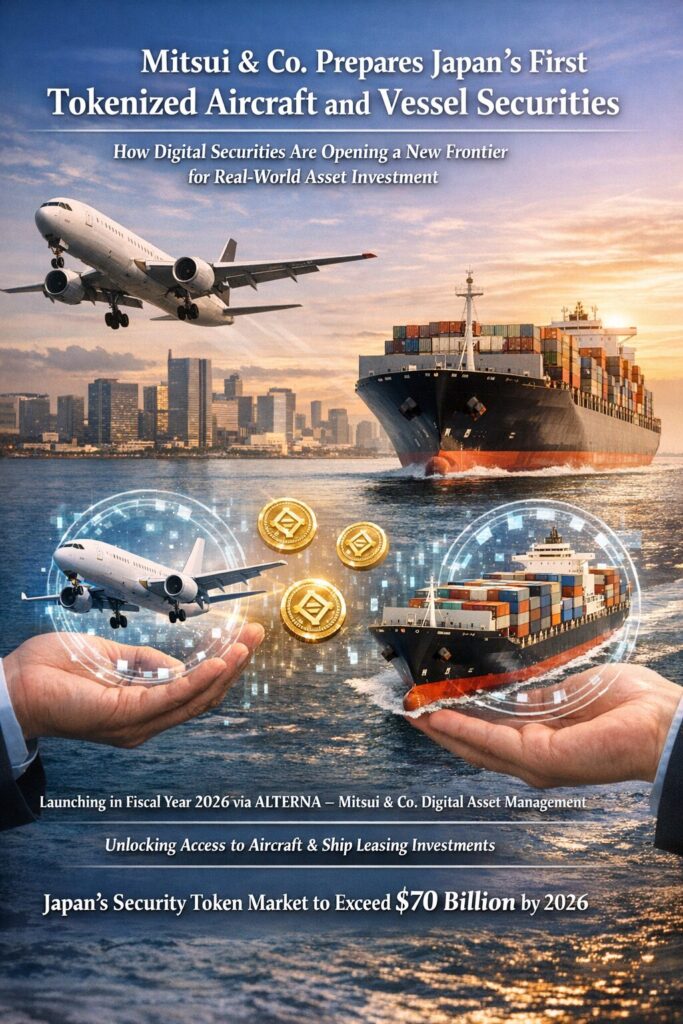
- Mitsui & Co. Group is preparing to issue Japan’s first digital securities backed by aircraft and vessels, with commercial launch expected in fiscal year 2026.
- These security tokens (STs) will allow individual investors to access aircraft and ship leasing investments that were previously limited to institutional capital.
- The products will be distributed through ALTERNA, a digital asset investment platform operated by Mitsui & Co. Digital Asset Management (MDM).
- Lease income from airlines and shipping operators will form the basis of investor distributions, creating a stable, real-asset-backed yield model.
- Japan’s security token market is projected to exceed $70 billion in outstanding value by the end of 2026, signaling a major structural shift in capital markets.
Introduction: From Institutional Assets to Individual Portfolios
According to reports by The Nikkei, Mitsui & Co. is preparing to issue Japan’s first-ever digital securities backed by aircraft and maritime vessels. The initiative represents a milestone in Japan’s capital markets, as it brings traditionally institutional-only assets—commercial aircraft and cargo ships—into the reach of individual investors through blockchain-based tokenization.
The planned issuance is expected to begin during fiscal year 2026 and will be conducted through Mitsui’s dedicated digital asset platform, ALTERNA. By fractionalizing ownership and distributing it via security tokens, Mitsui aims to redefine how real-world infrastructure assets are financed and owned in Japan.
What Are Security Tokens (STs)?
Security tokens are blockchain-based representations of legally recognized securities under Japan’s Financial Instruments and Exchange Act. Unlike cryptocurrencies, STs are fully regulated financial products that represent ownership rights, receivables, or profit-sharing claims tied to real-world assets.
Japan officially recognized security tokens as financial instruments following legal reforms in 2020. Since then, tokenized real estate has led market adoption, allowing investors to participate in large-scale assets with minimum investments of approximately $700–$1,000.
Aircraft and vessels, however, represent a far more complex and capital-intensive asset class—making Mitsui’s move particularly significant.
ALTERNA: The Distribution Platform
The aircraft and vessel security tokens will be offered via ALTERNA, an asset management service operated by Mitsui & Co. Digital Asset Management (MDM).
Launched in May 2023, ALTERNA allows individual investors to access institutional-grade assets such as:
- Prime urban real estate in central Tokyo
- Large-scale logistics and distribution facilities
- Income-generating infrastructure assets
As of early 2026, ALTERNA has achieved:
- 19 active funds, the largest number in Japan’s ST market
- Cumulative profit distributions exceeding $170 million
- Total assets under management surpassing $14 billion
One notable success was the “Nihonbashi–Ningyocho Fund,” which achieved an annualized return of 5.0%, exceeding its initial projection of 3.0%, leading to early redemption in late 2025.
How Aircraft and Vessel STs Generate Returns
1. Lease-Based Cash Flow
The underlying assets—aircraft and ships—are leased to airlines and shipping operators. These long-term leases generate predictable, USD-denominated lease income, which becomes the primary source of investor distributions.
2. Asset-Backed Stability
Aircraft and vessels are globally traded assets with established secondary markets. Even in volatile economic conditions, essential transportation infrastructure tends to retain residual value.
3. Optional Non-Financial Benefits
According to reports, Mitsui is also considering non-monetary perks for aircraft ST investors, such as:
- Seat upgrade privileges
- In-flight service benefits
- Priority access to partner airline services
While symbolic in value, these benefits reinforce the connection between investors and the underlying real-world asset.
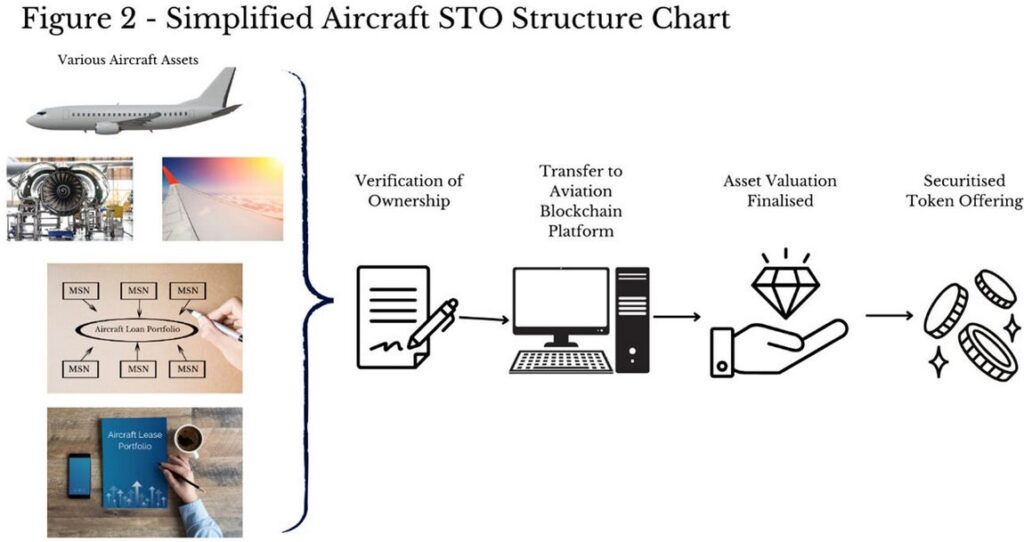
【Traditional Aircraft Investment vs. Tokenized Aircraft Investment】 (A side-by-side diagram showing “Institutional-Only / $10M+ Minimum / Closed Market” versus “Tokenized / $1,000 Minimum / Open Retail Access.”)
Strategic Importance for Mitsui
For Mitsui, this initiative is not merely a product launch—it is a strategic repositioning.
MDM has announced a target of expanding total security token sales to $7 billion by fiscal year 2030, roughly four times its 2025 level. Diversifying from real estate into mobile infrastructure assets such as aircraft and vessels significantly broadens the addressable market.
This aligns with Mitsui’s broader strategy of combining traditional asset finance expertise with next-generation digital infrastructure.
The Rapid Expansion of Japan’s Security Token Market
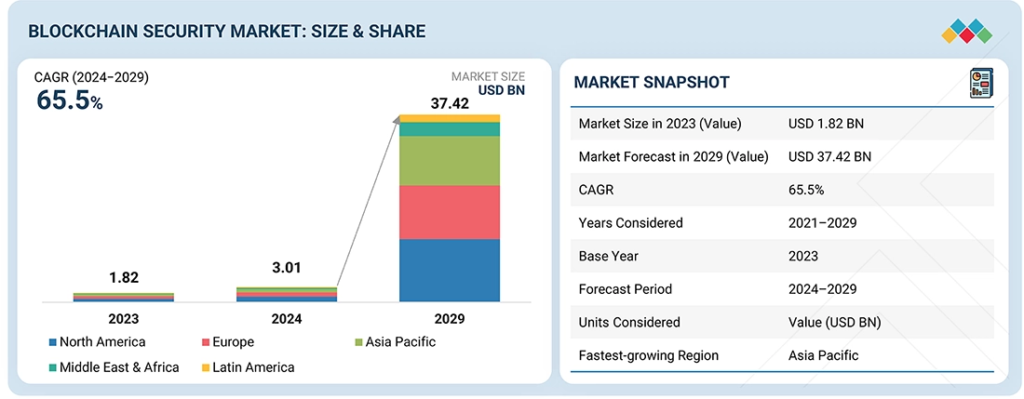
Japan’s ST market is growing at an unprecedented pace. According to projections by Progmat, outstanding security token projects are expected to reach approximately $70.5 billion by the end of 2026—nearly double the level projected for the end of 2025.
Key drivers include:
- Increased institutional comfort with blockchain-based settlement
- Regulatory clarity around custody and investor protection
- Growing interest in real-world asset (RWA) tokenization
- Early experimentation with DeFi integration and stablecoin settlement
【Growth of Japan’s Security Token Market (2023–2026, USD)】 (A rising bar chart showing market size growth from ~$15B in 2023 to ~$70B in 2026.)
Infrastructure Behind the Scenes: Progmat and ibet for Fin
To support this expansion, MDM established ALTERNA Trust in March 2025, creating an end-to-end structure covering product structuring, trust management, and distribution.
The platform relies on:
- Progmat SaaS, a digital asset issuance and lifecycle management system
- ibet for Fin, a blockchain infrastructure platform operated by BOOSTRY
This institutional-grade architecture ensures regulatory compliance, operational resilience, and scalability—key requirements for onboarding large real-world assets.
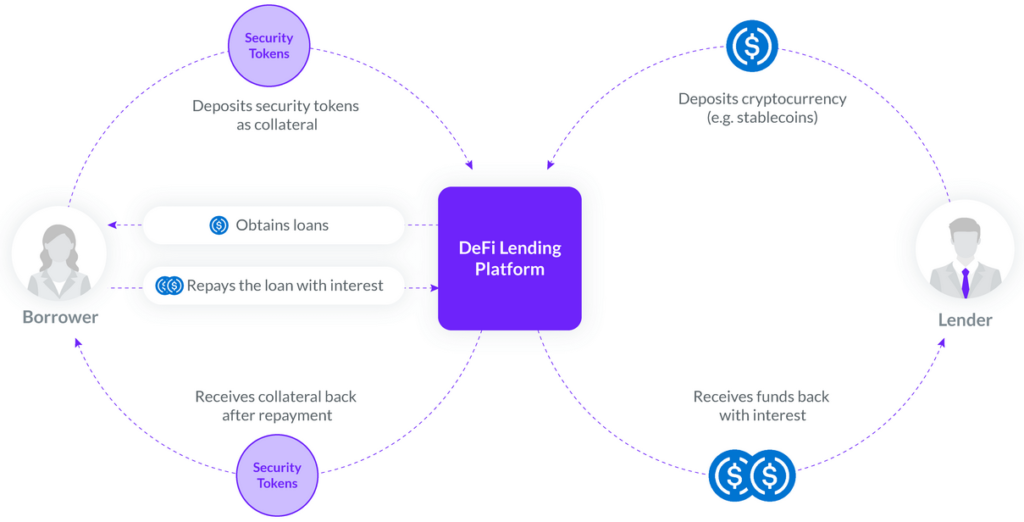
Security Tokens as a Bridge Between TradFi and DeFi
Looking ahead, 2026 is expected to mark a turning point where traditional capital markets begin to intersect meaningfully with decentralized finance.
Potential developments include:
- Stablecoin-based settlement for security tokens
- Tokenized funds and equities
- Programmable compliance and automated distribution
- Secondary markets with near-instant liquidity
Aircraft and vessel STs represent an ideal test case: globally standardized assets, predictable cash flows, and clear legal ownership structures.
【The Evolution of Capital Markets Through Tokenization】 (A flow diagram moving from “Traditional Finance” → “Tokenized Assets” → “DeFi-Integrated Capital Markets.”)
Conclusion: A Structural Shift, Not a Trend
Mitsui’s planned issuance of aircraft and vessel security tokens marks more than a technological experiment—it signals a structural shift in how capital, ownership, and infrastructure intersect.
For investors seeking new income sources, exposure to real-world assets, and practical blockchain applications, security tokens represent a compelling middle ground between traditional finance and crypto-native innovation.
As Japan continues to provide regulatory clarity and institutional leadership, the country is positioning itself as one of the global hubs for real-world asset tokenization. Mitsui’s move may well be remembered as the moment when aviation, shipping, and blockchain finance truly converged.
