
Main Points :
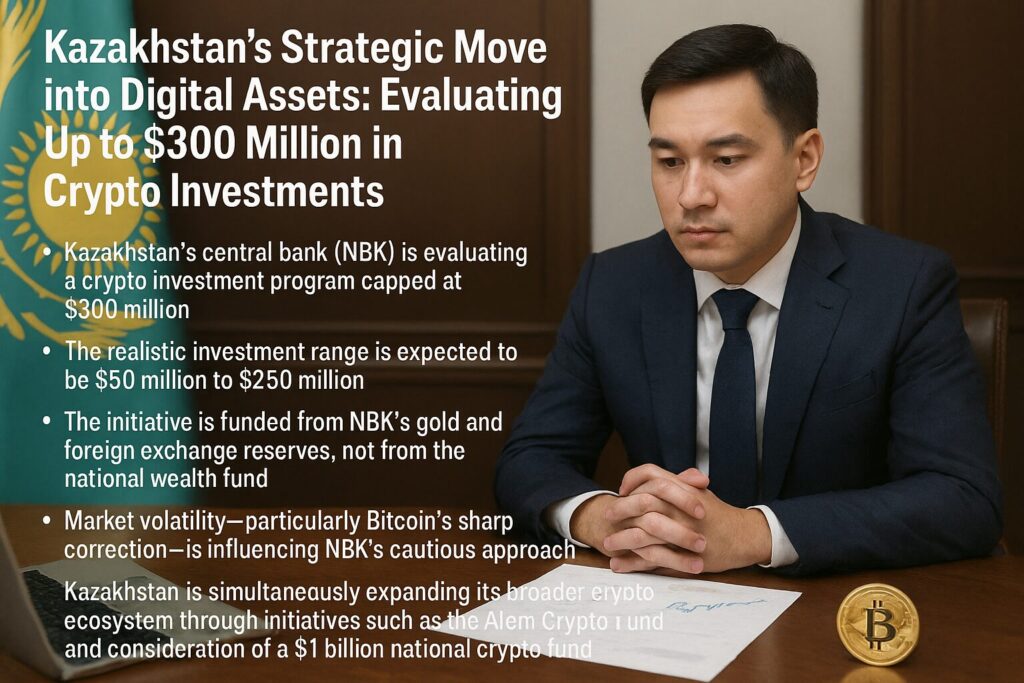
- Kazakhstan’s central bank (NBK) is evaluating a crypto investment program capped at $300 million.
- The realistic investment range is expected to be $50 million to $250 million.
- The initiative is funded from NBK’s gold and foreign exchange reserves, not from the national wealth fund.
- Market volatility—particularly Bitcoin’s sharp correction—is influencing NBK’s cautious approach.
- Kazakhstan is simultaneously expanding its broader crypto ecosystem through initiatives such as the Alem Crypto Fund and consideration of a $1 billion national crypto fund.
- The country’s strategy aligns with global sovereign trends toward digital assets, including ETFs, blockchain equities, and infrastructure investments.
I. Introduction: A Nation Positioning Itself for the Next Digital Cycle
Kazakhstan, traditionally known for its vast natural resources and growing influence in Central Asia, is emerging as an unexpected but increasingly influential player in the global digital asset ecosystem. The National Bank of Kazakhstan (NBK), under Governor Timur Suleimenov, recently announced that it is considering deploying up to $300 million into cryptocurrencies and digital asset-linked products.
However, the central bank stresses that this ceiling does not reflect the expected investment level. The likely amount—between $50 million and $250 million—will depend heavily on market stability, regulatory confidence, and broader macroeconomic conditions. Crucially, NBK clarified that the investment will come directly from its gold reserves and FX reserves, not from the national wealth fund, which has separate socioeconomic objectives.
This development signals a calculated and institutionally grounded shift toward digital assets rather than a speculative or politically driven move.
II. The Market Context: Why NBK Is Proceeding Carefully
A. Impact of Recent Crypto Market Decline
In November, global cryptocurrency markets lost approximately $500 billion in value. Bitcoin suffered a 17% decline, falling from around $110,000 to $81,000, marking a seven-month low. This chart provides a visual illustration of the correction:
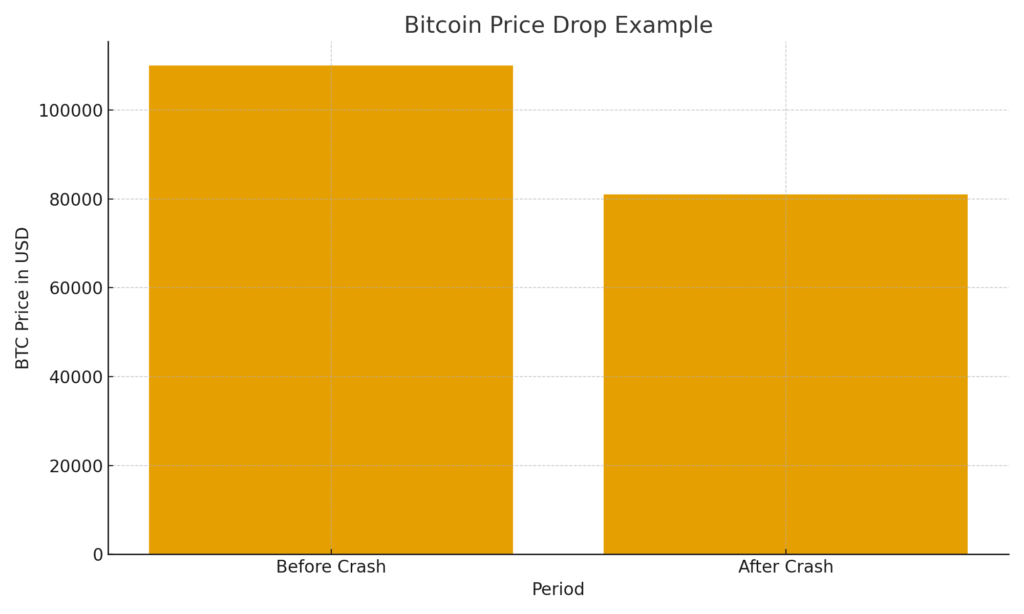
NBK views this volatility as a key reason for caution. Governor Suleimenov emphasized that the central bank will not aggressively enter the market until signs of stabilization and renewed structural strength appear. Even though NBK already has a regulatory and operational framework for digital asset investments, the timing of capital deployment remains strategic.
B. The Long-Term View on Crypto Adoption
NBK acknowledges that digital assets are here to stay and will likely become a major component of global financial portfolios. Still, it stresses the importance of long-term profitability and sustainability. For sovereign institutions, crypto is not just a high-yield asset—it is an exposure to technological transformation and cross-border financial evolution.
The central bank therefore prefers a phased and opportunistic approach, benefiting from market consolidation rather than chasing speculative peaks.
III. A New Portfolio Approach: Crypto as Part of National Reserves
A. Funding Source: Gold and FX Reserves
A defining aspect of Kazakhstan’s plan is the use of reserve assets—a departure from many nations that use sovereign wealth funds for digital asset exposure. NBK indicates that it already invests a portion of these reserves into technology equities and digital-asset-related financial products.
Adding direct crypto exposure would create a three-layer diversification model:
- Traditional reserves (gold, USD, EUR, etc.)
- Technology stocks and digital-economy financial instruments
- Direct exposure to Bitcoin, crypto-ETFs, and potentially diversified digital-asset baskets
This resembles frameworks seen in countries such as Singapore (Temasek) and Norway (NBIM), which also evaluate digital assets as fundamental components of long-term economic positioning.
IV. National Crypto Ecosystem Expansion
Kazakhstan’s investment signals go beyond reserve management. The country is building an integrated digital-asset ecosystem:
A. Alem Crypto Fund – Backed by Binance
In September, the Alem Crypto Fund officially began operations. Established by the Ministry of Artificial Intelligence and Digital Development with support from Binance, the fund’s first investment was into Binance’s BNB token.
This marks Kazakhstan’s first government-linked entry into token-based allocation.
B. Development of a $1 Billion National Crypto Fund
Governor Suleimenov previously outlined plans to create a $1 billion national cryptocurrency fund. This fund would invest in:
- Crypto ETFs
- Digital-asset infrastructure companies
- Blockchain-innovation startups
The approach signals Kazakhstan’s ambition to rival emerging crypto-forward nations such as the UAE, Singapore, and Hong Kong.
V. Global Context: Rising Institutional Appetite for Digital Assets
Kazakhstan’s central bank is not alone. Worldwide, sovereign institutions and central banks are evaluating digital assets in multiple ways:
1. Bitcoin ETFs
The approval of Bitcoin ETFs in the U.S. and several Asian markets has made institutional access safer and more regulated.
2. Strategic Reserves Diversification
Countries like El Salvador have integrated Bitcoin into national reserves, while others quietly accumulate exposure through ETFs or blockchain-equity holdings.
3. Digital Asset Infrastructure
Nations such as the UAE and Hong Kong are aggressively positioning themselves as global hubs, competing to attract talent, exchanges, and institutional capital.
Kazakhstan’s move therefore aligns with a broader macro trend:
Digital assets are becoming a structural part of sovereign investment strategies.
VI. NBK’s Expected Investment Ranges and Strategic Priorities
Below is a visual representation of Kazakhstan’s anticipated investment categories:
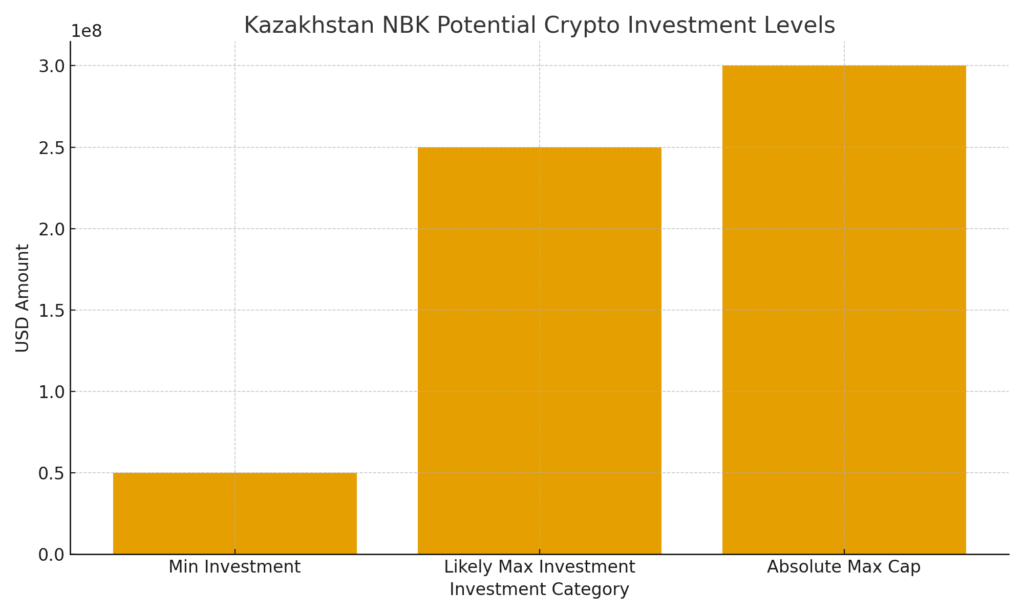
The strategic logic behind these figures:
- $50M level: exploratory and risk-controlled entry point
- $250M level: full confidence deployment under stable market conditions
- $300M cap: maximum exposure only if market conditions and legal frameworks are ideal
NBK is explicitly avoiding rapid or aggressive entry.
VII. Implications for Global Crypto Markets
Short-Term Impact
- A cautious central bank stance shows institutional hesitancy, especially after volatility.
- Markets interpret such moves as a signal that sovereign buyers may enter during deep pullbacks.
Mid- to Long-Term Impact
- Kazakhstan’s structure may encourage other emerging markets to adopt reserve-based crypto portfolios.
- Institutional capital inflows from sovereign players could stabilize markets and reduce reliance on retail cycles.
For Investors and Builders
Kazakhstan’s digital strategy provides three important takeaways:
- State-backed demand for crypto is rising, not shrinking.
- Opportunistic accumulation during downturns is becoming the norm for institutional actors.
- Ecosystem investments (funds, ETFs, infrastructure) will likely outperform pure token speculation in the next cycle.
VIII. Conclusion
Kazakhstan’s exploration of up to $300 million in crypto investments marks a turning point in both national strategy and institutional market structure. While cautious about market volatility—especially following a major Bitcoin correction—the country is clearly preparing itself for deeper engagement in the digital economy.
The establishment of government-linked funds, partnerships with Binance, and planning of a $1 billion national crypto fund show a long-term vision:
Kazakhstan wants to anchor itself as a Central Asian hub for blockchain innovation and digital-asset finance.
As more nations evaluate digital assets not as speculative instruments but as necessary reserve and growth tools, Kazakhstan’s approach may serve as an important reference model for emerging markets and institutional investors worldwide.
