
Main Points :
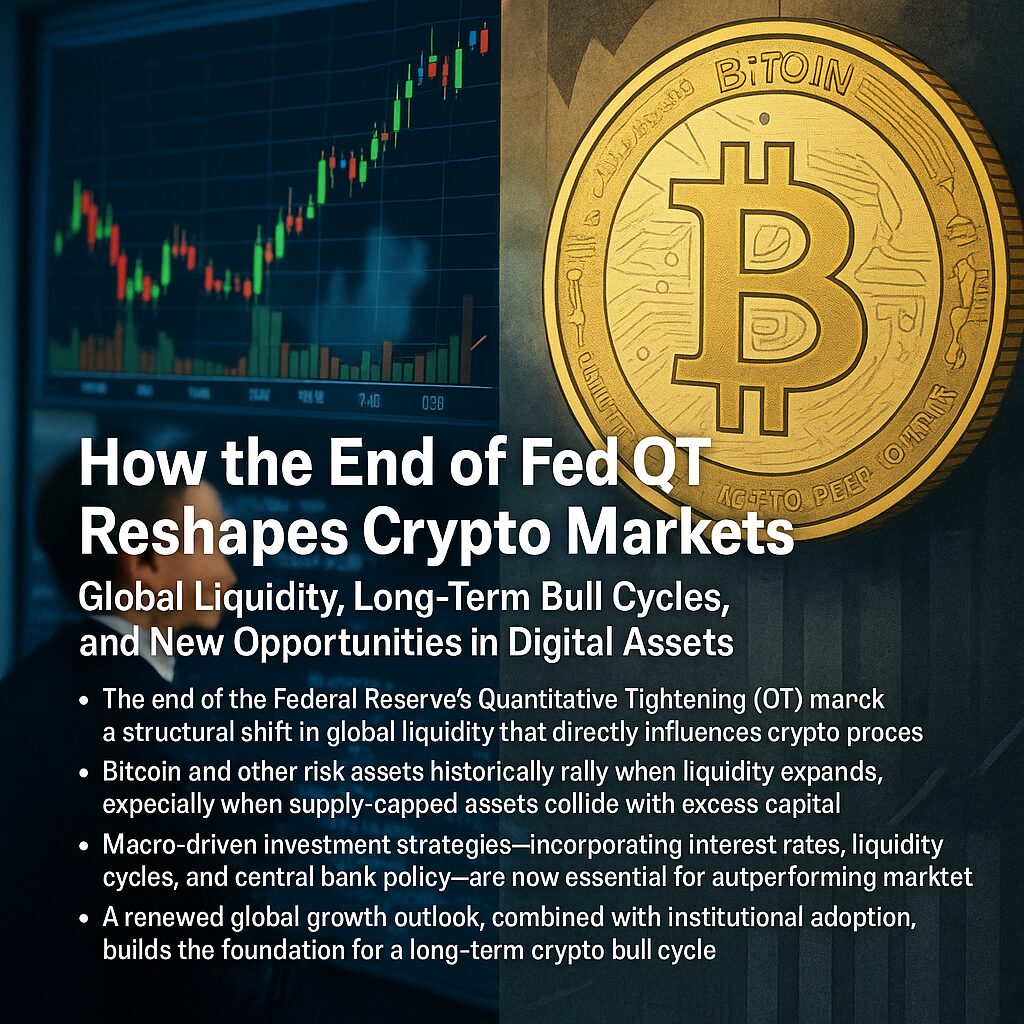
- The end of the Federal Reserve’s Quantitative Tightening (QT) marks a structural shift in global liquidity that directly influences crypto prices.
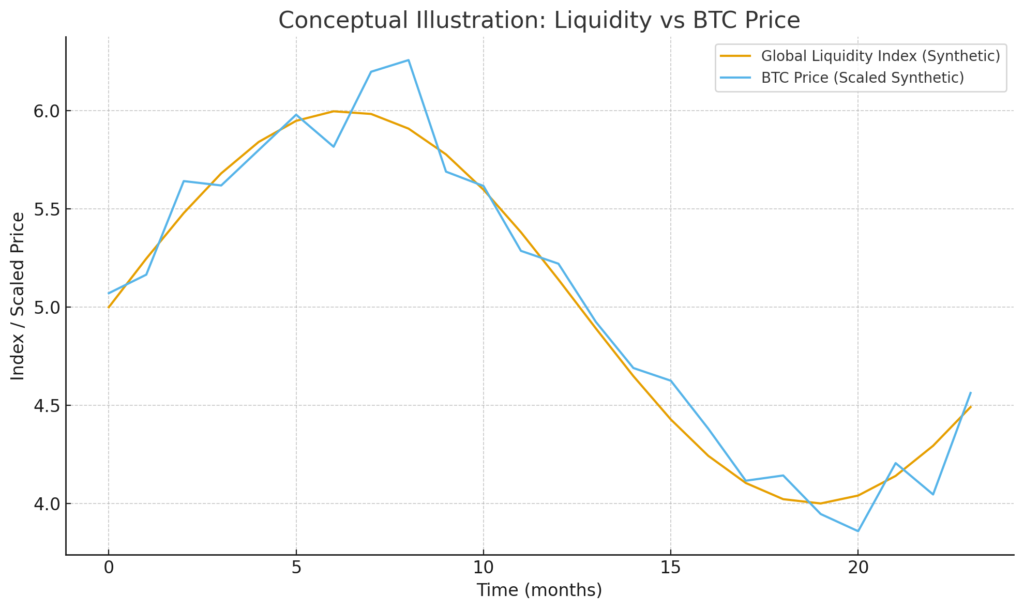
- Bitcoin and other risk assets historically rally when liquidity expands, especially when supply-capped assets collide with excess capital.
- Macro-driven investment strategies—incorporating interest rates, liquidity cycles, and central bank policy—are now essential for outperforming the market.
- A renewed global growth outlook, combined with institutional adoption, builds the foundation for a long-term crypto bull cycle.
- Investors seeking new crypto assets or emerging blockchain-based income streams must understand liquidity dynamics, not only project fundamentals.
Section 1 — Global Liquidity as the New Determinant of Crypto Prices
1.1 Crypto Markets Are No Longer Independent From Macroeconomics
The modern digital asset market has matured far beyond its origins as a niche technological sector. Today, Bitcoin, Ethereum, and emerging altcoins move in tight correlation with global liquidity conditions. The Federal Reserve’s decision to end its 3.5-year Quantitative Tightening (QT) cycle signals a fundamental turning point not only for traditional markets but especially for crypto assets.
QT is the process through which the Fed reduces its balance sheet by allowing assets to mature without reinvestment—effectively draining liquidity out of the financial system. The end of QT operates as the reverse: markets anticipate stabilization in interest rates, a slower pace of liquidity withdrawal, and eventually a net increase in excess capital. Historically, these macro shifts precede significant rallies in risk assets.
When liquidity expands, capital seeks returns. And among all risk assets, Bitcoin—with a fixed supply of 21 million—historically benefits the most from new capital inflows. Altcoins with strong narratives (AI tokens, DePIN, restaking, and RWAs) also tend to outperform during liquidity expansions.
1.2 Why Liquidity Matters More Than Individual Project News
The referenced article states a central truth: individual project updates matter far less than the global liquidity cycle.
Even a breakthrough technological upgrade or partnership rarely offsets the macro momentum driven by Federal Reserve policy.
This means the dynamics of Bitcoin and altcoin prices are tied to:
- Interest rates
- Balance sheet size of central banks
- Bank reserves and reverse repo flows
- Fiscal policy and Treasury issuance
Crypto’s integration into global financial markets means that liquidity cycles—once studied only by macro hedge funds—are now essential knowledge for crypto investors searching for new assets or yield opportunities.
Section 2 — Advanced Investment Strategy: Incorporating Macro Forces
2.1 Crypto Investors Must Adopt Macro-Integrated Frameworks
The end of QT forces a strategic evolution. Traditional on-chain metrics, tokenomics, and project milestones remain important but must now sit alongside macroeconomic indicators in any serious investment framework.
Modern crypto investment requires tracking:
- Liquidity indices (e.g., global M2, central bank balance sheets)
- Forward rate expectations
- Dollar strength (DXY)
- Real yields (which closely correlate with Bitcoin’s trend)
- Institutional fund flows
When real yields fall and liquidity rises, Bitcoin’s long-term trend historically turns strongly bullish.
2.2 A Turning Point for Institutional Capital
Major institutional players—BlackRock, Fidelity, global pension systems, and Asian sovereign wealth funds—have increasingly integrated digital assets into their macro portfolios.
The end of QT strengthens this trend because:
- Lower liquidity pressure reduces tail risk
- Long-duration assets (like BTC and ETH) become attractive
- Balance sheet expansion cycles often align with record highs in crypto
In other words, macro tailwinds enable institutions to justify larger allocations.
2.3 New Opportunities for Investors Seeking the “Next Asset”
For readers searching for new crypto assets or revenue opportunities, macro liquidity regimes help identify sectors primed for growth:
| Sector | Why It Benefits From Post-QT Liquidity |
|---|---|
| AI Tokens | Capital seeks exponential-growth narratives |
| Real-World Assets (RWA) | Institutions enter with bond tokenization |
| Restaking & Yield Tokens | Liquidity expansion boosts staking ROI sustainability |
| DePIN / Infrastructure | High CAPEX sectors benefit from easier capital |
| Layer-1 Alternatives | Rotation into higher-beta ecosystems resumes |
Understanding macro cycles can dramatically improve asset selection in early phases of a bull market.
Section 3 — Macro Factors Supporting a Long-Term Bull Market
3.1 QT Ending as a Foundational Bullish Signal
Across market history, crypto bull cycles typically begin during or just after:
- The end of tightening
- A plateau in interest rates
- A rise in global liquidity
- A soft landing or mild growth cycle
This combination aligns perfectly with the Fed’s QT decision.
3.2 Economic Conditions Reinforce Optimism
The article notes that the end of QT suggests confidence that recession risk is declining. Several real-world indicators support this:
- Corporate earnings in the U.S. and Asia have stabilized
- Global PMI indices have returned to expansion territory
- Treasury yields have cooled after historic highs
- Cross-border capital flows into emerging markets are increasing
These signs create a supportive environment for risk assets, including crypto.
3.3 Bitcoin’s Supply Shock Meets Liquidity Expansion
Bitcoin’s halving cycles are well understood. But when a halving coincides with a liquidity expansion, the impact becomes exponentially stronger:
- New BTC supply entering the market drops by 50%
- Liquidity expands
- Institutional demand rises
- Excess capital rotates into constrained assets
This is why several analysts predict Bitcoin could break its previous all-time highs and move toward significantly higher price ranges, with models ranging from $125,000 to $180,000 depending on liquidity conditions.
3.4 The Crypto Market Is Becoming Fully Integrated Into Global Finance
Crypto’s maturity can be observed through:
- ETF approvals (Bitcoin, Ethereum, Solana ETF pending in multiple jurisdictions)
- Integration into payment systems
- Tokenization of bonds and treasury products
- Corporate adoption of stablecoins
- Government-level blockchain pilots
When global liquidity improves, these adoption channels accelerate because capital becomes cheaper, compliance frameworks become clearer, and risk tolerance expands.
Section 4 — Strategic Guidance for Investors in the New Macro Era
4.1 For Investors Seeking New Crypto Assets
Use liquidity-based filters:
- Buy early into sectors that historically outperform during liquidity additions
- Prioritize tokens with strong fundamentals but suppressed valuations during QT
- Avoid illiquid microcaps during tightening phases
4.2 For Investors Seeking Income Opportunities
Liquidity expansion boosts:
- Staking APY sustainability
- Restaking rewards
- RWA yields
- Lending/borrowing activity on-chain
These income streams strengthen dramatically in post-QT environments.
4.3 For Investors Focused on Practical Blockchain Use Cases
Real-world adoption accelerates during macro easing because institutions have:
- Lower borrowing costs
- More budget for blockchain pilots
- Higher risk tolerance
- Incentives to tokenize assets for efficiency
Expect growth in:
- Tokenized Treasury systems
- Cross-border payment rails
- Enterprise blockchain compliance tools
- On-chain identity and regulated stablecoin frameworks
Conclusion — A New Era Where Macro Forces Define Crypto’s Future
The end of QT marks a decisive turning point.
Crypto is no longer a separate ecosystem—it is a fully integrated asset class shaped by global monetary cycles.
Key conclusions:
- Liquidity, not narrative, now drives the largest crypto price movements.
- Investors must adopt macro-driven strategies to capture outsized returns.
- A long-term bull cycle is forming as global liquidity stabilizes and institutions enter the market.
- Bitcoin, altcoins, RWAs, and AI-related tokens all stand to benefit from the macro tailwinds of 2025 and beyond.
For investors seeking new crypto assets, next-generation revenue models, or real-world blockchain applications, understanding macro liquidity will be the key competitive advantage in the years ahead.
