
Main Points :
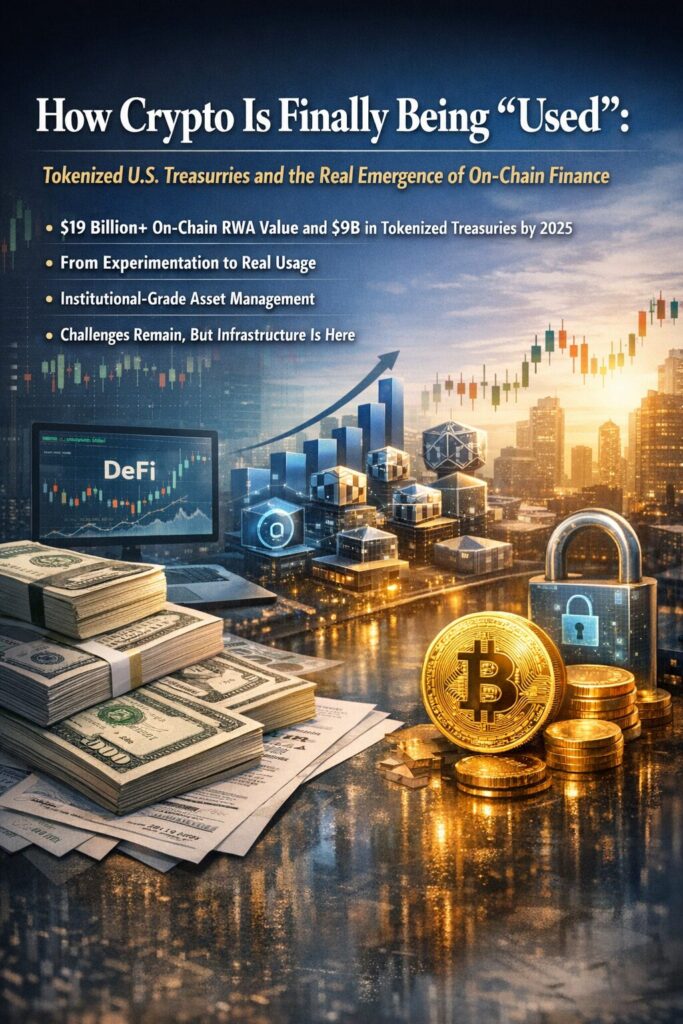
- Tokenized U.S. Treasuries have become the largest and fastest-growing segment of on-chain Real World Assets (RWA), reaching approximately $9 billion by the end of 2025.
- Total on-chain RWA value surpassed $19 billion, more than tripling in one year, signaling a transition from experimentation to real usage.
- DeFi is evolving into “on-chain finance”, shifting from speculative yield to institutional-grade asset management.
- Tokenized Treasuries offer transparent yield, low credit risk, and operational compatibility with corporate and institutional treasury strategies.
- Regulatory and accounting challenges remain, but 2025 marked the year RWA moved from proof-of-concept to operational infrastructure.
1. From Speculation to Usage: What “Using Crypto” Now Means
For much of its history, cryptocurrency has been defined by what it might become rather than how it is actually used. Narratives around decentralized finance (DeFi), Web3, and tokenization promised a re-architecture of finance, but real-world adoption often lagged behind theory.
That perception began to shift decisively in 2025.
Rather than chasing volatile yields or experimental protocols, market participants increasingly turned to tokenized U.S. Treasuries—a product that looks conservative by traditional standards, yet revolutionary in its implications. These instruments represent a tangible bridge between legacy finance and blockchain-based infrastructure, offering something crypto has long struggled to provide: predictable, explainable, real-world yield.
This shift suggests that crypto is no longer just being traded—it is being used as financial infrastructure.
2. The Scale of the RWA Market in 2025
According to data aggregated by the RWA analytics platform rwa.xyz, the total value of Real World Assets issued and circulating on-chain—referred to as Distributed Asset Value—reached approximately $19 billion by the end of 2025.
[Total On-Chain RWA Market Growth]

Of this total, tokenized U.S. Treasuries alone accounted for roughly $9 billion, representing nearly half of the entire on-chain RWA market. At the beginning of 2025, total RWA stood at approximately $6 billion, meaning the market expanded more than threefold in a single year.
What makes this growth notable is not just its magnitude, but its consistency. Rather than short-lived spikes driven by hype, tokenized Treasuries accumulated steadily throughout the year, suggesting repeat usage and operational trust.
3. Why U.S. Treasuries Became the Gateway Asset
Tokenized U.S. Treasuries emerged as the dominant RWA category for several structural reasons.
First, credit risk is clear and widely understood. U.S. Treasuries are considered the global risk-free benchmark, making them easier for compliance teams, auditors, and boards to approve compared to corporate debt or private credit.
Second, yield is transparent. Unlike DeFi protocols where returns depend on token incentives or liquidity dynamics, Treasury yields are publicly observable and macro-driven. This clarity makes them suitable for corporate treasury management and institutional portfolios.
Third, operational compatibility matters. For enterprises already managing cash through money market funds or short-term government securities, tokenized Treasuries fit naturally into existing workflows—while adding new benefits such as 24/7 settlement and programmable ownership.
In effect, tokenized Treasuries allow institutions to access real-world fixed income returns through blockchain rails, without embracing crypto volatility.
4. DeFi’s Quiet Transformation into On-Chain Finance
The rise of tokenized RWAs marks a fundamental shift in the nature of DeFi itself.
During the 2020 “DeFi Summer,” the ecosystem revolved around crypto-native activities: token swaps, liquidity mining, and governance incentives. Yield was high, but often unstable, opaque, and reflexive.
By contrast, the current phase emphasizes integration rather than isolation. RWAs tie blockchain systems directly to real-world economic activity—interest rates, sovereign credit, and corporate cash management.
As a result, the term “on-chain finance” is increasingly used to describe this new reality. The focus is no longer decentralization for its own sake, but efficiency, transparency, and settlement finality delivered via blockchain infrastructure.
Participation has shifted accordingly: from retail users to enterprises, funds, and institutions.
5. Tokenized Treasuries as Treasury Infrastructure
One of the most important but under-discussed impacts of tokenized Treasuries is their role in Digital Asset Treasury (DAT) strategies.
While early DAT initiatives—particularly in Japan—focused on holding Bitcoin as a balance-sheet asset, newer approaches emphasize yield-generating, low-volatility deployment of digital assets.
Instead of simply “holding crypto,” companies are beginning to operate on-chain treasuries, allocating stablecoin liquidity into tokenized government securities, optimizing idle cash without leaving blockchain environments.
This evolution reflects a broader shift from asset exposure to asset management.
6. The Remaining Challenges: Regulation, Custody, and Accounting
Despite rapid adoption, tokenized RWAs still face unresolved practical challenges.
- Regulation remains fragmented across jurisdictions, with differing classifications between securities, payment instruments, and digital assets.
- Custody models must balance decentralization with institutional control, often requiring hybrid solutions.
- Accounting and taxation standards have yet to fully adapt to tokenized representations of traditional assets.
None of these issues are trivial. However, the key takeaway from 2025 is that adoption continued despite these uncertainties—suggesting that the economic value proposition is strong enough to justify ongoing investment.
7. Japan’s Position and the Emerging Time Lag
In Japan, interest in on-chain finance intensified with the announcement of the Japan Digital Distributed Finance Association (JDFA) in December 2025, bringing together banks, securities firms, and crypto operators under a single cross-industry framework.
At the same time, regulatory reform is expected to move crypto oversight from the Payment Services Act to the Financial Instruments and Exchange Act, with implementation projected for 2027. Bitcoin ETFs are widely anticipated around 2028.
This creates a notable time lag compared to the United States, where institutional adoption of tokenized Treasuries is already well underway.
Whether this gap becomes a disadvantage—or an opportunity to leapfrog through refined regulation—will depend on how quickly practical frameworks are implemented.
8. 2026 and Beyond: When On-Chain Treasuries Become “Normal”
The most striking conclusion from the rise of tokenized U.S. Treasuries is not technological, but behavioral.
In 2025, on-chain RWAs crossed a psychological threshold: they stopped being experimental tools and started becoming default options for certain financial use cases.
If this trajectory continues, 2026 may be remembered as the year on-chain Treasuries became boring—and that is precisely what finance needs to scale.
Conclusion
Tokenized U.S. Treasuries reveal how crypto is finally being used—not as an alternative to finance, but as its next operational layer. By anchoring blockchain systems to real-world yield, they transform speculative infrastructure into functional financial plumbing.
The question is no longer whether on-chain finance works, but how widely and how quickly it will be adopted.
