
Main Takeaways :
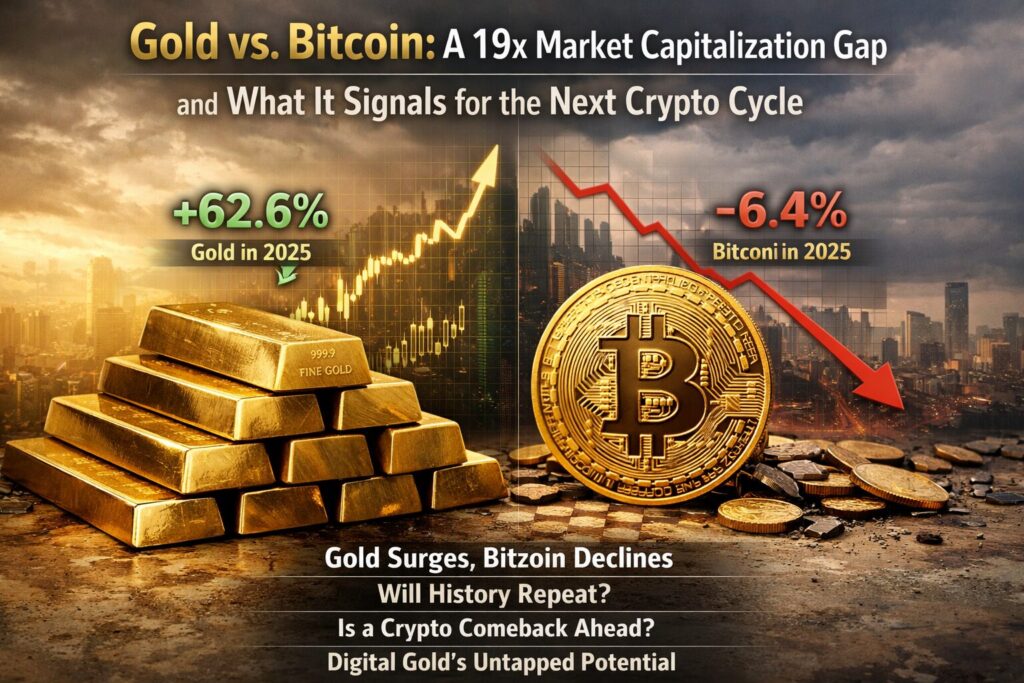
- The market capitalization gap between gold and Bitcoin has widened dramatically from about 9.5x to nearly 19x in just one year.
- In 2025, gold delivered a +62.6% return, while Bitcoin recorded a -6.4% decline, marking its first annual loss since 2022.
- Historical cycles suggest that gold often rallies first, with Bitcoin following later once liquidity conditions improve.
- Rising gold prices may be signaling future monetary easing, potentially setting the stage for renewed capital inflows into Bitcoin and broader crypto markets.
- For investors and builders, the current divergence may represent not weakness, but unrealized upside potential for “digital gold.”
1. The Expanding Gap Between Gold and Bitcoin
Bitcoin is often described as “digital gold,” yet recent market data shows that the gap between the two assets has never been wider.
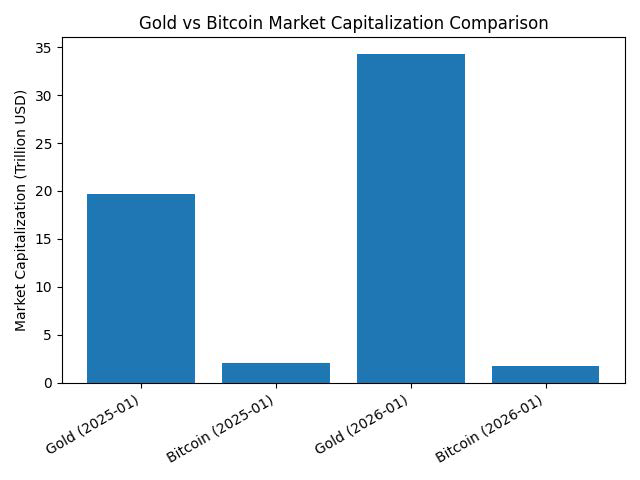
As of January 31, 2025, the global market capitalization of gold stood at approximately $19.7 trillion, while Bitcoin’s market cap was around $2.08 trillion. At that time, gold was valued at roughly 9.5 times Bitcoin.
Fast forward to January 23, 2026, and the contrast has become far more pronounced. Gold’s market capitalization has surged to approximately $34.3 trillion, driven by rising prices and sustained institutional demand. In contrast, Bitcoin’s market cap has declined to roughly $1.78 trillion, expanding the valuation gap to nearly 19 times.
This divergence has fueled renewed debate about whether Bitcoin can truly fulfill its role as a long-term store of value comparable to gold—or whether it is simply lagging in the current macroeconomic cycle.
[Market Capitalization Comparison of Gold and Bitcoin]
2. Diverging Performance in 2025: Gold Shines, Bitcoin Stumbles
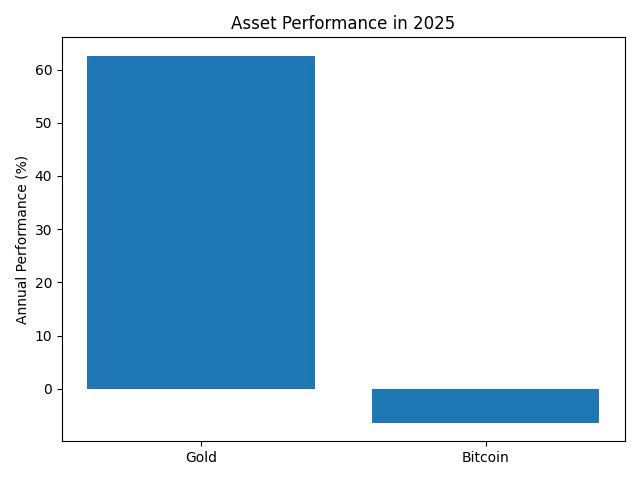
According to CoinGecko’s 2025 annual report, gold emerged as the best-performing major asset class of the year, recording a remarkable +62.6% gain. Several factors contributed to this surge:
- Aggressive gold accumulation by central banks seeking to diversify reserves.
- Heightened geopolitical and trade uncertainty, including renewed tariff tensions.
- Declining real yields, which historically support higher gold prices.
In contrast, Bitcoin posted a -6.4% annual return, marking its first negative year since 2022. A major factor behind this underperformance was a massive liquidation event—estimated at $19 billion—triggered by the announcement of 100% tariffs on Chinese goods by the United States. This shock led to rapid deleveraging across crypto markets, amplifying downside volatility.
[Asset Performance Comparison in 2025]
3. Is Bitcoin Losing Its “Digital Gold” Narrative?
At first glance, Bitcoin’s underperformance relative to gold appears to undermine the “digital gold” thesis. If Bitcoin is meant to hedge against inflation, monetary debasement, and systemic risk, why has it failed to keep pace?
However, such a conclusion may be premature. Bitcoin and gold respond to macroeconomic conditions differently. Gold tends to react quickly to expectations of declining real interest rates and monetary easing. Bitcoin, on the other hand, is far more sensitive to liquidity conditions, risk appetite, and leverage availability.
This distinction is crucial. Bitcoin often remains subdued during early phases of macro transitions, only to accelerate sharply once liquidity visibly returns to financial markets.
4. Historical Cycles: Gold Leads, Bitcoin Follows
Looking back at previous market cycles reveals a recurring pattern: gold rallies first, Bitcoin follows later.
- In periods of tightening or uncertainty, capital flows into gold as a traditional safe haven.
- As central banks pivot toward easing and liquidity expands, risk assets—including Bitcoin—tend to outperform dramatically.
- Bitcoin’s supply constraints and reflexive market structure often amplify these late-cycle inflows.
In prior cycles, Bitcoin’s most explosive rallies occurred after gold had already established a strong upward trend. From this perspective, the current divergence may be less a sign of failure and more a signal that Bitcoin’s phase has yet to begin.
5. What Rising Gold Prices May Be Signaling
Despite the Federal Reserve’s cautious stance on interest rate cuts, gold prices continue to climb. This suggests that markets are front-running future monetary easing, even if policymakers are not yet ready to acknowledge it openly.
Gold’s rally implies declining confidence in long-term real yields and fiat purchasing power. If this interpretation is correct, Bitcoin could benefit significantly once liquidity conditions loosen and investors seek higher-beta alternatives to gold.
In this framework, gold functions as an early warning system, while Bitcoin acts as a delayed—but potentially more explosive—response.
6. The 19x Gap as “Potential Energy”
If Bitcoin were to eventually achieve parity with gold as a global store of value, the current market capitalization gap could be interpreted as latent upside potential rather than permanent disadvantage.
A 19x difference does not mean Bitcoin must immediately catch up—but it does highlight the asymmetry. Even partial convergence could imply substantial appreciation, particularly if institutional adoption, payment use cases, and on-chain financial infrastructure continue to mature.
For investors searching for the next source of asymmetric returns, this gap may represent opportunity rather than risk.
7. Practical Implications for Investors and Builders
For those exploring new crypto assets, revenue opportunities, or practical blockchain applications, several lessons emerge:
- Macro cycles matter. Bitcoin’s performance cannot be evaluated in isolation from liquidity and monetary conditions.
- Timing is critical. Historically, Bitcoin’s strongest rallies occur after macro signals—often led by gold—become clear.
- Infrastructure and utility are increasingly important. Beyond price, Bitcoin’s role in payments, settlement, and collateralization continues to expand.
Developers and entrepreneurs should view the current period not as stagnation, but as a foundation-building phase before the next expansion.
Conclusion: Watching Gold to Understand Bitcoin’s Future
The widening market capitalization gap between gold and Bitcoin is striking, but it is not necessarily bearish for crypto. History suggests that gold often moves first, signaling shifts in monetary conditions that later benefit Bitcoin.
With gold prices surging and market expectations increasingly tilted toward future easing, Bitcoin may be approaching the calm before its next major move. If “digital gold” is to live up to its name, the current 19x gap may ultimately be remembered not as a failure—but as unrealized potential waiting to be unlocked.
