
Main Points :
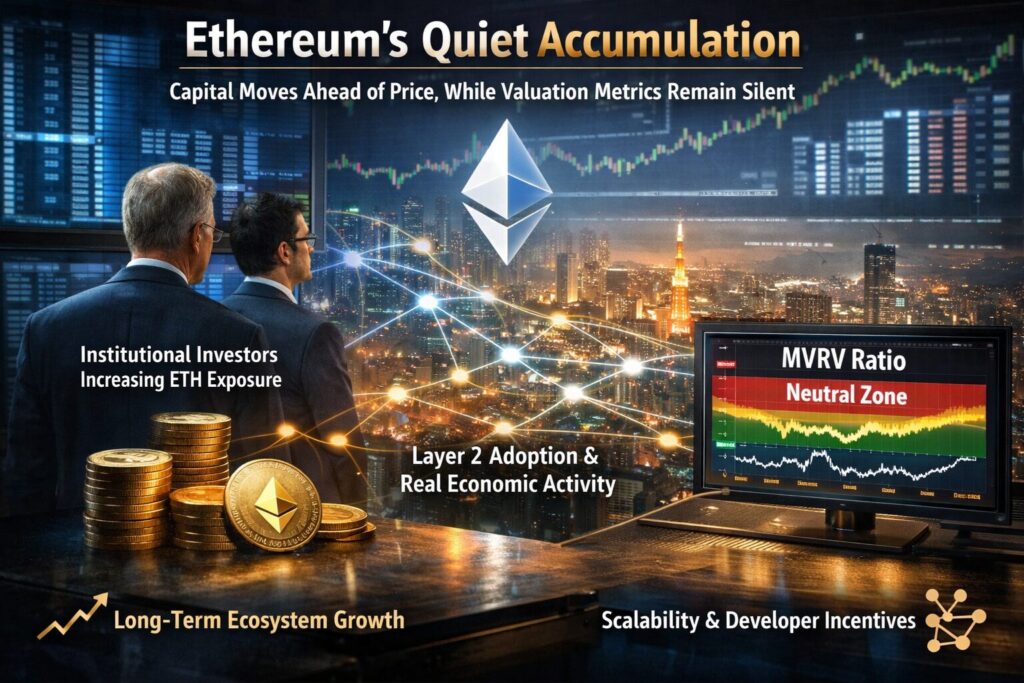
- Institutional investors are steadily increasing ETH exposure through staking-focused, medium- to long-term positioning rather than short-term speculation.
- Network usage continues to expand, driven largely by Layer 2 adoption and real economic activity, even as price and valuation metrics lag behind.
- Ethereum’s protocol design prioritizes long-term ecosystem growth over short-term fee maximization, reinforcing scalability and developer incentives.
- Valuation indicators such as MVRV remain in a neutral zone, suggesting structural consolidation rather than a confirmed bullish trend.
1. Capital Moves Before Price: The Nature of Institutional Accumulation
One of the most notable features of the current Ethereum cycle is the disconnect between capital behavior and price action. Large institutional players are building exposure quietly, without the aggressive leverage or speculative flows that typically characterize late-stage bull markets.
A recent example is BitMine, led by Tom Lee, which staked approximately 82,560 ETH in a single day, equivalent to roughly $260 million. Within a single week, its total staked ETH reportedly reached close to $1.7 billion in value. This activity is not designed to capture short-term price volatility. Instead, it reflects a deliberate strategy to participate in the Ethereum network itself, earning protocol-native yield while maintaining long-term exposure.
This pattern is fundamentally different from speculative inflows observed in previous cycles. Rather than chasing momentum, institutions are positioning ahead of it. Historically, such behavior has tended to precede major shifts in market structure, even if price confirmation arrives much later.
2. Network Activity at Record Highs, Price Still Catching Up
While price action remains relatively subdued, Ethereum’s on-chain activity tells a different story. Transaction counts have reached historical highs, reflecting sustained and growing use of the network.
Importantly, this growth is not primarily driven by short-term trading or meme-driven speculation. Instead, it is increasingly attributed to Layer 2 ecosystems, which now handle a significant share of user activity while settling security back to Ethereum’s mainnet.
This divergence—rising usage with muted price response—suggests that Ethereum has entered a more mature phase. In earlier cycles, price often surged ahead of fundamentals. Today, fundamentals are advancing first, with valuation yet to respond.
3. Ethereum’s Design Choice: Sacrificing Short-Term Fees for Long-Term Growth
From a protocol design perspective, Ethereum continues to demonstrate a long-term orientation that differentiates it from many competing networks.
In 2025, Ethereum intentionally forewent over $100 million in potential fee revenue. Following the Dencun upgrade, fees paid by Layer 2 networks to the Ethereum mainnet amounted to only around $10 million, while Layer 2 ecosystems themselves retained approximately $119 million in revenue.
This imbalance is not an accident. It reflects a strategic choice: prioritize scalability, developer participation, and application growth over immediate base-layer monetization. By allowing Layer 2s to thrive economically, Ethereum strengthens its position as a settlement and security layer rather than extracting maximum value upfront.
Such decisions may suppress short-term revenue metrics, but they reinforce Ethereum’s role as foundational infrastructure for decentralized applications, finance, and digital settlement.
4. Valuation Signals: Understanding MVRV and Realized Price
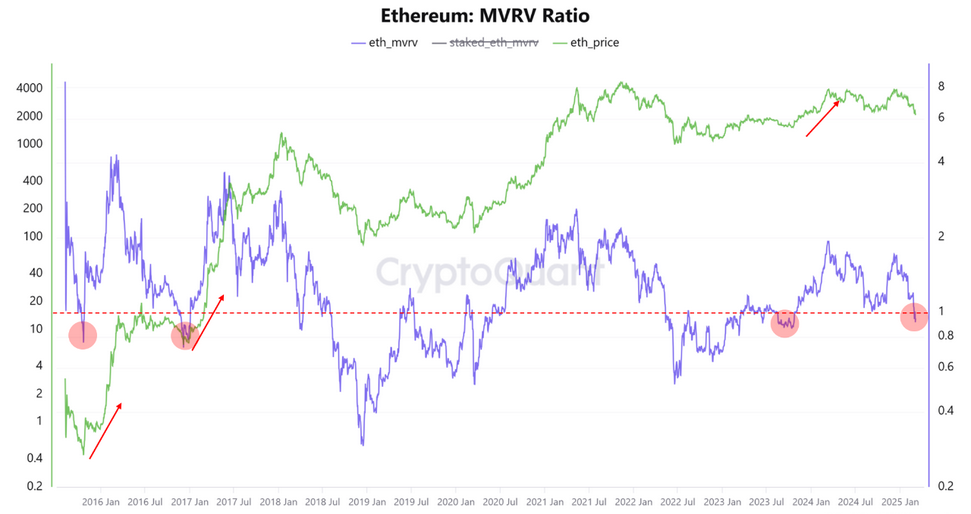
Despite improving fundamentals, valuation indicators remain notably restrained. The Market Value to Realized Value (MVRV) ratio—a commonly used on-chain metric—provides a clear illustration.
MVRV compares Ethereum’s current market price to the average acquisition cost of all holders (the Realized Price). Historically, strong bull markets have been accompanied by elevated MVRV levels, indicating widespread unrealized profits. Conversely, deep bear markets have coincided with low MVRV readings, where selling pressure tends to exhaust itself.
At present, Ethereum’s MVRV sits near its long-term neutral zone. It is neither overheated nor deeply undervalued.
This positioning implies two things:
- Downside pressure may be limited, as most holders are not sitting on extreme losses.
- The market has not yet entered a phase where broad unrealized gains fuel aggressive risk-taking.
In other words, the current environment supports structural consolidation, not an explosive trend—at least for now.
5. Base Scenario: Structural Consolidation Backed by Fundamentals
Given the data, the most plausible base scenario is a prolonged period of range-bound movement or gradual adjustment, supported by improving fundamentals rather than speculative excess.
Ethereum’s ecosystem continues to expand quietly: developers build, institutions stake, and users transact—often without fanfare. Price may eventually reflect these developments, but the absence of leverage-driven euphoria suggests that the system is still early in its next major phase.
That said, this assessment is conditional. A sharp rise in MVRV or a renewed surge in leverage-driven speculation would warrant a reassessment. Until then, Ethereum appears to be accumulating strength beneath the surface.
6. Interpreting On-Chain Metrics Correctly
It is important to emphasize that metrics like MVRV are not price prediction tools. They do not tell investors where ETH “should” trade, nor do they signal exact turning points.
Instead, they provide context. MVRV around 1 typically coincides with balance between profits and losses, often leading to sideways or corrective markets. High values suggest overheating; low values suggest capitulation. The current neutral reading simply tells us where the market stands—not where it must go.
For Ethereum, this reinforces a broader narrative: the network is advancing ahead of market recognition.
Conclusion: Ethereum’s Silent Phase Before the Next Narrative
Ethereum today is characterized by quiet accumulation, expanding real usage, and restrained valuation signals. Institutions are positioning through staking, not speculation. Developers and Layer 2 ecosystems are capturing economic value. And on-chain metrics suggest stability rather than excess.
For investors and operators seeking long-term exposure to blockchain infrastructure, this phase may prove more significant than headline-driven rallies. Ethereum is not shouting its progress—but history suggests that such silent phases often precede the loudest moves.
