
Main Points :
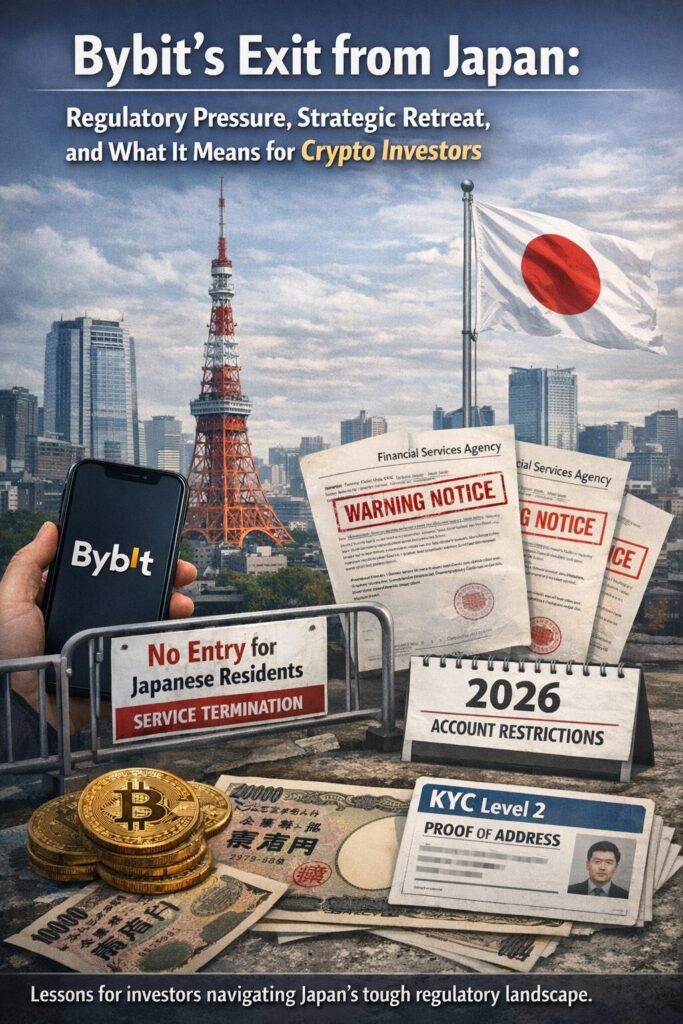
- Bybit announced a phased termination of services for Japan residents, marking a de facto exit from the Japanese market.
- The move follows three formal warnings from Japan’s Financial Services Agency (FSA) for operating without registration.
- Account restrictions will begin in 2026, with residency determined by KYC Level 2 (proof of address).
- Japan’s regulatory framework remains one of the strictest globally, shaping how foreign exchanges approach the market.
- The case offers critical lessons for investors seeking new crypto assets, yield opportunities, and practical blockchain use under regulatory constraints.
1. Background: Bybit’s Announcement and Immediate Impact
On December 22, 2025, Bybit—one of the world’s largest cryptocurrency exchanges—announced that it would terminate services for residents of Japan and introduce phased account restrictions starting in 2026.
Users classified as Japan residents will gradually face limitations, the full details of which are to be disclosed later.
To avoid being automatically categorized as a Japan resident, affected users must complete KYC Level 2 verification, including proof of address, by January 22, 2026. Failure to do so will result in the account being conclusively treated as belonging to a Japan resident.
This announcement followed an earlier step taken on October 31, 2025, when Bybit halted new account registrations for Japanese residents. While the company initially stated that existing users would not be immediately affected, the December announcement effectively confirmed a strategic withdrawal from Japan.
2. Regulatory Context: Japan’s Financial Services Agency and the Warning History
Financial Services Agency has issued three warnings to Bybit for conducting unregistered crypto asset exchange operations:
- May 2021
- March 2023
- November 2024
Under Japan’s Payment Services Act, any entity providing crypto asset exchange services to Japan residents must register with the FSA and comply with strict requirements, including:
- Segregation of customer assets
- Robust AML/CFT frameworks
- Ongoing reporting and audit obligations
Bybit’s repeated warnings indicate that Japanese regulators were willing to publicly signal non-compliance while giving the exchange time to adjust. The December 2025 decision suggests that Bybit ultimately concluded that full compliance costs and operational constraints outweighed the benefits of remaining in the Japanese market.
3. Why Japan Is Different: A Global Comparison
Japan was among the first major economies to establish a comprehensive crypto regulatory framework after the 2014 Mt. Gox collapse. While this has enhanced consumer protection, it has also created a high barrier to entry.
Regulatory Strictness Comparison (Illustrative)
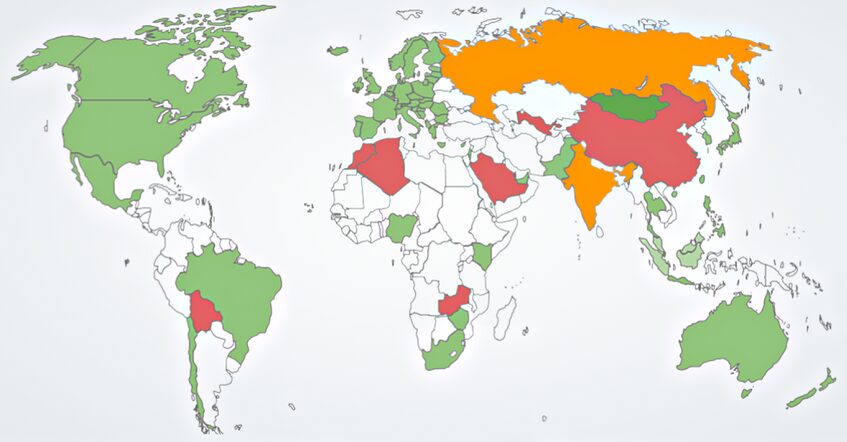

[Comparative chart of crypto regulatory strictness — Japan vs US vs EU vs Singapore]
- Japan: Mandatory registration, strict custody rules, limited leverage
- EU (MiCA): Harmonized framework, gradual implementation
- US: Fragmented oversight (SEC, CFTC, state regulators)
- Singapore: Licensing regime with clearer pathways for foreign firms
For global exchanges like Bybit, Japan represents high compliance certainty but low flexibility, especially for derivatives, leverage, and rapid product iteration.
4. Strategic Retreat or Rational Reallocation?
From a business perspective, Bybit’s exit does not signal weakness but capital reallocation. Major exchanges increasingly concentrate on jurisdictions where:
- Regulatory frameworks are clear but scalable
- Product innovation (staking, derivatives, structured yield) is permitted
- Compliance costs align with market size and growth potential
Japan’s market is sizable but mature and conservative, with many users already served by domestic licensed exchanges. For Bybit, reallocating resources to regions such as the Middle East, Eastern Europe, or parts of Asia may offer higher ROI.
5. Impact on Japanese Users: Practical Considerations
For Japanese users, the implications are immediate and practical:
- Account limitations beginning in 2026
- Potential forced migration of assets to domestic exchanges
- Reduced access to high-yield or advanced trading products
This reinforces a broader trend: regulatory borders increasingly define user experience in crypto.
Asset Migration Flow (Conceptual)
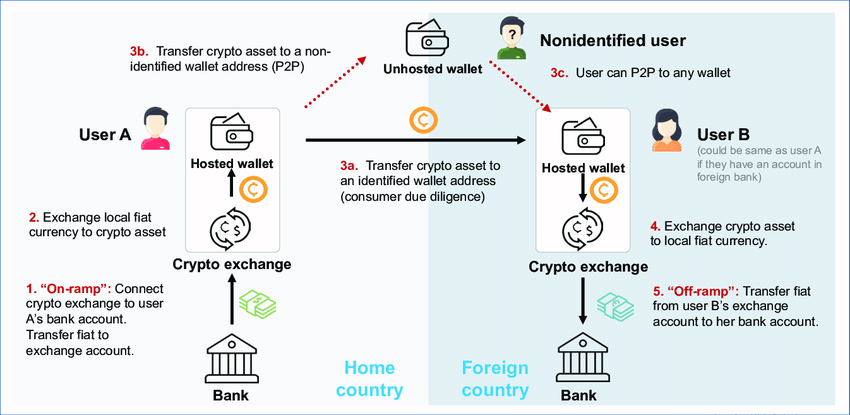
[Diagram showing user asset migration from Bybit to domestic exchanges or self-custody wallets]
6. Lessons for Crypto Investors and Builders
For readers seeking new crypto assets and income opportunities, the Bybit case underscores several lessons:
- Regulatory Risk Is Real
Yield, liquidity, and innovation can disappear overnight due to jurisdictional changes. - Self-Custody and On-Chain Finance Matter
Decentralized protocols, when used correctly, reduce reliance on centralized intermediaries. - Compliance Shapes Product Design
Builders must design services that can adapt to multiple regulatory regimes without fragmenting UX.
7. Broader Market Implications
Bybit is not alone. Other offshore exchanges have either:
- Established Japan-specific licensed entities, or
- Exited the market entirely
This trend may accelerate consolidation among domestic Japanese exchanges, while pushing sophisticated users toward:
- Overseas-compliant platforms
- Decentralized finance (DeFi)
- Hybrid CeFi–DeFi models
8. Conclusion: A Signal, Not an Endpoint
Bybit’s withdrawal from Japan is not the end of crypto adoption in the country. Rather, it highlights a structural tension between innovation and regulation. For investors and builders, the message is clear:
Understanding regulatory geography is as important as understanding tokenomics.
Those who can navigate both will be best positioned to discover the next generation of crypto assets, revenue models, and practical blockchain applications.
