
Main Points :
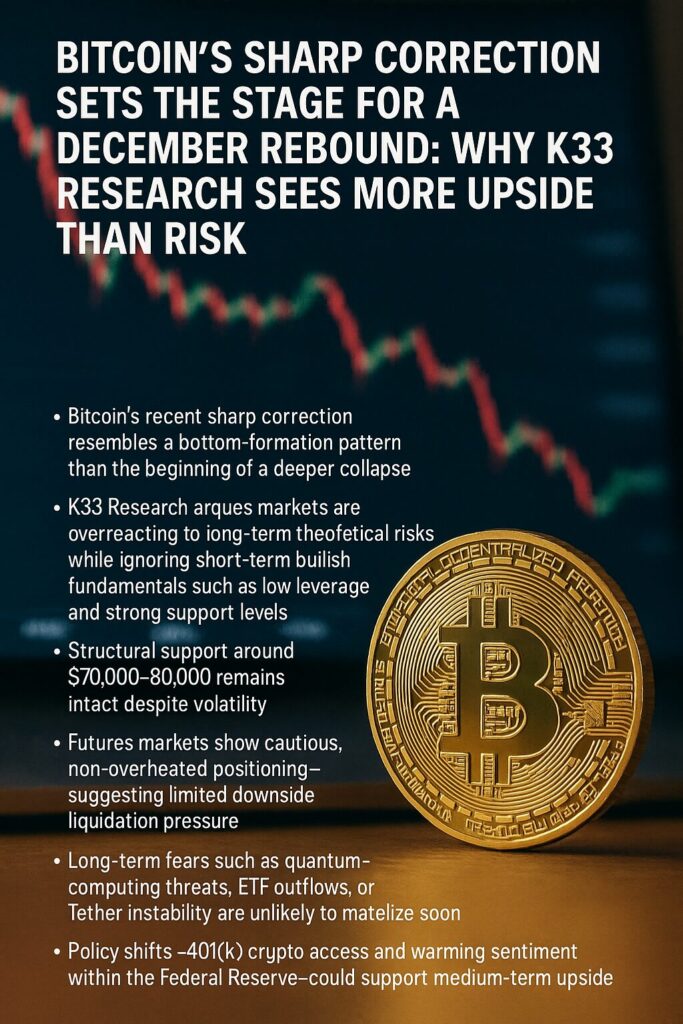
- Bitcoin’s recent sharp correction resembles a bottom-formation pattern rather than the beginning of a deeper collapse.
- K33 Research argues markets are overreacting to long-term theoretical risks while ignoring short-term bullish fundamentals such as low leverage and strong support levels.
- Structural support around $70,000–$80,000 remains intact despite volatility.
- Futures markets show cautious, non-overheated positioning—suggesting limited downside liquidation pressure.
- Long-term fears such as quantum-computing threats, ETF outflows, or Tether instability are unlikely to materialize soon.
- Policy shifts—401(k) crypto access and warming sentiment within the Federal Reserve—could support medium-term upside.
- December may offer “accumulation opportunities,” particularly for investors seeking new assets, yield streams, and real-world blockchain use cases.
Introduction: A Correction That Doesn’t Behave Like a Collapse
Bitcoin’s slide through late November and early December has caused anxiety across the market. Prices briefly fell below levels traders assumed were secure, and sentiment deteriorated sharply. Yet K33 Research argues that this downturn should not be interpreted as the start of an 80% drawdown or a broader structural breakdown. Instead, it may serve as the final flush that prepares markets for a December rebound.
Analyst Vetle Lunde notes that although the correction has been the steepest since the previous bear market, the broader market structure today is fundamentally different. The data suggests that despite selling pressure from structural sources—chiefly Bitcoin spot ETFs turning net sellers in November—downside momentum is not being matched by panic-driven leverage unwinding.
Markets, K33 says, are reacting emotionally to threats that sound catastrophic but are not realistically imminent. Meanwhile, they are ignoring multiple data points that historically precede relief rallies and medium-term trend reversals.
Macro Conditions: ETFs, Futures, and the TradFi Hesitation
One of the biggest contributors to Bitcoin’s pullback has been the shift in ETF flow dynamics. For most of 2024 and 2025, spot Bitcoin ETFs were a major source of net inflows. But in November, these vehicles turned into net sellers—a noteworthy headwind given the size of ETF-driven demand.
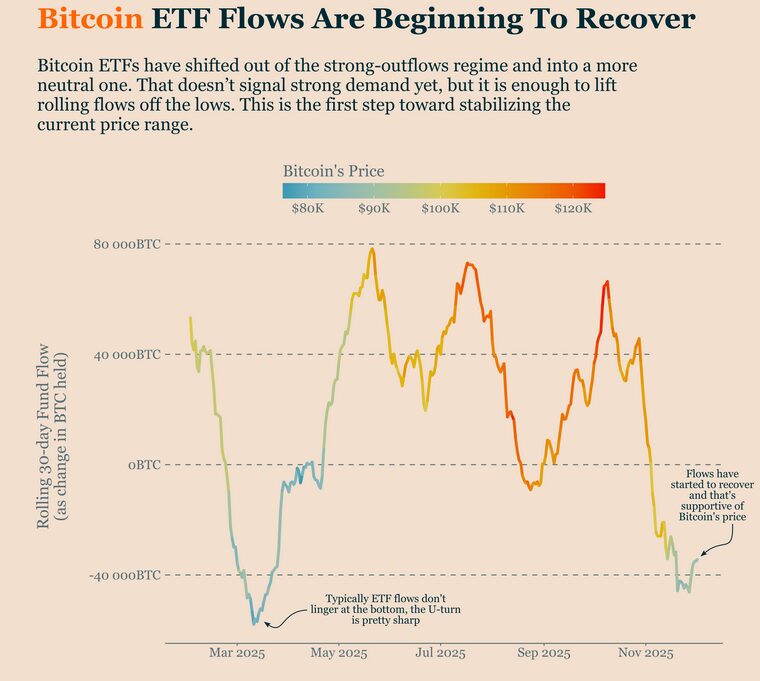
At the same time:
- CME Bitcoin futures volume dropped to multi-year lows
- Institutional (TradFi) participation pulled back
- Bitcoin underperformed equities, falling to its weakest relative level versus the Nasdaq since 2024
This paints a picture of hesitation rather than conviction-based selling. TradFi investors are waiting for clarity on macro policy—especially around rate cuts and liquidity expansion—before recommitting capital.
Yet from a contrarian standpoint, such low participation often marks a late-stage correction rather than the start of a full bear cycle.
Why K33 Research Believes the Market Is Overreacting
1. Structural Support Remains Strong Around $70,000–$80,000
Bitcoin is currently trading near one of the most historically significant support zones of this entire cycle. The $70,000–$80,000 range represents:
- A long-term demand accumulation area
- The upper boundary of 2024’s consolidation channel
- A region with repeated validated support tests
Even during deep sell-offs, buyers have consistently added exposure in this band.2. Futures Markets Show Low Leverage and No Liquidation Spiral
This point is crucial for derivatives-driven markets like crypto.
K33 emphasizes that:
- Open interest is not elevated
- Funding rates are not overheated
- Perpetual futures show net-neutral to slightly negative funding
- No significant long liquidation cascades have occurred
When markets crash from overleveraged conditions, liquidation chains amplify the downside. But when leverage is low, selling pressure loses momentum more quickly.
This is why K33 concludes that another catastrophic 80% drop is “statistically and structurally unrealistic” given the current environment3. Catastrophic Long-Term Threats Are Real but Not Immediate
The market has priced in fears that are unlikely to materialize soon, including:
- Quantum-computing attacks
- Major ETF sponsors unwinding positions
- Tether solvency or regulatory pressure
- Corporate treasury liquidations such as Strategy’s Bitcoin holdings
While these threats generate dramatic headlines, K33 argues:
“None of these risks are realistically positioned to impact Bitcoin pricing in the near future. Each would require years—not months—to fully materialize.”
Markets often overreact to long-term uncertainties while ignoring actionable, short-term signals.
Short-Term Bullish Catalysts That Traders Are Ignoring
1. Policy Tailwinds: 401(k) Access and Evolving U.S. Federal Stance
Several policy developments could become structural bullish catalysts:
- Discussions around allowing U.S. 401(k) retirement accounts broader access to crypto
- Gradual warming of sentiment inside the Federal Reserve toward digital asset innovation
- Legislative momentum around clearer digital-asset taxation and custody rules
These developments may encourage institutional re-entry, similar to how ETF approvals unlocked an entirely new demand category.2. Fear Has Pushed Bitcoin Below Fundamental Value
K33 notes that Bitcoin’s current valuation reflects fear rather than fundamentals. Risk appetite collapsed faster than macro or on-chain data can justify. Historically, when fear drives undervaluation, medium-term rebounds follow—especially when leverage is low and investors hold stable long-term conviction.
Technical Outlook: Support Zones and Market Structure
K33 sees Bitcoin’s recent downturn as technically significant but not structurally destructive. Their model highlights:
- A resilient support zone at $70k–$80k
- Oversold conditions on short-term momentum indicators
- No breakdown below long-term moving averages
- A lack of aggressive leveraged short positioning
Below is a conceptual chart illustrating Bitcoin’s price movement relative to the support zone.
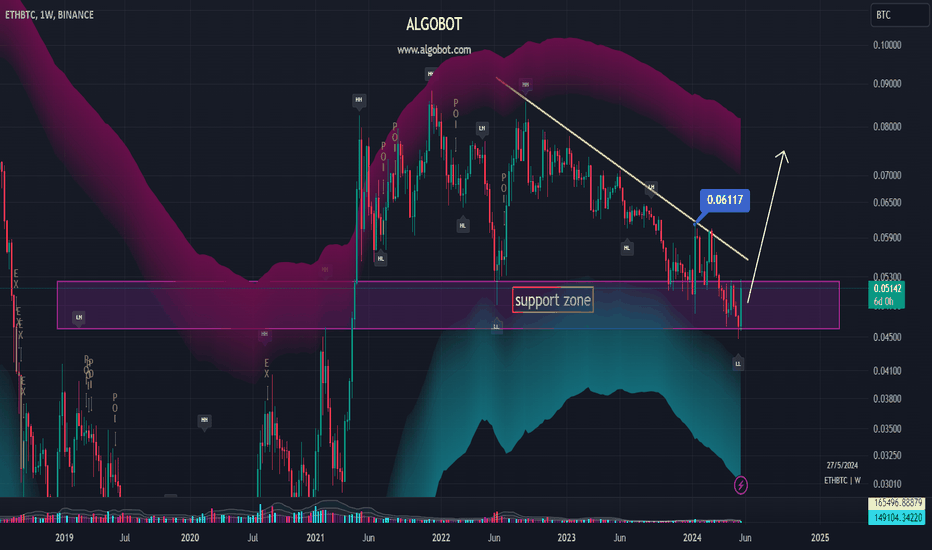
This simplified chart highlights how Bitcoin’s corrections repeatedly revisit but do not violate the structural support area. The durability of this zone reinforces K33’s view that downward risk is limited.
Market Psychology: Why December Could Be the Turnaround Month
Historically, December has been a strong month for Bitcoin, with several cycles showing:
- Post-correction rebounds
- Increased institutional allocation before year-end
- Improved liquidity conditions entering Q1
Moreover, cautious futures positioning means that if spot buyers return—especially ETF flows—there is little resistance to upward price movement.
K33 argues that:
“The market remains fearful, but this fear is creating opportunity rather than signaling collapse.”
For investors searching for new digital assets, yield-generating opportunities, or early-stage blockchain projects, December could represent the re-emergence of a favorable risk-reward environment.
Broader Crypto Trends to Watch (External Market Research Added)
Beyond the K33 analysis, several real-world developments strengthen the upside potential:
1. Expansion of Global Spot ETF Markets
Japan, South Korea, and parts of the EU have begun exploring Bitcoin ETF frameworks. Global ETF expansion historically increases liquidity and reduces volatility over time.
2. Cross-chain interoperability growth
Projects such as Chainlink CCIP, Cosmos IBC, and LayerZero continue enabling asset mobility across chains—opening new opportunities for yield, liquidity aggregation, and real-world tokenization.
3. Enterprise and banking adoption
Banks in Singapore, Hong Kong, and Europe increasingly integrate tokenized deposits, stablecoin rails, or institutional DeFi solutions.
These trends suggest that even if Bitcoin faces temporary volatility, the broader crypto ecosystem is strengthening structurally.
Conclusion: A Correction With More Opportunity Than Danger
K33 Research concludes that Bitcoin’s December correction is better interpreted as an opportunity than a warning. The combination of:
- Low leverage
- Strong support levels
- Overblown long-term fears
- Potential policy tailwinds
- Weak but stabilizing institutional participation
creates a market setup where upside potential outweighs downside risk.
For traders and long-term investors looking for new crypto assets, income streams, and real-world blockchain applications, December may offer some of the most favorable risk-reward conditions since early 2024.
The message is clear:
“This is not the beginning of an 80% collapse. It is the exhaustion phase before the next expansion.”
