
Key Points :
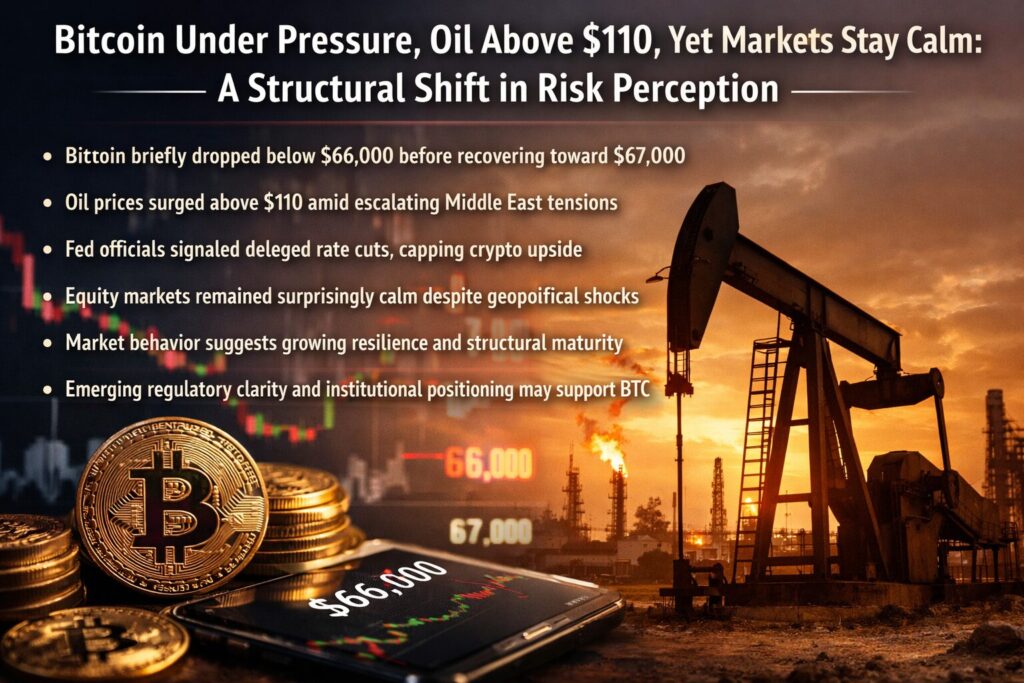
- Bitcoin briefly dropped below $66,000 before recovering toward $67,000
- Oil prices surged above $110 amid escalating Middle East tensions
- Federal Reserve officials signaled delayed rate cuts, capping crypto upside
- Equity markets remained surprisingly calm despite geopolitical shocks
- Market behavior suggests growing resilience and structural maturity
- Emerging regulatory clarity and institutional positioning may support BTC
BTC Price Reaction vs Oil Spike
1. A Market That Refuses to Panic
The global financial landscape in early April 2026 presents a paradox that would have seemed improbable just a few years ago. Bitcoin, often described as a high-beta risk asset, experienced a sharp decline following geopolitical escalation, while oil surged past $110 per barrel. Yet, equity markets—historically sensitive to such shocks—remained largely composed.
Bitcoin fell from near $69,000 to below $66,000 following renewed tensions involving Iran, the United States, and regional actors. However, the recovery toward $67,000 suggests that panic selling was limited and short-lived. This resilience is particularly notable given the simultaneous spike in oil prices and uncertainty around global monetary policy.
Traditionally, such a combination—geopolitical instability, rising energy costs, and hawkish central bank signals—would trigger broad risk-off behavior. But the current market appears to be operating under a new paradigm.
2. Geopolitics and Oil: The Dominant Macro Driver
Oil Price Surge and Strait of Hormuz Risk

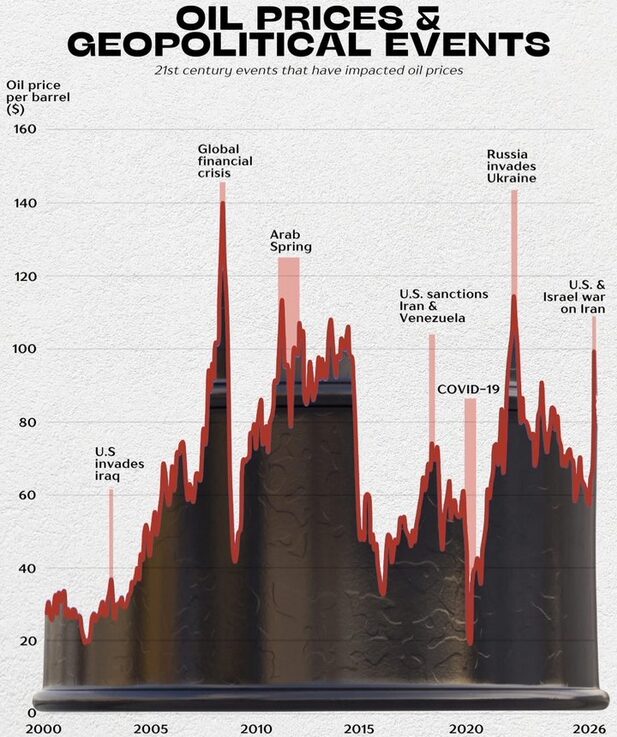
The immediate catalyst for market volatility was a renewed escalation in Middle East tensions. Statements from political leadership indicating intensified military action, combined with retaliatory strikes, pushed oil prices to nearly $114 per barrel.
The strategic importance of the Strait of Hormuz cannot be overstated. As one of the world’s most critical oil chokepoints, any perceived disruption instantly translates into price volatility. Reports suggesting Iran may maintain effective control over the region—even in a negotiated outcome—add a layer of long-term uncertainty to energy markets.
Interestingly, while oil reacted violently, equities did not follow suit. This divergence suggests that investors may be interpreting the situation not as the beginning of a prolonged conflict, but as a high-stakes negotiation nearing resolution.
3. Bitcoin’s Technical Structure: Weakness with Underlying Support
From a technical perspective, Bitcoin exhibited several bearish signals:
- Breakdown from an ascending channel
- Formation of a descending flag
- Ichimoku “three bearish signals” alignment
These indicators typically precede further downside. However, the market’s behavior contradicted a full bearish continuation.
The rebound from sub-$66,000 levels indicates the presence of strong buying interest. Compared to earlier phases in the cycle, several stabilizing factors are now in play:
- ETF outflows have stabilized
- Institutional positioning is more strategic than speculative
- Liquidity conditions, while tightening, remain manageable
This suggests that Bitcoin is transitioning from a purely speculative asset toward a structurally supported macro instrument.
4. The Federal Reserve Factor: A Ceiling on Risk Assets
Another key factor limiting Bitcoin’s upside is the evolving stance of the Federal Reserve. Officials, including regional Fed presidents, expressed concern that rising oil prices could delay anticipated rate cuts.
Higher-for-longer interest rates typically suppress risk assets by:
- Increasing the opportunity cost of holding non-yielding assets like Bitcoin
- Strengthening the U.S. dollar
- Tightening overall financial conditions
This dynamic creates a ceiling effect: even when Bitcoin shows resilience, macro headwinds prevent sustained rallies.
5. Why Equity Markets Remain Calm
Perhaps the most intriguing aspect of the current environment is the relative calm in equity markets. Several explanations can be considered:
1. Negotiation Phase Interpretation
Investors may believe that the current escalation represents the final stage of negotiations rather than the start of a prolonged war.
2. Risk Pricing Already Embedded
Markets may have already priced in the risk of oil supply disruption and regional instability.
3. Structural Liquidity and Passive Flows
Modern markets are heavily influenced by passive investment strategies, which dampen short-term volatility.
4. Diversification of Risk Across Asset Classes
With crypto, commodities, and equities behaving differently, systemic risk is being distributed rather than concentrated.
This calmness does not necessarily indicate safety—but rather a shift in how risk is absorbed.
6. Emerging Positive Catalysts in the Crypto Space
Amid macro uncertainty, several constructive developments are emerging within the crypto industry:
- Discussions around regulatory clarity (e.g., potential “Clarity Act”-type frameworks)
- Increasing institutional engagement
- Strategic investments in future technologies such as quantum-resistant systems
Major exchanges and infrastructure providers are signaling a long-term commitment to strengthening the ecosystem. This is particularly important for investors seeking sustainable opportunities rather than short-term speculation.
7. Structural Shift: Bitcoin as a Hybrid Asset
Bitcoin is increasingly behaving as a hybrid between:
- A risk asset (sensitive to liquidity and macro conditions)
- A hedge-like instrument (resilient during geopolitical instability)
This dual nature creates complex price dynamics. In the current scenario:
- Geopolitical risk pushes investors toward alternative assets
- Monetary tightening limits the upside
The result is a market that moves sideways with high volatility but limited directional conviction.
8. Forward Outlook: Fragile Stability with Hidden Strength
Looking ahead, the Bitcoin market faces a delicate balance:
Downside Risks
- Further escalation in geopolitical conflict
- Sustained oil prices above $110
- Delayed or canceled rate cuts
Upside Catalysts
- De-escalation or diplomatic breakthroughs
- Regulatory clarity boosting institutional confidence
- Continued absorption of selling pressure
The most likely scenario in the near term is not a dramatic collapse or breakout, but a continuation of range-bound volatility with underlying support.
Conclusion: A Market That Has Learned to Endure
The events of early April 2026 highlight a critical evolution in global markets. Bitcoin’s ability to recover quickly, combined with the composure of equity markets, suggests that investors are no longer reacting reflexively to geopolitical shocks.
Instead, markets appear to be:
- Interpreting events within broader strategic contexts
- Pricing risk more efficiently
- Relying on structural liquidity and institutional frameworks
For crypto investors, this marks an important transition. The opportunity is no longer simply in volatility, but in understanding how Bitcoin fits into a multi-asset, macro-driven world.
