
Main Points :
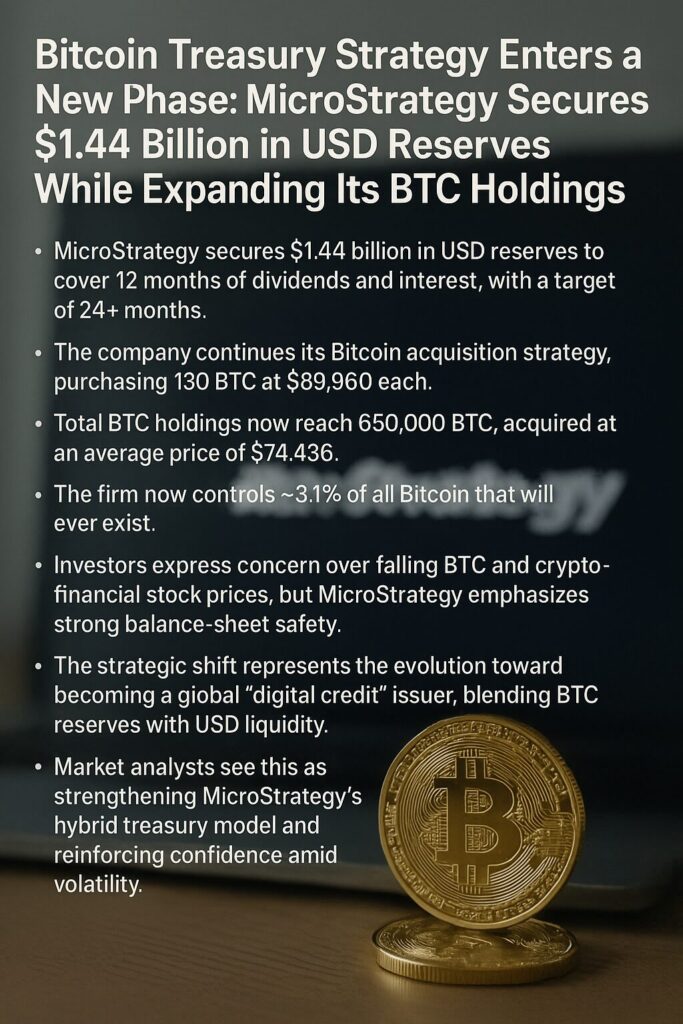
- MicroStrategy secures $1.44 billion in USD reserves to cover 12 months of dividends and interest, with a target of 24+ months.
- The company continues its Bitcoin acquisition strategy, purchasing 130 BTC at $89,960 each.
- Total BTC holdings now reach 650,000 BTC, acquired at an average price of $74,436.
- The firm now controls ~3.1% of all Bitcoin that will ever exist.
- Investors express concern over falling BTC and crypto-financial stock prices, but MicroStrategy emphasizes strong balance-sheet safety.
- The strategic shift represents the evolution toward becoming a global “digital credit” issuer, blending BTC reserves with USD liquidity.
- Market analysts see this as strengthening MicroStrategy’s hybrid treasury model and reinforcing confidence amid volatility.
1. Introduction: A New Phase in Corporate Bitcoin Strategy
MicroStrategy — widely regarded as the world’s largest corporate holder of Bitcoin — has entered a new chapter in its long-term Bitcoin treasury strategy. On December 1st, the company announced that it had secured $1.44 billion (approximately ¥224 billion) in USD reserves specifically dedicated to covering preferred stock dividends and interest payments arising from past capital-raising activities.
Unlike previous fund-raising rounds, which primarily fueled direct Bitcoin acquisitions, this latest move enhances liquidity and aims to stabilize the company’s financial structure for the long run. It reflects an increasingly mature “Bitcoin-plus-cash” balance-sheet model that seeks to reduce short-term volatility risks while preserving upside potential.

2. Why MicroStrategy Secured $1.44 Billion in USD Reserves
2.1 A Shift from Pure Bitcoin Accumulation to Hybrid Stability
For years, MicroStrategy issued convertible bonds and preferred shares to raise capital, directing most of the proceeds into Bitcoin purchases. This led to an unprecedented accumulation of BTC—transforming the company into a de facto Bitcoin investment vehicle.
However, these earlier issuances also created obligations:
- Preferred stock dividends
- Interest payments on convertible bonds
- Ongoing financing commitments
Instead of relying solely on continued market strength or future Bitcoin appreciation, MicroStrategy now wants to ensure predictability.
The newly raised $1.44 billion was obtained through an at-the-market (ATM) equity offering program. This method sells Class A shares on the open market gradually, reducing heavy impact on share price.
2.2 Maintaining 12 Months of Payments — Targeting 24 Months Later
The company announced:
- It currently holds 12 months worth of liquidity for obligations.
- It aims to secure 24 months or more, offering durability even in prolonged downturns.
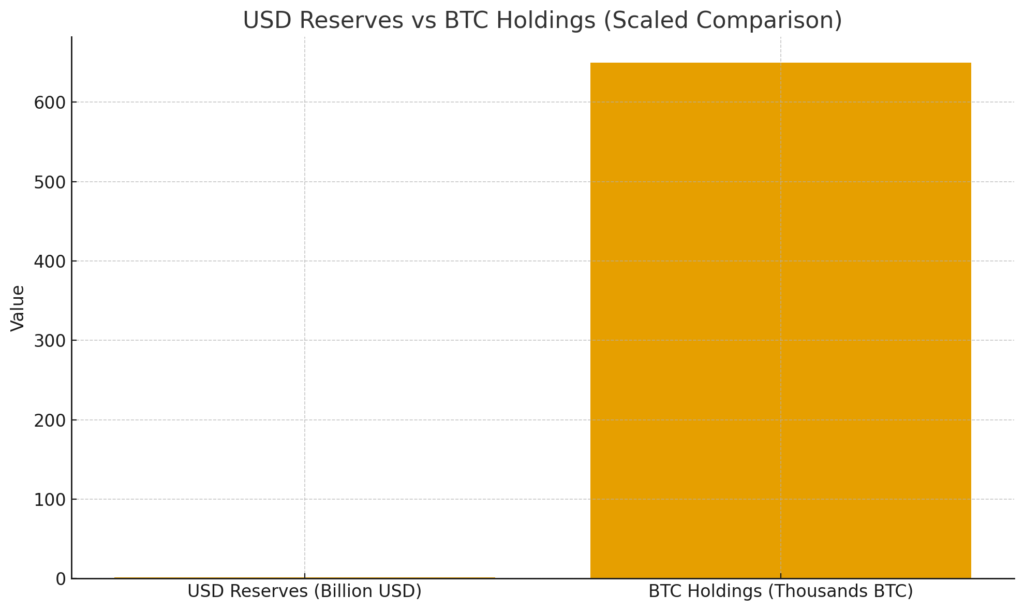
This represents an evolution in MicroStrategy’s approach. Previously, Bitcoin acted as both long-term reserve asset and implicit liquidity buffer, meaning selling BTC could theoretically satisfy obligations. But the new model puts cash buffers in place — allowing the Bitcoin holdings to remain untapped and intact.
3. Saylor’s Vision: “Digital Credit” and the Future of Corporate Treasury
Executive Chairman Michael Saylor framed the move as a strategic leap toward becoming a global issuer of digital credit. According to Saylor:
“Securing USD reserves to complement our Bitcoin reserves is the next step in our evolution. These reserves help us navigate short-term market volatility and support our vision of becoming the world’s leading issuer of digital credit.”
This concept blends two fundamentals:
3.1 Bitcoin as Long-Term Collateral
Bitcoin remains the backbone of MicroStrategy’s balance sheet. Its scarcity and long-term appreciation potential align with Saylor’s philosophical stance that BTC is “digital property” and superior to traditional stores of value.
3.2 USD Reserves as Short-Term Liquidity
The company acknowledges that financial obligations require stable, predictable cash flows—not volatile assets.
The dual-reserve model positions MicroStrategy somewhere between:
- A corporate treasury,
- A Bitcoin investment trust, and
- A proto-digital-credit institution.
This hybrid architecture is drawing significant interest from institutions studying Bitcoin treasury models.
4. Investor Concerns and Market Context
4.1 Declining Bitcoin Price and Crypto-Financial Stocks
Investors have been watching the recent price decline in Bitcoin, as well as a broader downturn in publicly traded crypto-financial firms. MicroStrategy’s share price, for instance, trades at $174.38 in after-hours trading—down roughly 55% from six months ago.
Despite this, the firm highlights:
- Even if Bitcoin drops to $74,000, it still holds 5.9× the value relative to its outstanding convertible notes.
- Its Bitcoin holdings are not encumbered and remain free from liens.
This message aims to ease investor concerns about leverage risk.
4.2 Market Perception: Confidence or Desperation?
Analysts have interpreted the news in two ways:
Positive Outlook
- Strengthened liquidity reduces the likelihood of forced BTC selling.
- Reinforces MicroStrategy’s ability to weather bear cycles.
- Solidifies its position as the largest BTC treasury.
Negative Interpretation
- The ATM equity program may cause gradual dilution.
- Investors may interpret the move as defensive amid volatility.
On balance, corporate finance analysts generally see the liquidity upgrade as rational and prudent—especially given MicroStrategy’s bold, long-term Bitcoin strategy.
5. MicroStrategy’s Latest Bitcoin Purchase: 130 BTC at $89,960
5.1 Continued Accumulation Despite Volatility
On December 1st, Saylor announced a new purchase:
- 130 BTC
- Price per BTC: $89,960
- Acquisition period: Nov 17–30
- Total BTC holdings: 650,000 BTC
- Average cost basis: $74,436
This purchase might seem small compared to their massive holdings, but symbolically it reinforces:
- Long-term commitment
- Opportunistic buying amid price dips
- Steady accumulation rather than sporadic speculation
5.2 3.1% of Total Bitcoin Supply
Given Bitcoin’s hard-capped 21 million supply, MicroStrategy now owns approximately:
650,000 / 21,000,000 ≈ 3.1%
No other corporation or institution comes close to this level of BTC concentration.
6. Industry and Regulatory Landscape
6.1 Institutional Bitcoin Demand Remains Strong
Major financial institutions continue pushing into the Bitcoin ecosystem:
- Expanded institutional custody offerings
- Derivative and spot product development
- Global ETF frameworks
- Growing stablecoin adoption for payments
MicroStrategy’s dual-reserve announcement aligns with this macro trend: the merging of traditional finance and digital assets.
6.2 Companies Are Emulating MicroStrategy’s Treasury Approach
Many firms now explore BTC-based treasury diversification, especially in:
- Technology sectors
- International remittance businesses
- Fintech platforms
- High-growth startups seeking inflation hedges
MicroStrategy’s model is increasingly studied as a case of modern corporate finance intersecting with blockchain economics.
7. What This Means for Crypto Investors and Builders
7.1 Lessons for Investors Seeking New Crypto Assets
MicroStrategy’s strategic shift suggests:
- Holding long-term reserves (BTC) is powerful, but liquidity buffers (USD) are equally important.
- High-leverage BTC strategies must be offset with institutional-grade liquidity planning.
- Corporate accumulation continues even during market uncertainty.
7.2 Lessons for Blockchain Businesses
Entrepreneurs building crypto products should take note:
- Market volatility requires dual-denomination treasury strategies.
- Regulatory clarity and liquidity protection attract investor confidence.
- BTC can serve as long-term treasury collateral without replacing stable cash positions.
8. Conclusion: A More Resilient Bitcoin-Treasury Future
MicroStrategy’s decision to secure $1.44 billion in USD reserves signals the beginning of a more mature phase in the Bitcoin corporate economy. It blends:
- Bitcoin’s long-term, inflation-resistant properties, and
- USD’s short-term stability and liquidity.
This hybrid model strengthens financial durability and enables continued BTC accumulation without compromising operational safety.
For investors, builders, and companies exploring digital-asset strategies, MicroStrategy offers a rare example of large-scale execution and disciplined risk management. Its approach may become a blueprint for future corporate Bitcoin treasuries worldwide.
