

Main Points :
- Bitcoin fell below the psychological $70,000 level for the first time since early February amid renewed macro uncertainty.
- U.S. policy risks—particularly tariff tensions and the unresolved “Clarity Act” crypto market structure bill—have intensified risk-off sentiment.
- The decline appears to be spot-driven rather than a derivatives-led liquidity crisis, suggesting a structurally “healthy” correction.
- Options markets show rising put demand and a higher Put/Call Ratio (PCR), signaling short-term downside hedging.
- AI-related systemic risk narratives are gaining traction, adding to macro tail-risk awareness across global markets.
- Upcoming economic events and regulatory deadlines may define Bitcoin’s next major directional move.
1. Bitcoin Breaks the $70,000 Psychological Floor
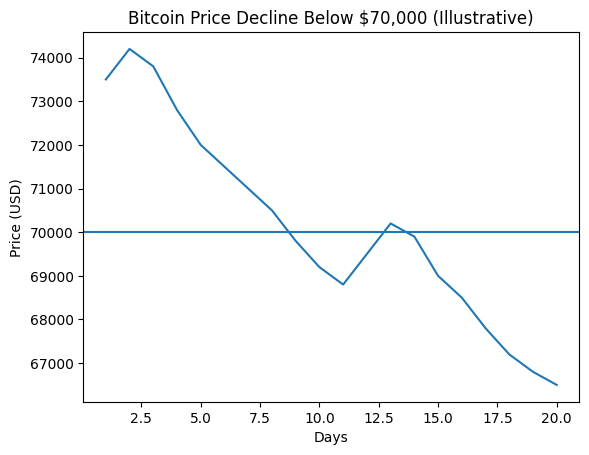
Bitcoin (BTC) declined sharply between February 23 and 24, slipping below the key psychological threshold of $70,000 (approximately ¥10 million equivalent). This marks the first decisive breach of that level since February 6, underscoring a shift in short-term sentiment.
The drop was not triggered by a single technical catalyst. Instead, it reflects a broader macro-driven risk-off environment. U.S. equities weakened simultaneously, and risk-sensitive assets—including crypto—were caught in the downdraft. Importantly, Bitcoin’s fall occurred in tandem with global equity pressure rather than in isolation.
Psychological levels such as $70,000 often act as liquidity magnets. When breached, they can trigger algorithmic stop-loss flows and amplify volatility. However, the structure of this decline offers deeper insight.
2. Tariff Uncertainty Resurfaces After Supreme Court Ruling
A key driver of renewed volatility was policy uncertainty in the United States. After the U.S. Supreme Court reportedly ruled that certain tariff measures exceeded executive authority, political tensions escalated. Strong reactions from the Trump administration raised fears that trade conflicts could reintensify.
Markets are highly sensitive to tariff risks because they directly affect corporate margins, supply chains, and inflation expectations. If tariff disputes reemerge aggressively:
- Global trade volumes could weaken.
- Corporate earnings expectations could compress.
- Inflation volatility could complicate Federal Reserve policy decisions.
Under such conditions, risk assets typically experience broad-based selling. Bitcoin, despite its long-term “digital gold” narrative, continues to behave as a high-beta risk asset in macro stress episodes.
3. Clarity Act Deadline: Regulatory Overhang Remains
Another major overhang is the pending U.S. crypto market structure legislation, often referred to as the “Clarity Act.” The White House has reportedly set March 1 as a discussion deadline, yet political compromise remains elusive.
Regulatory clarity is crucial for institutional capital allocation. Without it:
- Exchanges face uncertainty regarding token classification.
- Institutional custodians hesitate to expand offerings.
- Stablecoin and DeFi integration plans stall.
Recent years have shown that regulatory headlines can generate volatility spikes comparable to macro data releases. Even in the absence of immediate enforcement action, ambiguity itself suppresses risk appetite.
From an investor’s standpoint, unresolved regulation is a volatility premium embedded into price.
4. Market Microstructure: A Spot-Led Decline
One of the most notable aspects of this correction is its structure.
4.1 Spot Market Dominance
Order flow analysis indicates that the decline was primarily spot-driven rather than derivatives-driven. This is critical. In past crypto downturns, cascading liquidations in futures markets accelerated price collapses. In this case, no significant abnormal divergence between futures and spot prices has been observed.
This suggests:
- No immediate liquidity crunch.
- No large-scale funding stress.
- No systemic leverage unwind (yet).
In other words, the market is selling—rather than being forcibly liquidated.
4.2 Futures Basis Stability
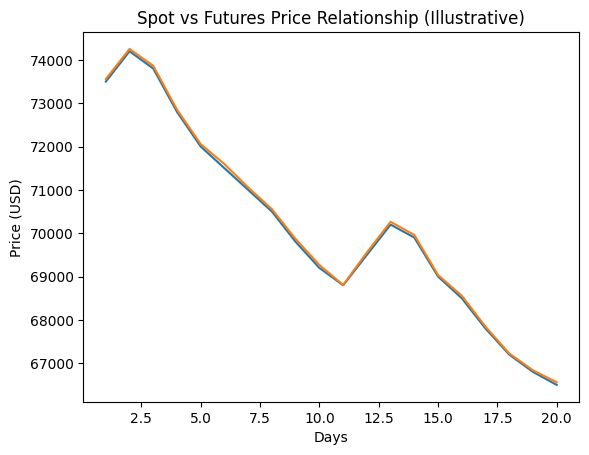
The basis between futures and spot prices remains relatively stable. In distressed environments, futures often decouple sharply due to funding constraints or panic hedging. The absence of such dislocation implies this is a controlled repricing event rather than a structural breakdown.
5. Options Market Signals: Rising Hedging Demand
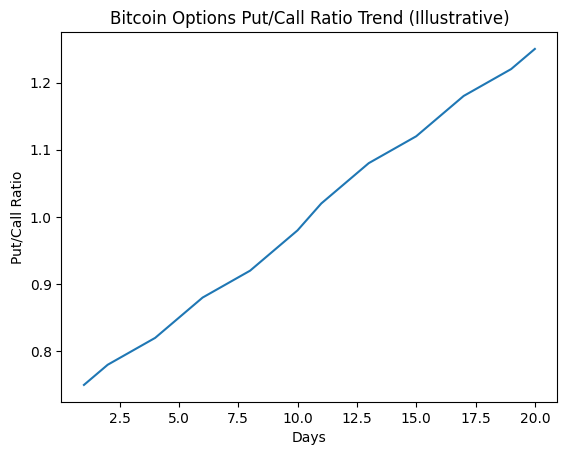
The options market tells a more cautionary story.
The Put/Call Ratio (PCR) has been trending higher, indicating increased demand for downside protection. Particularly noteworthy is the surge in short-dated put option demand.
This behavior suggests:
- Investors are not necessarily pricing in long-term structural collapse.
- Instead, they are hedging near-term event risk.
Short-dated puts are commonly used ahead of:
- Regulatory deadlines.
- Macro data releases.
- Political announcements.
In essence, traders are paying premiums to insure against short-term volatility spikes.
6. AI “Tail Risk” Narrative Gains Momentum
Beyond tariffs and regulation, a more abstract but increasingly discussed theme is AI-driven systemic risk. Reports analyzing a potential “2028 Global Intelligence Crisis” scenario have circulated, arguing that rapid AI disruption could destabilize labor markets and corporate earnings models.
While the probability of such a systemic shock may be limited, its potential impact is substantial. Markets are beginning to price in “tail risk awareness” rather than immediate probability.
Historically, financial markets respond not only to realized events but to shifts in perceived distribution tails. If AI disruption narratives intensify:
- Equity valuations may compress.
- Tech-heavy indices could underperform.
- High-beta assets like Bitcoin could experience volatility spillover.
Arthur Hayes and other prominent crypto voices have framed Bitcoin as a “liquidity fire alarm” in AI-driven crisis scenarios. However, in early stress phases, liquidity contraction tends to hurt speculative assets first.
7. Is Bitcoin Acting as a Safe Haven?
Despite long-term claims of digital gold status, Bitcoin continues to correlate positively with equities during macro tightening cycles. In the current environment, it is being treated as a risk asset rather than a defensive hedge.
Safe-haven transitions historically require:
- Deep monetary easing.
- Sovereign credit stress.
- Fiat confidence erosion.
At present, the narrative is not monetary collapse but policy and structural uncertainty. Thus, Bitcoin remains in the risk bucket.
However, if central banks respond to volatility with liquidity expansion, Bitcoin’s narrative could shift quickly.
8. Key Upcoming Catalysts
Several near-term events could define market direction:
- February 24: S&P Case-Shiller Home Price Index (20-city composite).
- March 1: Clarity Act negotiation deadline.
- March 3–6: FIN/SUM (major fintech event co-hosted by Japan’s Financial Services Agency and Nikkei).
Housing data influences inflation expectations. Regulatory deadlines influence institutional flows. Fintech conferences influence innovation narratives and policy messaging.
Each event carries asymmetric volatility potential.
9. Strategic Implications for Investors Seeking New Crypto Opportunities
For readers searching for emerging crypto assets or yield opportunities, several strategic considerations emerge:
9.1 Corrections Create Relative Value
Spot-driven corrections without systemic stress often create selective entry points. Investors may explore:
- Infrastructure tokens tied to compliance and custody.
- AI-integrated blockchain projects.
- Real-world asset (RWA) tokenization platforms.
9.2 Regulatory-Resilient Projects
Projects aligned with compliance trends—especially those designed for regulated financial integration—may outperform in uncertain policy climates.
9.3 Options as Strategic Tools
Professional investors increasingly use options not only for speculation but for structured yield strategies:
- Covered call strategies.
- Cash-secured put entries.
- Volatility arbitrage.
Understanding derivatives is becoming essential for capital efficiency.
10. Conclusion: Controlled Correction, Elevated Uncertainty
Bitcoin’s break below $70,000 reflects a convergence of macro, regulatory, and narrative-driven risks rather than an internal structural collapse.
- The selloff is spot-led and orderly.
- Derivatives markets show hedging—not panic.
- Policy uncertainty remains unresolved.
- AI tail-risk discourse is expanding.
In the near term, volatility is likely to persist. However, absent a liquidity crisis, this environment resembles a repricing phase rather than a systemic unwind.
For long-term investors and blockchain practitioners, periods of macro-driven fear often serve as recalibration points. Regulatory clarity, technological adoption, and liquidity cycles will ultimately determine the next major trend.
The question is not merely whether Bitcoin reclaims $70,000—but whether the market can transition from uncertainty pricing to structural confidence once again.
