

Main Points :
- Bitcoin rebounds more than $10,000, supported by Ethereum’s successful Fusaka upgrade and expectations of friendlier U.S. monetary leadership.
- Derivatives and options markets show a decline in short positions, rising call interest toward $100,000, and sustained bullish sentiment.
- Liquidity outlook improves after the end of Quantitative Tightening (QT), but December’s seasonal slowdown poses risks.
- Ethereum upgrade boosts confidence in Layer-2 scaling and fee reduction, attracting capital rotation.
- Geopolitical tensions and macro policy shifts contribute to rising demand for “digital safety assets.”
Introduction
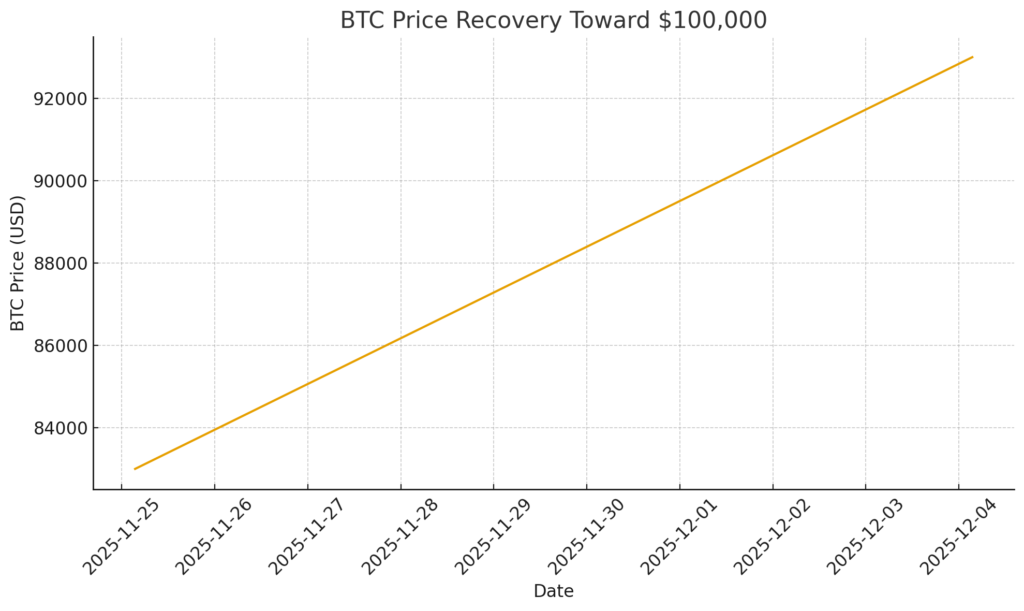
The crypto market entered December with an unexpected surge, driven not only by technical factors but also by a confluence of macroeconomic events, regulatory expectations, and a highly anticipated Ethereum protocol upgrade. Bitcoin (BTC), which slipped to the low $83,000 range earlier in the month, rebounded sharply—gaining more than $10,000 within roughly 48 hours. This rapid recovery reflects changes in derivatives positioning, improved liquidity expectations after the Federal Reserve ended Quantitative Tightening (QT), and renewed investor confidence following Ethereum’s successful “Fusaka” upgrade.
The following analysis synthesizes the referenced CoinPost report, recent cross-market updates from global crypto analytics platforms, and broader macroeconomic signals shaping investor sentiment. For readers seeking emerging digital assets, new revenue opportunities, and practical blockchain use cases, this article provides a comprehensive overview of what the latest market signals mean going into mid-December.
Section 1 — Bitcoin’s Sharp Rebound: Key Drivers Behind the $10,000 Move
Bitcoin’s strong rebound from ~$83,000 to the mid-$93,000 range came from several reinforcing catalysts:
- Ethereum’s major upgrade brought confidence into the broader crypto ecosystem.
- Derivatives markets triggered a large-scale short squeeze, rapidly removing downward pressure.
- Expectations of a crypto-friendly incoming Federal Reserve chair shifted market psychology.
- Rising geopolitical tensions, particularly between the U.S. and Venezuela, increased demand for non-sovereign assets.
Ethereum’s Fusaka Upgrade as a Market Catalyst
The Fusaka upgrade, launched early on December 4, enhanced Layer-2 efficiency and reduced transaction fees. Historically, major Ethereum upgrades—such as Shanghai and Merge milestones—have led to positive spillover effects for Bitcoin due to renewed institutional attention and liquidity inflows.
This upgrade reaffirmed Ethereum’s roadmap to scaling and fee reduction, two factors critical for Web3 adoption, real-world asset tokenization, and enterprise-grade blockchain deployments.
Section 2 — Derivatives Market Dynamics: Evidence of a Long-Biased Environment
Despite rising spot prices, open interest (OI) in Bitcoin derivatives declined, an uncommon but revealing pattern. This typically indicates:
- Short liquidation (forced closing of bearish positions)
- Capital rotation out of Bitcoin and into Ethereum due to the upgrade
- Reduction of leveraged speculation, resulting in a healthier market base
A slight tilt toward long positions suggests that traders expect upward continuation toward the widely watched $100,000 level.
Options Market Signals Peak Optimism
The options market offers additional insight:
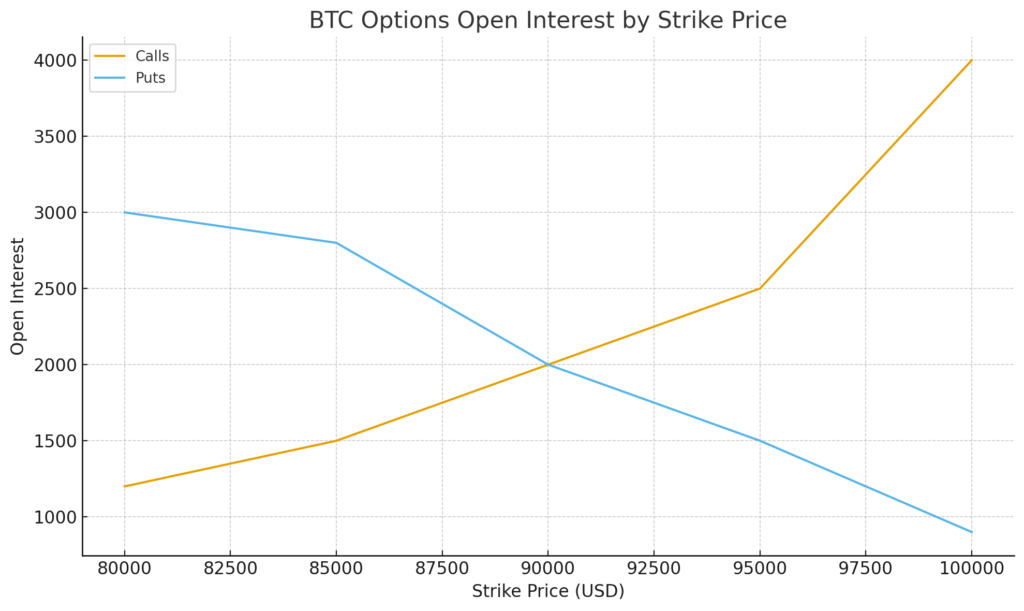
- The put/call ratio dropped, reflecting strong bullish sentiment.
- Support levels form at $80,000–$85,000 based on put positioning.
- $100,000 strike call options now hold the highest open interest.
This means a significant portion of sophisticated traders expect Bitcoin to test $100,000 in the near term
Section 3 — Market Psychology After QT End: Why Liquidity Matters
The Federal Reserve’s decision to end Quantitative Tightening (QT) after more than three years has major implications:
- QT had been removing liquidity from the financial system.
- Its termination increases available capital, raising investor appetite for high-beta assets like crypto.
- If the upcoming FOMC meeting signals rate cuts, liquidity could expand further.
Crypto markets historically correlate with global liquidity cycles. Improved liquidity tends to favor large-cap assets first (BTC, ETH), followed by altcoins and emerging blockchain utility tokens.
Section 4 — Geopolitical Pressures and Bitcoin as a Digital Safe Haven
Reports of rising military tension between the U.S. and Venezuela added a geopolitical layer to Bitcoin’s rally. Even partial geopolitical stress often leads investors to seek assets that:
- Are portable across borders
- Are not controlled by any government
- Offer inflation and seizure resistance
While the scale of the tension remains controlled, market participants increasingly view Bitcoin as a hedge comparable to digital gold.
Section 5 — Ethereum’s Upgrade and the Expanding Role of Layer-2 Networks
Ethereum’s Fusaka upgrade directly impacts:
- Transaction fees, making DeFi and Web3 applications more economical
- Layer-2 network stability, improving settlement throughput
- Institutional adoption, as enterprises require predictable fee environments
Recent trends from L2Beat, DeFiLlama, and other analytics sources show:
- Layer-2 total value locked (TVL) is up significantly in Q4
- Many L2 networks are preparing 2025 upgrades
- Real-world asset tokenization volumes continue to expand
Investors searching for new assets or opportunities may find that Layer-2 ecosystem tokens (e.g., scaling solutions or modular infrastructure assets) benefit the most from reduced Ethereum settlement costs.
Section 6 — Short-Term Outlook: Toward $100,000 but With Seasonal Risks
Bullish Case Through Mid-December
If no major negative events occur, Bitcoin may sustain upward momentum into mid-December due to:
- Strong derivatives posture
- Improved liquidity outlook
- Positive spillover from the Ethereum upgrade
- Reduced selling pressure after recent liquidations
The primary target is $100,000, now validated by options market positioning.
Late December Risk Environment
However, late December brings:
- Lower liquidity due to holiday trading schedules
- Index rebalancing uncertainty ahead of January 15
- Higher probability of sudden price wicks or slower upward movement
Markets may become “thin,” meaning small sell orders could create exaggerated price reactions.
Section 7 — What This Means for Investors Seeking New Assets and Revenue Streams
1. Bitcoin remains the most stable upward candidate.
Institutional flows, improving liquidity, and macro conditions favor further appreciation.
2. Ethereum’s Fusaka upgrade may ignite the next wave of Web3 and L2 growth.
Lower fees unlock use cases in:
- Gaming
- Real-world asset tokenization
- Cross-border payment rails
- Enterprise blockchain adoption
3. Layer-2 tokens and infrastructure assets may enter a growth phase.
These often outperform Ethereum itself during major scaling cycles.
4. Derivatives data shows professional traders are preparing for a strong Q1 2026.
This aligns with expectations of monetary easing.
Conclusion: A Market Poised for Expansion—but Timing Matters
Bitcoin’s sharp rebound and Ethereum’s Fusaka upgrade come at a strategically important time. Liquidity is improving, regulatory signals are softening, and major upgrades are restoring optimism across the crypto ecosystem. The path to $100,000 is increasingly realistic—supported not by speculation alone, but by structural market changes, derivatives positioning, and macroeconomic transitions.
However, the seasonal slowdown in late December requires caution. Investors exploring new assets or income opportunities should monitor liquidity conditions and derivative positioning while preparing for volatility spikes.
Overall, the market appears stronger, more mature, and better aligned for sustainable growth heading into 2026.
