

Main Points :
- Bitcoin miners are experiencing the steepest revenue decline since the industry’s inception.
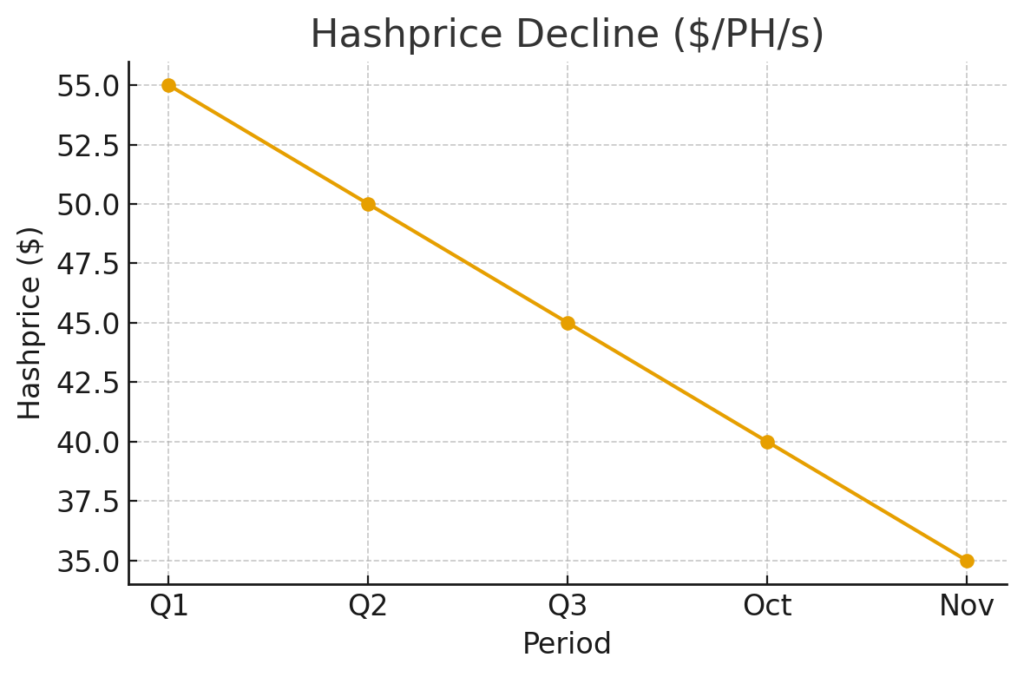
- Hashprice has fallen from $55/PH/s in Q3 to about $35/PH/s, a structural—not temporary—shift.
- Miner profitability is collapsing due to high electricity costs, higher network difficulty, and BTC price volatility.
- Public mining companies have seen stock prices drop between 32% and 54% since mid-October.
- Debt burdens and long ROI cycles on new mining machines (1,000+ days) threaten industry stability ahead of the next halving.
- Liquidity risk is growing as miners deleverage and unwind Bitcoin-backed credit lines.
- Only the most efficient miners—those with extremely low cost-per-hash—are likely to survive.
- This environment may accelerate M&A, restructuring, and geographic shifts toward ultra-low-cost energy regions.
1. Introduction — A Historic Downturn in Bitcoin Mining
The Bitcoin mining industry has entered what many analysts call the most severe economic pressure in its 15-year history. Despite Bitcoin reaching an all-time high of $126,000 in October, the subsequent crash to $80,000 over the next month devastated mining profitability.
For miners, price alone is not destiny. What matters is the combination of:
- BTC market price
- Network difficulty / hash rate
- Electricity prices
- Machine efficiency
- Debt levels and liquidity
When these factors converge negatively—as they have today—the financial stress becomes systemic.
In late November, The Miner Magazine concluded that the present mining economy reflects a “structurally hostile revenue environment” rather than a temporary downturn. Miners are being squeezed from all sides: falling revenue, rising costs, difficulty increases, and tightening capital markets.
2. The Collapse of Hashprice — Why Profitability Has Cratered
Hashprice—mining revenue per unit of hashrate—is the single most important profitability metric for miners.
In Q3, the average U.S. hashprice was $55 per PH/s per day. By November, it had plunged to $35, a nearly 36% collapse in less than 90 days.
3. Structural Issues Behind the Revenue Decline
The decline in hashprice is not solely the result of BTC price volatility. The following structural forces are making the downturn more dangerous:
(A) Record-High Network Difficulty
Global Bitcoin hash rate continues hitting all-time highs, driven by:
- Large miners expanding operations
- New generation ASICs entering markets
- Cheap capital raised during 2020–2023 bull periods
This rising hash rate means:
“Miners are fighting for smaller pieces of an increasingly competitive pie.”
(B) Electricity and Energy Constraints
Energy prices in the U.S. and Canada remain high compared to alternative mining regions (Kazakhstan, Paraguay, Ethiopia).
For many public miners, electricity now accounts for 65–78% of total operating costs.
(C) Equipment ROI Extending Beyond 1,000 Days
Today’s mining machines—like the S19 XP or M60—face:
- 900–1,200 day ROI at current revenue levels
- A halving event in ~850 days that will cut block rewards from 3.125 BTC to 1.5625 BTC
This creates a deeply problematic scenario:
Miners will not recover hardware investment before rewards are halved again.
4. Balance Sheets Under Stress — Liquidity Crisis in Motion
The Miner Magazine reports that miners’ balance sheets are “starting to react.”
One major example:
CleanSpark fully repaid its Bitcoin-backed credit line with Coinbase.
While this appears positive, the underlying interpretation is that:
- Miners are deleveraging rapidly
- There is growing fear of forced liquidations if BTC price continues to fall
- Financing costs have become unsustainable
Mining credit, once abundant between 2020–2022, has tightened dramatically:
- Higher interest rates
- Lower collateral values
- Lower investor appetite for mining debt
5. Public Mining Stocks Crash — Equity Markets Lose Confidence
The mining liquidity crisis deepened when BTC fell from $126,000 → $80,000, triggering:
- Broad sell-offs in U.S. tech stocks
- Mining-specific capitulation
According to The Miner Magazine, mining stocks have suffered a dramatic breakdown since mid-October.
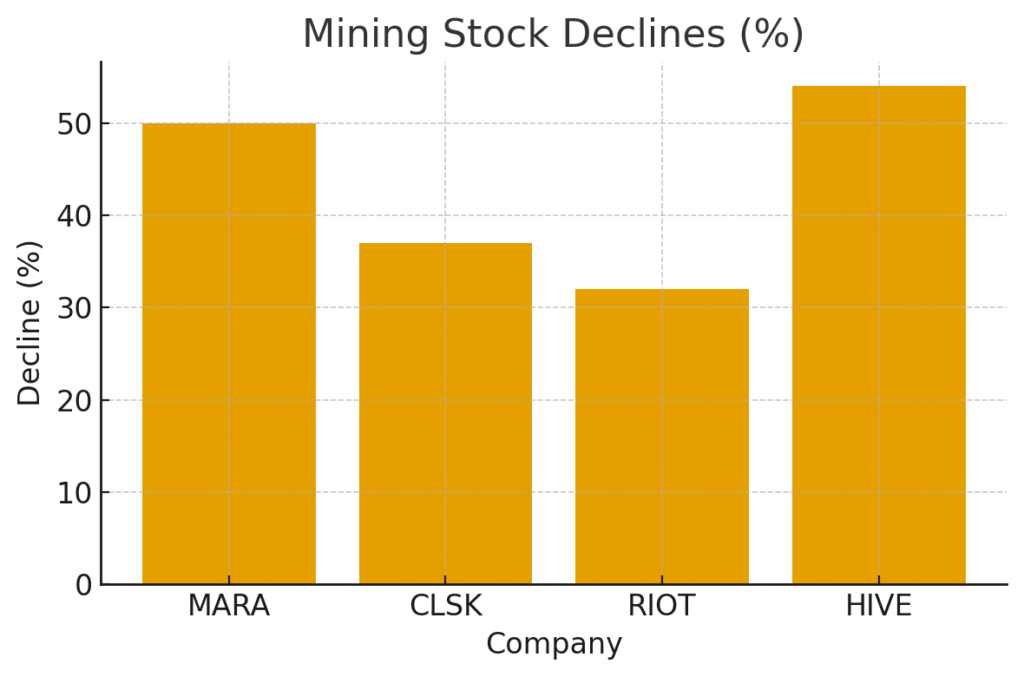
| Company | Decline Since Oct 15 |
|---|---|
| MARA Holdings (MARA) | −50% |
| CleanSpark (CLSK) | −37% |
| Riot Platforms (RIOT) | −32% |
| HIVE Digital (HIVE) | −54% |
These declines show that equity investors expect:
- Lower near-term revenue
- Profitability compression
- Increased bankruptcy risk
Mining stocks historically trade as high-beta derivatives of Bitcoin price.
In downturns, they fall much sharper than BTC itself.
6. The Growing Divide Between Efficient and Inefficient Miners
The downturn is exposing a widening gap between:
A. Ultra-Efficient Miners
These companies have:
- Access to electricity under $0.03/kWh
- Highly efficient ASIC fleets (S19 XP, M60, WhatsMiner M63)
- Scale advantages
- Hedging strategies and sophisticated treasury management
B. At-Risk Miners
These firms suffer from:
- Older mining rigs with low efficiency
- Electricity above $0.05/kWh
- Heavy leverage from 2021–2022 expansion
- Limited cash reserves
- Rising hosting costs
The cost-per-hash metric now determines survival.
7. Global Geographic Shifts — Moving Toward Cheaper Power Regions
In 2024–2025, mining expansion has moved substantially toward:
- Paraguay (hydropower)
- Ethiopia (hydropower)
- Oman and UAE (natural gas flare capture)
- Texas (excess wind/solar + ERCOT demand response credits)
As U.S. operational costs increase, many mid-sized miners are considering:
- Selling facilities
- Relocating ASICs abroad
- Merging with lower-cost competitors
8. Implications for Investors and Crypto Entrepreneurs
For your audience—investors looking for new crypto assets, revenue streams, and practical blockchain utility—the mining downturn presents both risk and opportunity.
Potential Opportunities
- Distressed mining asset acquisitions
- Stronger long-term miners may become undervalued
- Hosting facilities may become cheaper
- Mining-related tokens could offer volatility-driven trading opportunities
Potential Risks
- Mining token insolvency risk
- ASIC resale value collapse
- Hosting fraud in offshore regions
- Higher default risk among public miners
9. Outlook — What Comes Next for the Mining Sector
(A) If BTC Price Recovers Above $100,000
Miners stabilize
Hashprice improves
Stock prices rebound
Machine ROI shortens
(B) If BTC Stays Below $80,000
Mass deleveraging
Bankruptcies
Forced BTC liquidations
Difficulty plateaus or drops
(C) Next 18 Months
The period leading to the next halving will be extremely dangerous for inefficient miners.
10. Conclusion — The Hardest Era Begins
The Bitcoin mining sector is entering a historic inflection point:
- High difficulty
- Lower BTC price
- Increased competition
- Higher energy costs
- Long ROI cycles
- Tight credit markets
Only the most efficient miners will survive the next two years.
For investors and entrepreneurs, this is not merely a downturn—it is a complete restructuring of the mining ecosystem. Those who understand the economics beneath the surface will spot opportunities that others miss.
