
Main Points :
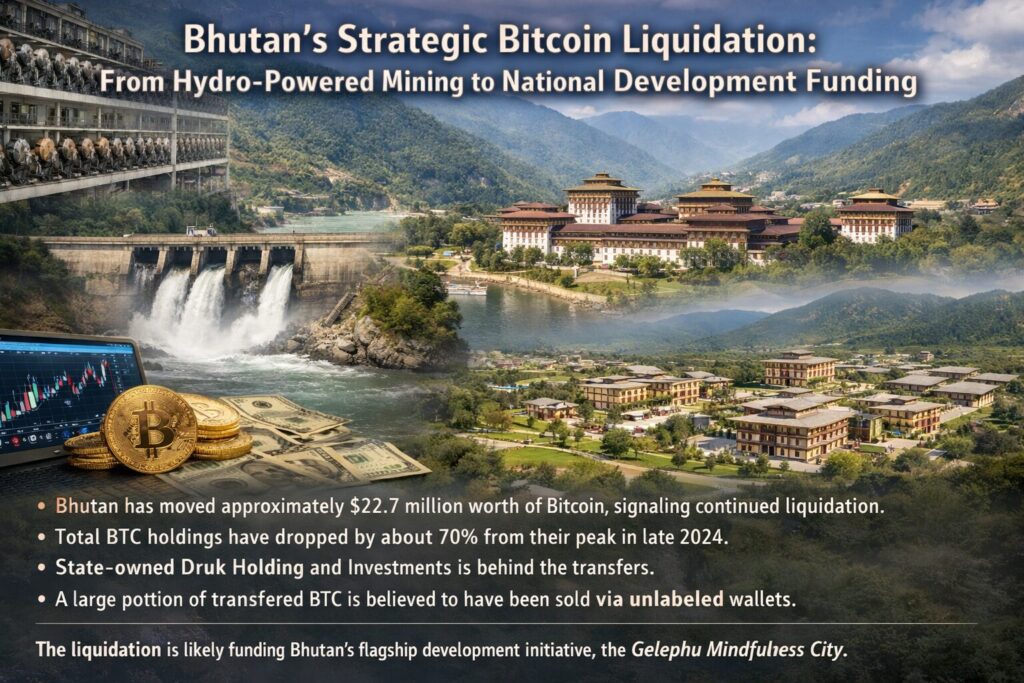
- Bhutan has moved approximately $22.7 million worth of Bitcoin (≈319.7 BTC) in recent transactions.
- Total BTC holdings have dropped about 70% from their late-2024 peak, now around 3,954 BTC.
- A significant portion of transfers appears routed through unlabeled wallets, likely for liquidation.
- The activity is linked to Druk Holding & Investments (DHI), Bhutan’s state investment arm.
- Proceeds are believed to fund the Gelephu Mindfulness City, a flagship national project.
- Bhutan’s once-active hydropower-based Bitcoin mining appears to have slowed or possibly stopped.
1. A Small Nation, A Strategic Move: Understanding Bhutan’s Bitcoin Transfers
Bhutan, a small Himalayan kingdom often associated with its Gross National Happiness philosophy, has quietly emerged as one of the most fascinating sovereign actors in the cryptocurrency space. Recent blockchain analytics indicate that Bhutan has transferred approximately 319.7 BTC, equivalent to around $22.7 million, marking yet another step in what appears to be a long-term liquidation strategy.
These movements were first flagged by blockchain analytics platforms, which observed that the funds were routed through wallets previously associated with liquidation activity. A further portion was transferred to newly created addresses, raising speculation that Bhutan is carefully managing liquidity while maintaining operational privacy.
The broader context is even more striking. According to aggregated on-chain data, Bhutan has moved approximately $215.7 million worth of Bitcoin in 2026 alone, with roughly $162.6 million likely sold via unlabeled wallets. This suggests not a one-off event, but a structured, phased monetization strategy.
From a market participant perspective, this behavior resembles that of institutional treasury management rather than speculative trading. Bhutan is not reacting to price volatility; it is executing a strategic reallocation of capital.
2. From Peak Accumulation to Controlled Reduction
Bhutan’s Bitcoin holdings have declined dramatically—by about 70% from their late-2024 peak. At that time, the country had amassed a sizable reserve through an unconventional but highly efficient approach: state-backed Bitcoin mining powered by renewable hydropower.
Today, the remaining holdings stand at approximately 3,954 BTC, still substantial for a sovereign entity of Bhutan’s size. However, the absence of significant inflows over the past year suggests that accumulation has effectively stopped.
This transition—from accumulation to liquidation—is critical. It signals a shift in Bhutan’s strategic posture:
- Phase 1 (2020–2024): Accumulation via mining
- Phase 2 (2025–2026): Monetization and capital deployment
Unlike many governments that acquire Bitcoin through market purchases, Bhutan effectively mined its reserves at near-zero marginal cost using surplus hydroelectric energy. This gives it a unique advantage: every sale is almost pure profit from a cost basis perspective.
For investors and policymakers, this raises an important question: Is Bitcoin better treated as a reserve asset—or as a development funding mechanism?
Bhutan appears to be answering: both, but sequentially.
3. The Role of Hydropower Mining: A Near-Zero Cost Advantage
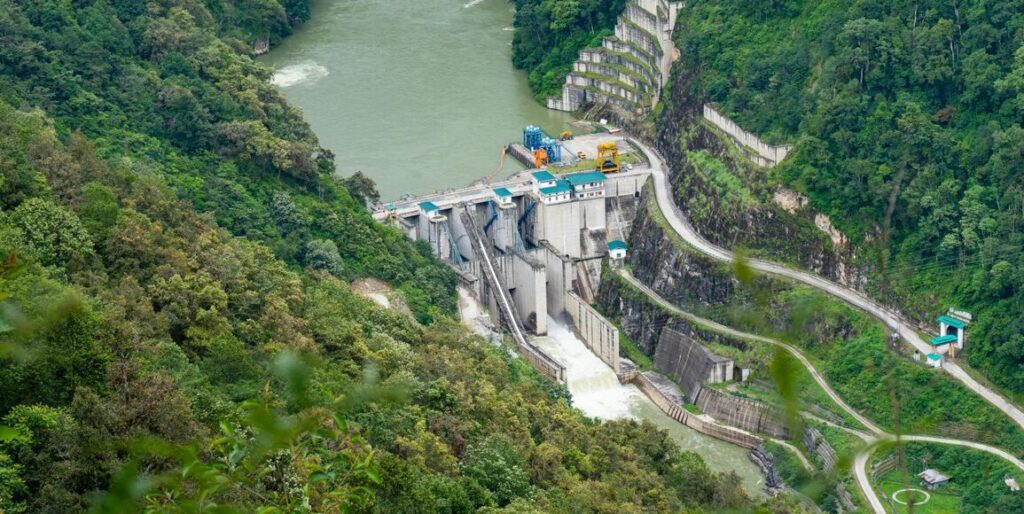
Bhutan’s entry into Bitcoin was not speculative—it was infrastructural. Leveraging its abundant hydropower resources, the country deployed mining operations that converted excess electricity into digital assets.
This model has several notable characteristics:
- Low operating cost due to renewable energy
- Energy surplus utilization instead of waste
- Minimal external dependency
- Scalable accumulation strategy
At its peak, Bhutan’s mining operations contributed to a steady inflow of Bitcoin, effectively turning natural resources into sovereign digital reserves.
However, recent data suggests that mining activity has slowed significantly or possibly ceased. There are several plausible explanations:
- Opportunity Cost Shift: Selling BTC may now offer higher ROI than mining new coins.
- Energy Reallocation: Hydropower may be redirected to domestic or export use.
- Strategic Completion: Bhutan may have reached its target reserve level.
Importantly, no official statement confirms a shutdown. Yet, the absence of inflows strongly indicates a pause or reduction.
For countries exploring similar strategies—especially those with renewable energy surpluses—Bhutan’s model provides a compelling blueprint, albeit one that requires careful timing and execution.
4. Funding the Future: Gelephu Mindfulness City
The most compelling aspect of Bhutan’s Bitcoin strategy lies in how the proceeds are being used.
Reports strongly suggest that the liquidation is funding the Gelephu Mindfulness City, a large-scale national development initiative. This project aims to create a sustainable, innovation-driven urban center that blends economic development with Bhutan’s philosophical values.
In practical terms, this represents a direct conversion of digital assets into physical infrastructure.
This is a rare and powerful case study:
- Bitcoin → Liquidation → Fiat Capital → Infrastructure Investment
Unlike speculative gains sitting idle on balance sheets, Bhutan is actively deploying crypto-derived capital into real-world economic transformation.
For blockchain advocates, this reinforces the narrative that digital assets can serve as:
- Sovereign wealth reserves
- Development funding tools
- Bridges between digital and physical economies
The Gelephu project may ultimately become one of the first large-scale examples of “Bitcoin-funded nation-building.”
5. Global Context: Governments, Bitcoin, and Strategic Reserves
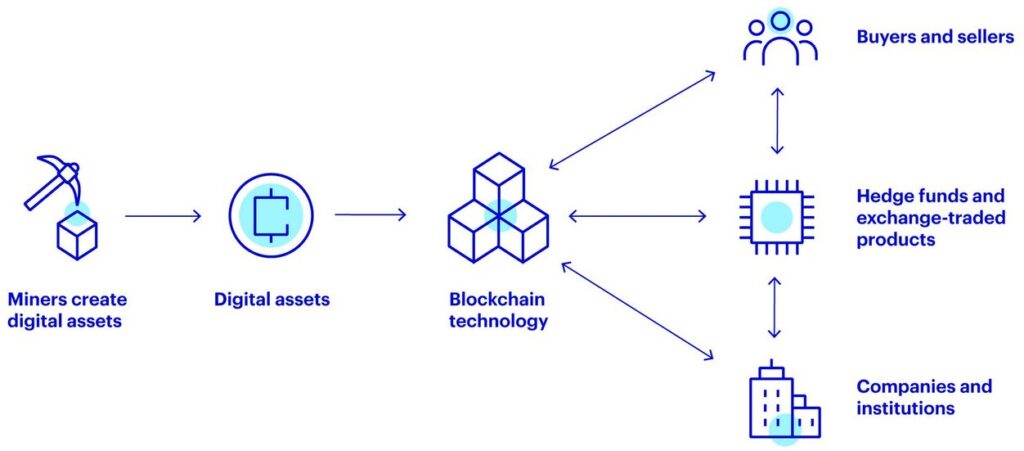
Bhutan’s actions should not be viewed in isolation. Across the globe, governments are increasingly exploring Bitcoin and digital assets—though with very different strategies.
- Some nations accumulate BTC as strategic reserves
- Others regulate it as a financial risk
- A few experiment with mining or adoption at scale
Bhutan stands out because it has successfully executed all three phases:
- Production (Mining)
- Accumulation (Reserve Building)
- Deployment (Liquidation for development)
This lifecycle mirrors corporate treasury strategies but at a sovereign level.
At the same time, the broader crypto market in 2025–2026 has been shaped by:
- Institutional inflows via ETFs
- Increased regulatory clarity in major economies
- Growing integration of crypto into payment and settlement systems
In this environment, Bhutan’s disciplined approach contrasts sharply with more reactive or politically driven strategies seen elsewhere.
6. Implications for Crypto Investors and Builders
For readers seeking new opportunities in crypto and blockchain applications, Bhutan’s case offers several key insights:
6.1 Bitcoin as a Capital Formation Tool
Bitcoin is not just a speculative asset—it can function as a capital formation mechanism, especially when acquired through mining or early adoption.
6.2 Energy Arbitrage Opportunities
Regions with surplus renewable energy can replicate Bhutan’s model, turning energy into digital value. This is particularly relevant for:
- Southeast Asia
- Africa
- Parts of Latin America
6.3 Strategic Exit Timing
Bhutan’s gradual liquidation suggests a disciplined approach to exit timing, avoiding market disruption while maximizing value.
6.4 Real-World Utility
Perhaps most importantly, Bhutan demonstrates how crypto gains can be translated into tangible economic outcomes.
For builders, this underscores the importance of:
- Infrastructure integration
- Regulatory alignment
- Real-world use cases
7. Risks and Open Questions
Despite its success, Bhutan’s strategy raises several questions:
- Transparency: Use of unlabeled wallets obscures transaction intent.
- Market Impact: Large-scale sovereign selling could influence liquidity.
- Sustainability: Without ongoing mining, reserves will eventually deplete.
- Replication Feasibility: Not all countries have Bhutan’s energy advantages.
Additionally, the apparent slowdown in mining raises concerns about long-term strategy continuity.
Conclusion: A Blueprint for Sovereign Crypto Strategy?
Bhutan’s Bitcoin journey is one of the most sophisticated sovereign experiments in digital asset management to date. It has successfully:
- Converted renewable energy into Bitcoin
- Built a sizable reserve
- Strategically liquidated assets
- Redirected capital into national development
This end-to-end lifecycle—from mining to infrastructure—represents a powerful model for how nations might engage with crypto beyond speculation.
For investors, it highlights the importance of macro-level strategy and timing.
For governments, it offers a blueprint for integrating digital assets into economic planning.
For builders, it underscores the value of connecting blockchain innovation to real-world impact.
As the crypto industry matures, Bhutan’s approach may well be remembered not as an anomaly—but as an early example of how digital assets can reshape national economies.
