
Main Points :
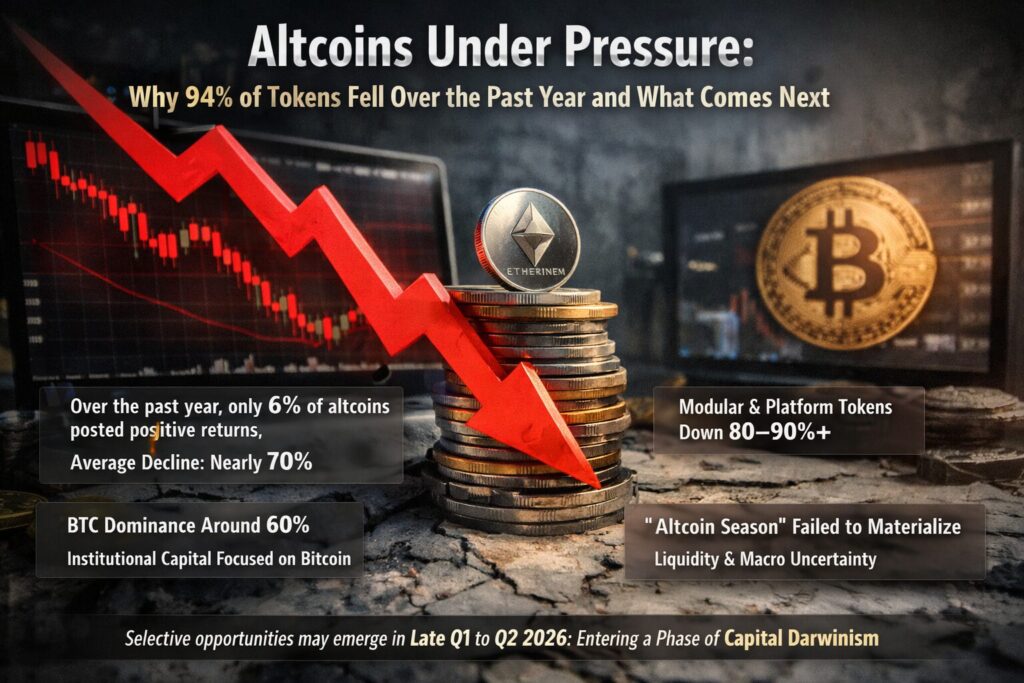
- Over the past year, only 6% of altcoins posted positive returns, while the average decline reached nearly 70%, according to Delphi Digital.
- Emerging sectors such as modular blockchains and platform/framework tokens suffered catastrophic drawdowns of over 80–90%.
- Institutional capital has overwhelmingly concentrated on Bitcoin, pushing BTC dominance to around 60%.
- The much-anticipated “altcoin season” has failed to materialize due to liquidity concentration, lack of differentiation, and macroeconomic uncertainty.
- Selective opportunities may emerge in late Q1 to Q2 2026, but the market is entering a phase of capital Darwinism, not broad-based recovery.
1. A Brutal Year for Altcoins: The Numbers Tell the Story
The past twelve months have been one of the harshest periods in the history of the altcoin market. According to a sector-wide dashboard released by Delphi Digital on February 1, the overwhelming majority of alternative cryptocurrencies experienced deep and sustained losses. Out of thousands of listed tokens, only 6% recorded price increases, while the average drawdown across the market reached approximately 70%.
This is not a typical cyclical pullback. Even during previous crypto bear markets, capital often rotated between sectors, allowing certain categories—such as DeFi, Layer 2s, or gaming tokens—to outperform. This time, the decline has been broad, deep, and indiscriminate.
Delphi Digital described the period as “a difficult year for altcoins,” a restrained phrase that masks just how severe the damage has been to speculative capital, early-stage projects, and retail investor confidence.
2. Sector Breakdown: Where the Damage Was Worst
The pain was not evenly distributed. Newer and more experimental sectors were hit the hardest, revealing a growing intolerance for unproven narratives.
Modular Blockchains: Innovation Without Liquidity
Tokens associated with modular blockchain architectures—often promoted as the future of scalability—posted an average decline of 83.78%. Despite strong technical narratives around data availability layers, execution layers, and rollup-centric design, capital failed to follow.
For investors, the lesson was clear: technical elegance alone does not guarantee token demand.
Platform and Framework Tokens: A 90% Collapse
Even more severe was the collapse in platform and framework-related tokens, which recorded an astonishing 90.42% average decline. Many of these projects positioned themselves as “infrastructure for developers,” yet struggled to demonstrate real user adoption, fee generation, or sustainable ecosystems.
The market appears to have reached saturation in tooling narratives, especially when revenue remains theoretical.
Layer 1s and Memecoins: No Safe Havens
Even traditionally resilient categories were not spared:
- Major Layer 1 tokens declined by an average of 54.62%
- Memecoins, often considered liquidity-driven and narrative-flexible, fell by 70.32%
The result was a rare alignment: nearly every category moved downward together.
3. Bitcoin Dominance and the Institutional Gravity Well
While altcoins collapsed, Bitcoin told a very different story.
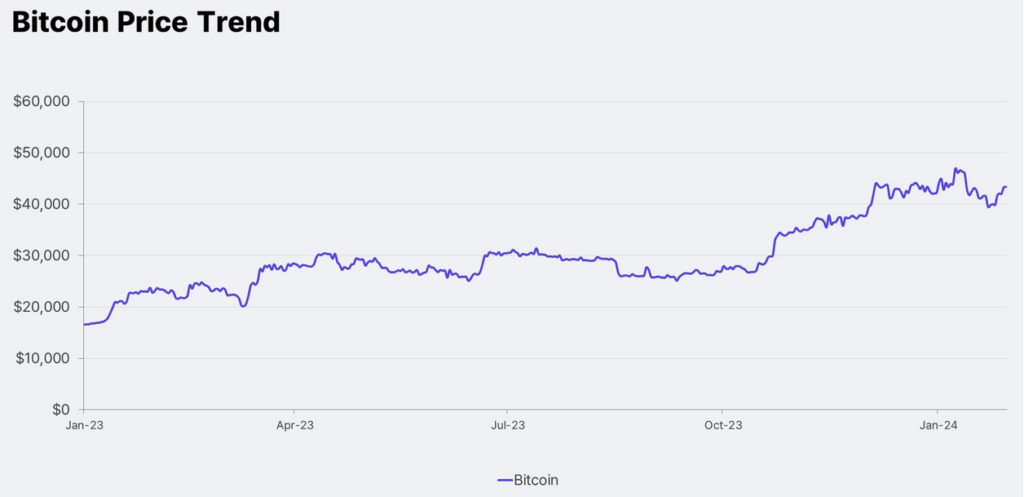
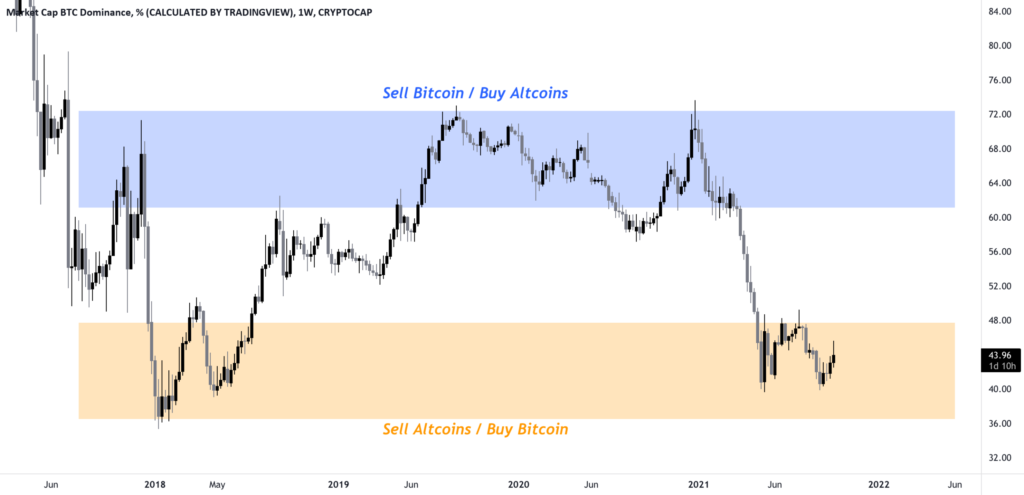
BTC market dominance has hovered around 60%, remaining near multi-year highs. This is not merely a retail phenomenon. The launch and expansion of Bitcoin spot ETFs fundamentally reshaped capital flows in the crypto market.
Institutional investors—pension funds, asset managers, and family offices—largely bypassed the altcoin universe. Instead, they allocated through regulated ETF products that offer:
- Custodial simplicity
- Regulatory clarity
- Deep liquidity
In contrast, thousands of altcoins remained fragmented across exchanges, with shallow order books and inconsistent compliance standards.
The result was extreme capital bifurcation: Bitcoin and, to a lesser extent, Ethereum absorbed inflows, while the long tail of tokens was starved of liquidity.
4. Why the Altcoin Season Never Arrived
The “altcoin season index,” a metric tracking whether altcoins outperform Bitcoin, briefly rose to 55 in early January, its highest level in three months. However, this rally quickly faded. The threshold typically used to define a true altcoin season—75 or higher—remained distant.
Several structural factors explain why:
- Liquidity Concentration
Capital flowed into a handful of large-cap assets, leaving mid- and small-cap tokens illiquid. - Lack of Differentiation
Many new tokens failed to present clear, defensible use cases or revenue models. - Excess Token Supply
Continuous launches diluted attention and capital. - Macro Headwinds
Tight global liquidity conditions reduced risk appetite across speculative assets.
In short, the market stopped rewarding narratives and started demanding results.
5. What This Means for Investors Seeking the “Next Opportunity”
For readers searching for new crypto assets, yield opportunities, or practical blockchain applications, the implications are profound.
This is not an environment for indiscriminate altcoin buying. Instead, the market is entering a phase where:
- Cash flow matters
- Real users matter
- Integration with existing financial or enterprise systems matters
Tokens tied to actual usage—payments, settlement, tokenized assets, compliance tooling, or infrastructure that institutions genuinely adopt—stand a far better chance of survival.
Speculation is giving way to selection.
6. Outlook: A Narrow Path to Recovery in 2026
Simon Dedic, founder of Moonrock Capital, has suggested that momentum in the altcoin market could begin to recover between late Q1 and Q2 of 2026. However, expectations are tempered.
A true altcoin season would require:
- Improved global liquidity conditions
- Stabilization or easing of monetary policy
- Clear winners emerging from the current shakeout
Rather than a broad rally, the more likely scenario is selective resurgence, where a small subset of tokens dramatically outperform while the majority remain stagnant or disappear.
Conclusion: The End of Easy Altcoin Money
The past year marked a turning point for the altcoin market. With 94% of tokens declining and average losses nearing 70%, the era of effortless narrative-driven gains appears to be over.
For serious participants—builders, investors, and institutions—this shift is ultimately healthy. Capital is becoming more disciplined, more selective, and more aligned with real-world utility.
The next generation of crypto winners will not be defined by hype, but by functionality, integration, and sustainable demand.
