
Main Points :
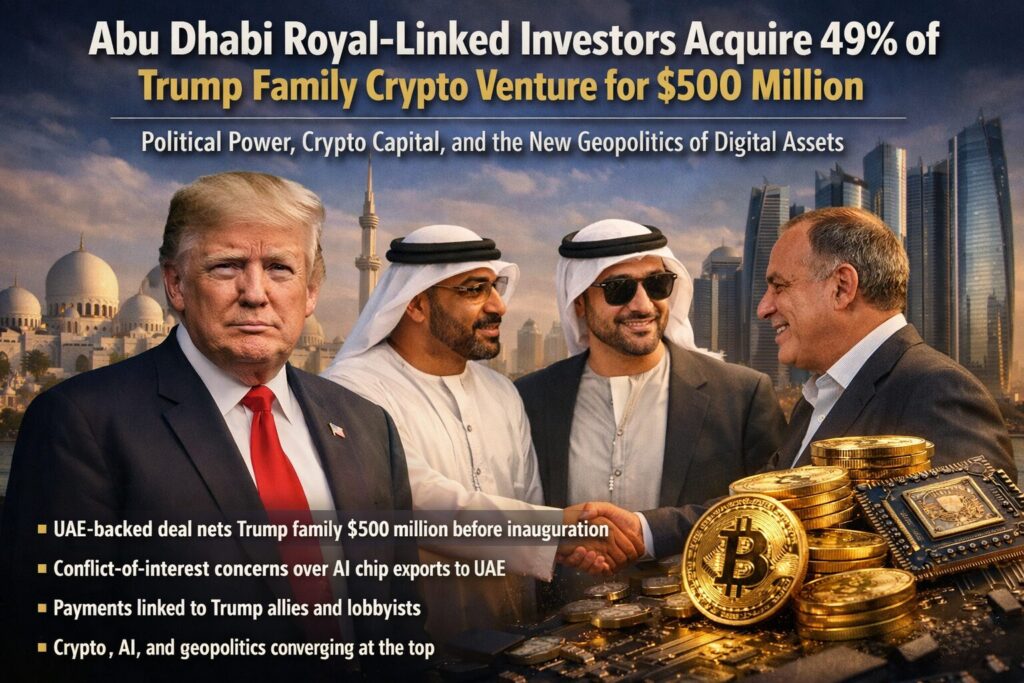
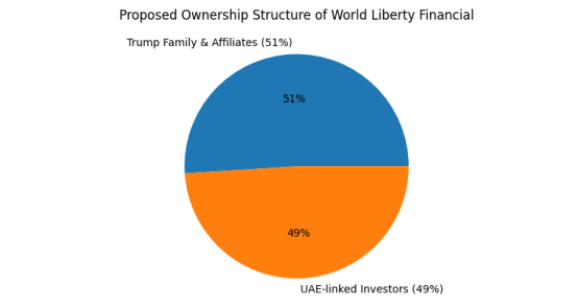
- UAE-linked investors associated with Abu Dhabi royal circles agreed to acquire 49% of World Liberty Financial (WLFI), a Trump family–owned crypto company, for $500 million just days before Donald Trump’s inauguration.
- The deal raises serious conflict-of-interest concerns, particularly given subsequent US approval of advanced AI chip exports to the UAE.
- Payments flowed not only to Trump-affiliated entities but also to companies linked to US Middle East envoy Steve Witkoff.
- The controversy intersects with ongoing US legislative debates over crypto regulation, notably the Clarity Act, which could directly affect presidential financial interests.
- For crypto investors and builders, the case illustrates how crypto, AI, geopolitics, and regulatory power are converging at the highest levels.
1. The Deal That Sparked Global Attention
According to reporting by The Wall Street Journal on February 1, investors linked to Tahnoun bin Zayed Al Nahyan, the UAE’s National Security Adviser and brother of the UAE president, signed an agreement to acquire 49% of World Liberty Financial (WLFI) for $500 million.
The timing was politically explosive. The agreement was signed four days before Donald Trump’s inauguration as President of the United States. The contract bears the signature of Eric Trump, acting on behalf of the Trump family’s business interests.
WLFI is positioned as a next-generation crypto-financial platform, reportedly focusing on digital asset infrastructure, tokenization, and blockchain-based financial services. While detailed public disclosures on WLFI’s operations remain limited, its valuation implied by the transaction places it among the most highly valued private crypto ventures with direct political family ownership.
2. Money Flows and Transaction Structure
The structure of the transaction is as controversial as its timing.
Under the agreement, the buyers prepaid half of the $500 million purchase price. Of this amount:
- $187 million was transferred to entities affiliated with the Trump family.
- At least $31 million was allocated to companies linked to relatives of Steve Witkoff, who currently serves as the US Middle East envoy.
The remaining funds are scheduled to be paid in later tranches, contingent on regulatory and operational milestones.
Critics argue that this payment structure blurs the line between private investment and political patronage, especially given the senior government roles held by individuals connected to both sides of the transaction.
3. Who Is Tahnoun bin Zayed Al Nahyan?
To understand the significance of the deal, one must understand the buyer’s influence.
Tahnoun bin Zayed Al Nahyan is not merely a royal family member. He oversees or chairs several of the UAE’s most strategically important institutions:
- Overseer of Abu Dhabi’s sovereign wealth structures managing over $1 trillion in assets.
- Chairman of G42, a major artificial intelligence firm.
- Chairman of MGX, an AI and advanced technology investment vehicle.
Tahnoun is widely regarded as the architect of the UAE’s AI-first national strategy, integrating capital, compute, and geopolitical leverage.
4. The AI Chip Connection: Coincidence or Quid Pro Quo?
Just months after the WLFI deal, in May 2025, the US government approved the export of 500,000 advanced AI chips to the UAE.
Notably:
- 20% of these chips were allocated to G42, the AI company chaired by Tahnoun.
- Such chips are among the most tightly controlled US technologies due to national security concerns.
While the White House insists there is no connection between the crypto deal and the chip approval, the sequence of events has fueled intense scrutiny.
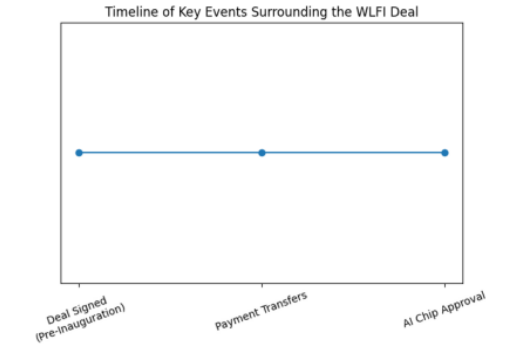
[Timeline of Key Events Surrounding the WLFI Deal]
5. Political Backlash and Ethical Concerns
US Senator Elizabeth Warren was among the most vocal critics, calling the transaction “blatant corruption” and demanding congressional hearings.
Her concerns center on three issues:
- Foreign government–linked capital entering a company owned by a sitting president’s family.
- Financial benefits flowing to individuals connected to US foreign policy decision-makers.
- Subsequent US policy decisions that materially benefit the same foreign actors.
The White House response has been consistent: President Trump’s assets are held in trusts managed by his children, and therefore no conflict of interest exists. Critics counter that control without ownership is still influence.
6. Crypto Regulation and the Clarity Act
The controversy unfolds as Congress debates the Clarity Act, a sweeping crypto market structure bill.
- Passed the House in July 2025 by 294–134.
- Currently stalled in the Senate due to disagreements over ethics provisions.
Democratic lawmakers are pushing to include clauses that would bar senior politicians and their families from profiting directly from crypto holdings.
Senator Ruben Gallego warned in January that weakening ethics rules would erode public trust. In contrast, Senate Banking Committee Chair Tim Scott argues that such provisions do not belong in market structure legislation.
If passed without ethics safeguards, the Clarity Act could significantly benefit platforms like WLFI.
7. Why This Matters for Crypto Investors and Builders
For readers seeking new crypto assets, revenue models, or real-world blockchain applications, this case offers several lessons:
- Crypto is no longer peripheral: It is deeply embedded in state power, diplomacy, and industrial policy.
- Regulatory outcomes can be shaped by capital flows, especially when political families are involved.
- Tokenization, AI integration, and sovereign capital are converging into a new investment category.
[Ownership Structure of World Liberty Financial]
8. Strategic Implications for the Global Crypto Market
This deal signals a broader trend:
- Middle Eastern sovereign and royal-linked capital is moving aggressively into crypto infrastructure.
- The US remains a regulatory battlefield where political outcomes can redefine market winners.
- Projects aligned with compliance, AI-readiness, and cross-border utility are most likely to attract institutional capital.
For builders, the message is clear: understanding geopolitics is becoming as important as understanding smart contracts.
9. Conclusion: A New Era of Crypto Power Politics
The $500 million acquisition of nearly half of World Liberty Financial is more than a business transaction. It is a case study in how crypto, political power, foreign policy, and advanced technology now intersect.
Whether or not legal wrongdoing is ultimately proven, the episode underscores a fundamental shift: digital assets are no longer just financial instruments—they are tools of statecraft.
For investors and practitioners, the future of crypto will be shaped not only by code and markets, but by who controls capital, regulation, and geopolitical leverage.
