Key Points :
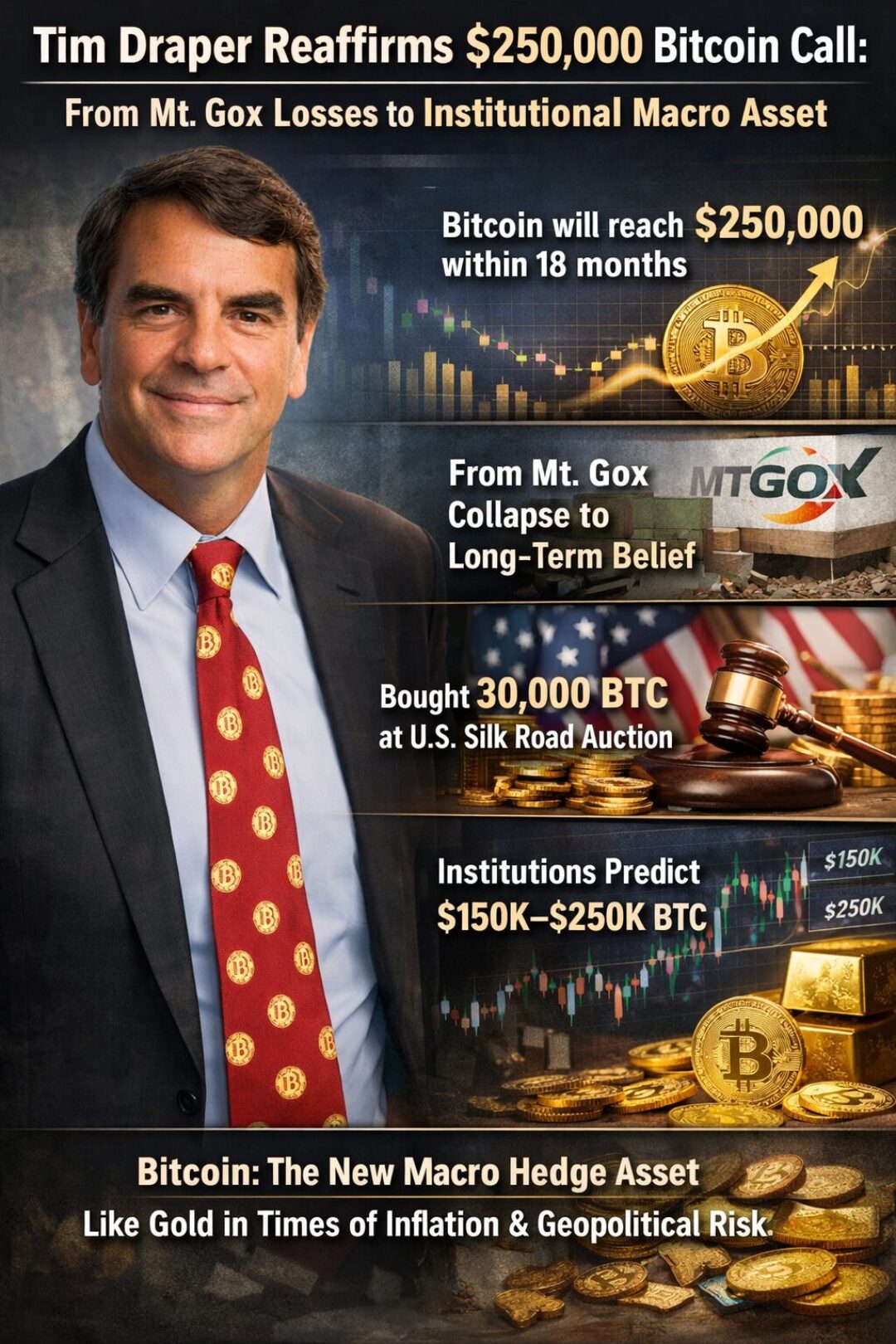
- Tim Draper reiterates his bold prediction that Bitcoin will reach $250,000 within 18 months
- Early setbacks, including the collapse of Mt. Gox, shaped his long-term conviction
- A turning point came with the U.S. government’s Silk Road Bitcoin Auction, where Draper acquired ~30,000 BTC
- Institutional forecasts align, with firms projecting $150,000–$250,000 BTC in the next 1–2 years
- Bitcoin is evolving into a macro hedge asset, comparable to gold amid inflation and geopolitical risk
1. The Conviction Behind the $250,000 Prediction
Silicon Valley venture capitalist Tim Draper has once again captured global attention by reaffirming one of the most ambitious forecasts in the cryptocurrency space: Bitcoin reaching $250,000 within the next 18 months.
This projection is not merely speculative enthusiasm. Draper’s thesis rests on two converging macroeconomic forces:
First, the continued devaluation of fiat currencies, particularly the U.S. dollar, driven by persistent inflation and expansive monetary policy. Second, the structural rise of Bitcoin as a decentralized, scarce digital asset, immune to centralized control.
According to Draper, Bitcoin is not simply rising in price—it is replacing trust in traditional financial systems. As governments continue to expand balance sheets and global debt levels increase, capital is gradually reallocating toward non-sovereign stores of value.
This perspective aligns with a broader shift in investor psychology. Bitcoin is no longer viewed solely as a high-risk speculative instrument, but increasingly as a long-term strategic hedge against systemic risk.
2. From Catastrophic Loss to Unshakable Belief
Draper’s confidence in Bitcoin did not emerge from smooth success—it was forged through failure.
In the early days of cryptocurrency, Draper experienced severe setbacks, including technical delays in mining infrastructure and the total loss of his holdings during the collapse of Mt. Gox, once the largest Bitcoin exchange in the world.
At the time, Mt. Gox’s bankruptcy represented a crisis of confidence for the entire ecosystem. Billions in value disappeared, and many questioned whether Bitcoin itself could survive.
However, Draper observed something critical: Bitcoin’s price did not collapse to zero.
Instead, the network persisted. Transactions continued. Adoption slowly resumed.
This resilience led Draper to a key realization—Bitcoin’s value was not dependent on any single company or institution. It was infrastructure, not a platform.
He later reflected that Bitcoin’s ability to survive such a catastrophic event proved its anti-fragility, a property rarely seen in financial systems.
3. The Silk Road Auction: A Defining Moment
A major turning point in Draper’s Bitcoin journey came in 2014, during the U.S. government’s auction of seized Bitcoin from the Silk Road marketplace.
At the Silk Road Bitcoin Auction, Draper acquired approximately 30,000 BTC at $632 per coin, a price above market rates at the time.
This move shocked the crypto community.
Why would a rational investor pay a premium for Bitcoin, especially given its association with illicit activity?
The answer lies in Draper’s long-term vision.
He recognized that the auction itself represented something profound: Bitcoin had transitioned from a “criminal asset” to a government-recognized commodity.
The fact that a federal agency could seize, hold, and legally auction Bitcoin demonstrated that it had entered the formal economic system.
This legitimization was, in Draper’s view, a signal that Bitcoin would eventually integrate into global finance.
4. Early Predictions and Proven Track Record
Draper’s credibility today is reinforced by his past accuracy.
In 2014, he publicly predicted that Bitcoin would reach $10,000 within three years—a forecast widely dismissed at the time.
Yet by late 2017, Bitcoin surpassed that level, validating his long-term outlook.
This pattern—early skepticism followed by eventual validation—has become a recurring theme in Bitcoin’s history.
Draper’s current $250,000 prediction may appear extreme, but it follows the same logic: exponential adoption curves often look unrealistic until they materialize.
5. Institutional Alignment: Not a Lone Voice
Importantly, Draper is no longer an outlier.
Major institutional players are now expressing similarly bullish outlooks:
- Galaxy Digital projects Bitcoin could reach $250,000 by 2027
- Bernstein maintains a $150,000 target by the end of 2026
- Bitwise Asset Management has even suggested that $1 million per BTC could become a long-term milestone
These projections are grounded in measurable trends:
- Increasing institutional inflows (ETFs, hedge funds)
- Growing corporate treasury allocations
- Expanding global liquidity cycles
The convergence of these forecasts indicates that Bitcoin’s growth narrative is shifting from retail-driven speculation to institutional capital flows.
6. Bitcoin as a Macro Asset: The New Gold?
One of the most significant developments in recent years is Bitcoin’s transformation into a macro asset class.
Traditionally, assets like gold have served as hedges against inflation, currency debasement, and geopolitical instability.
Bitcoin is now entering that same category.
Bitcoin Price Projection (USD)
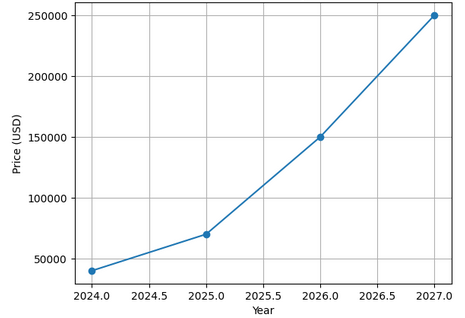
This chart illustrates a simplified trajectory based on current institutional forecasts, showing potential growth toward the $250,000 range.
Unlike gold, however, Bitcoin offers additional advantages:
- Portability: Instantly transferable across borders
- Divisibility: Easily fractionalized
- Transparency: Fully auditable on-chain
- Scarcity: Fixed supply of 21 million coins
As global uncertainty increases—whether due to inflation, war, or shifts in reserve currencies—Bitcoin’s role as a neutral, borderless asset becomes increasingly attractive.
7. Geopolitics, Currency Shifts, and Capital Flows
Recent macro developments further support the bullish thesis.
Rising geopolitical tensions, including conflicts in the Middle East, are accelerating discussions around the decline of the petrodollar system.
Some analysts warn that alternative settlement systems—such as yuan-based oil trading—could weaken the dominance of the U.S. dollar.
In this environment, Bitcoin benefits from a unique positioning:
- It is not tied to any nation-state
- It is resistant to censorship and capital controls
- It operates independently of traditional financial infrastructure
As a result, Bitcoin is increasingly viewed as a strategic reserve asset, particularly in regions experiencing currency instability.
8. Practical Implications for Investors and Builders
For investors, the implications are clear:
Bitcoin is transitioning from a speculative trade to a core portfolio allocation.
For builders and entrepreneurs, the opportunity is even broader.
If Bitcoin becomes a foundational financial layer, then entire ecosystems can be built around it:
- Payment rails for emerging markets
- Cross-border remittance systems
- Decentralized financial infrastructure
- Tokenized asset platforms
This aligns closely with the emerging vision of blockchain as financial infrastructure, not just an asset class.
9. Conclusion: From Vision to Inevitability
Tim Draper’s $250,000 Bitcoin prediction is not just a price target—it is a statement about the future of money.
From losing everything in Mt. Gox to acquiring thousands of BTC in a government auction, Draper’s journey reflects the evolution of Bitcoin itself:
- From fringe experiment
- To controversial asset
- To institutional investment
- To global macro infrastructure
As inflation persists, geopolitical uncertainty rises, and trust in centralized systems erodes, Bitcoin’s role continues to expand.
Whether it reaches $250,000 in 18 months or slightly later may ultimately be less important than the underlying trend:
Bitcoin is becoming an indispensable part of the global financial system.