Key Points :
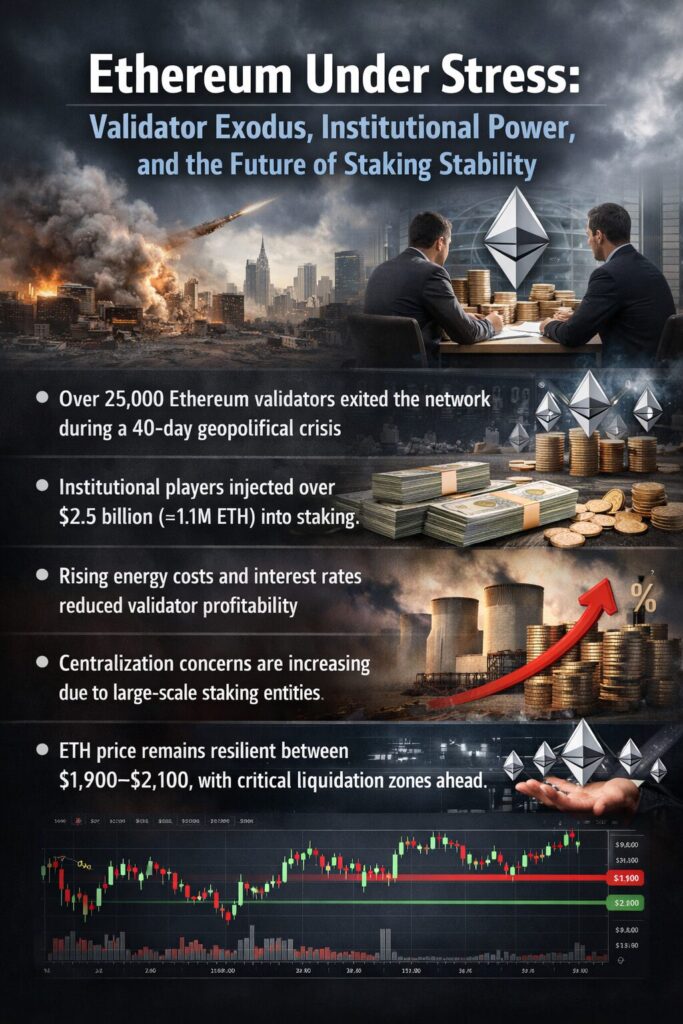
- Over 25,000 Ethereum validators exited the network during a 40-day geopolitical crisis
- Institutional players injected over $2.5 billion (≈1.1M ETH) into staking
- Rising energy costs and interest rates reduced validator profitability
- Centralization concerns are increasing due to large-scale staking entities
- ETH price remains resilient between $1,900–$2,100, with critical liquidation zones ahead
1. A Network Under Pressure: The 40-Day Validator Exodus
The Ethereum network, long celebrated for its transition to Proof-of-Stake (PoS), is now facing a real-world stress test. Over a 40-day period marked by escalating geopolitical tensions—particularly involving U.S.–Iran conflict dynamics—approximately 25,000 validators exited the network, representing a 2.58% decline in participation.
This is not merely a technical fluctuation; it reflects a broader macroeconomic and geopolitical shift. Validator participation is fundamentally tied to incentives, costs, and risk perception. When global uncertainty rises, capital retreats from risk-sensitive activities—and staking is no exception.
Ethereum’s validator count dropped from approximately 964,792 to 939,913, signaling that even a decentralized network is not immune to global instability.
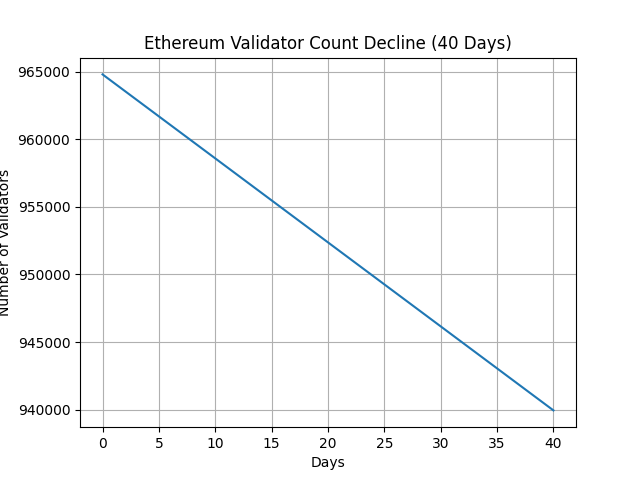
The decline suggests that smaller operators—especially independent or semi-professional validators—are struggling to maintain profitability. Rising costs, declining yields, and better alternatives are forcing them out.
2. Macro Forces: Inflation, Energy, and Interest Rates
Despite Ethereum’s 99.95% energy efficiency advantage over Bitcoin mining, it is not entirely insulated from macroeconomic pressures.
Energy Costs Still Matter
Validator operations still require:
- Server infrastructure
- Cooling systems
- Continuous uptime
- Data center or cloud costs
As global energy prices surged due to geopolitical tensions, operational costs increased—especially for validators in high-cost regions like the United States.
Interest Rate Competition
The U.S. Federal Reserve maintaining interest rates around 3.75% has created a competing “risk-free” yield environment.
Compare:
- Ethereum staking yield: ~2.77%
- Risk-free rate: ~3.75%
This inversion fundamentally changes capital allocation behavior. Institutional and retail investors alike begin to question:
Why stake ETH for lower yield with higher risk?
Shift Toward Capital Efficiency
As highlighted by market participants, capital is increasingly flowing toward:
- Prediction markets
- Perpetual trading platforms
- Liquid strategies with faster exit options
This reflects a deeper structural change:
Liquidity is now more valuable than passive yield.
3. Institutional Counterforce: $2.5 Billion Staking Inflow
Despite the validator exodus, Ethereum has not weakened—because institutions stepped in.
During the same 40-day period, approximately:
- 1.1 million ETH (~$2.5 billion) flowed into staking
Major Players Driving the Shift
Ethereum Foundation
- Staked 22,517 ETH (~$46 million)
- Total staking holdings now ≈ 24,623 ETH (~$50 million)
- Strategic shift: from selling ETH → generating yield
This marks a fundamental change in treasury strategy:
From liquidity extraction → yield generation and network support
Bitmine (BMNR)
- Staked 71,179 ETH (~$146 million)
- Total ETH holdings: 3.14 million ETH (~$6.3 billion)
- Launched MAVAN (Made in America Validator Network)
Bitmine is positioning itself as a global staking infrastructure provider, not just a passive holder.
4. The Hidden Risk: Centralization of Ethereum
While institutional capital stabilized staking participation, it introduced a new systemic risk:
Validator Concentration
As independent validators exit:
- Network control shifts toward large entities
- Decision-making power becomes concentrated
- Perceived decentralization weakens
This creates a paradox:
Stability improves in the short term—but decentralization erodes in the long term.
Why This Matters
Ethereum’s value proposition is rooted in:
- Neutrality
- Decentralization
- Resistance to control
If staking becomes dominated by:
- Foundations
- Corporations
- Institutional custodians
Then Ethereum risks becoming:
A “semi-centralized financial settlement layer” rather than a truly decentralized network.
5. The Bigger Trend: Ethereum as Global Settlement Infrastructure
At the same time, Ethereum’s importance is growing—not shrinking.
Recent developments show increasing integration between:
- Traditional Finance (TradFi)
- Decentralized Finance (DeFi)
Major Institutional Collaborations
Companies such as:
- JPMorgan
- Mastercard
- Mitsubishi
have formed partnerships with crypto firms like:
- Coinbase
- Binance
- Kinexys
These deals—worth billions—signal a major shift:
Ethereum is evolving into a global settlement layer for tokenized assets.
Tokenization Demand
Key use cases driving adoption:
- Tokenized commodities
- Real-world assets (RWA)
- Cross-border settlements
- On-chain financial instruments
In this context:
Network reliability becomes more important than ideological decentralization.
6. Market Structure: Liquidation Zones and Volatility
Ethereum’s price has remained relatively stable between:
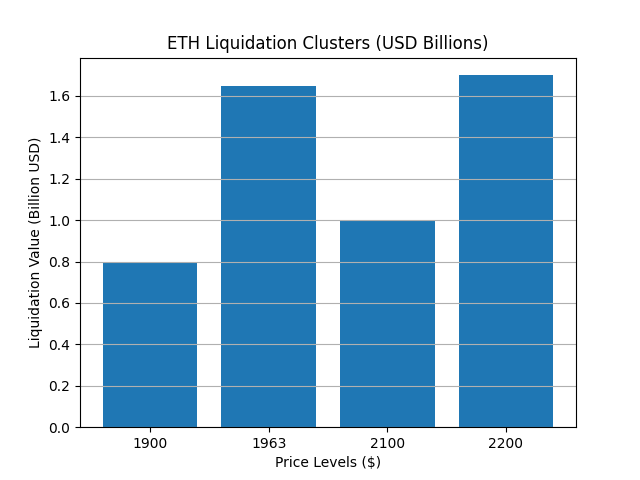
- Support: ~$1,963
- Resistance: ~$2,200
But beneath this stability lies a fragile derivatives structure.
Liquidation Map Insights
- $1.65B in long positions clustered near $1,963
- $1.7B in short positions near $2,200
This creates a “pressure zone”:
- If price drops → cascading long liquidations
- If price rises → short squeeze
Market Sentiment
- Shorts: ~$5.4B
- Longs: ~$3.07B
This imbalance indicates:
A risk-off sentiment, but also a setup for sharp volatility spikes.
7. Strategic Interpretation: What This Means for Investors
For readers seeking new crypto opportunities and practical applications, this situation presents multiple strategic insights:
1. Ethereum Is Becoming Institutional Infrastructure
- Increasing alignment with banks and financial systems
- Growing use in real-world asset tokenization
- Less speculative, more utility-driven
2. Yield Alone Is No Longer Competitive
- Staking yield must compete with TradFi
- Capital is moving toward liquidity-first strategies
- Expect innovations in liquid staking and restaking
3. Centralization Risk Is a Double-Edged Sword
- Positive: improves stability
- Negative: weakens decentralization narrative
This could create:
- New governance debates
- Regulatory implications
- Opportunities for alternative L1 chains
4. Volatility Is Structural, Not Temporary
The current balance of leverage suggests:
A breakout—up or down—will likely be violent and fast.
Conclusion: Ethereum at a Crossroads
Ethereum is entering a new phase—one defined not by ideology, but by economic reality.
The validator exodus reveals:
- The fragility of decentralized participation under macro pressure
The institutional inflow demonstrates:
- The growing importance of Ethereum as financial infrastructure
But together, they expose a deeper tension:
Can Ethereum remain decentralized while becoming globally adopted?
This is not just a technical question—it is a strategic one.
As Ethereum evolves into the backbone of tokenized finance, its future will be shaped by:
- Institutional power
- Economic incentives
- Regulatory alignment
- And the resilience of its core principles
For investors and builders alike, the opportunity lies not just in price movements—but in understanding this transformation.