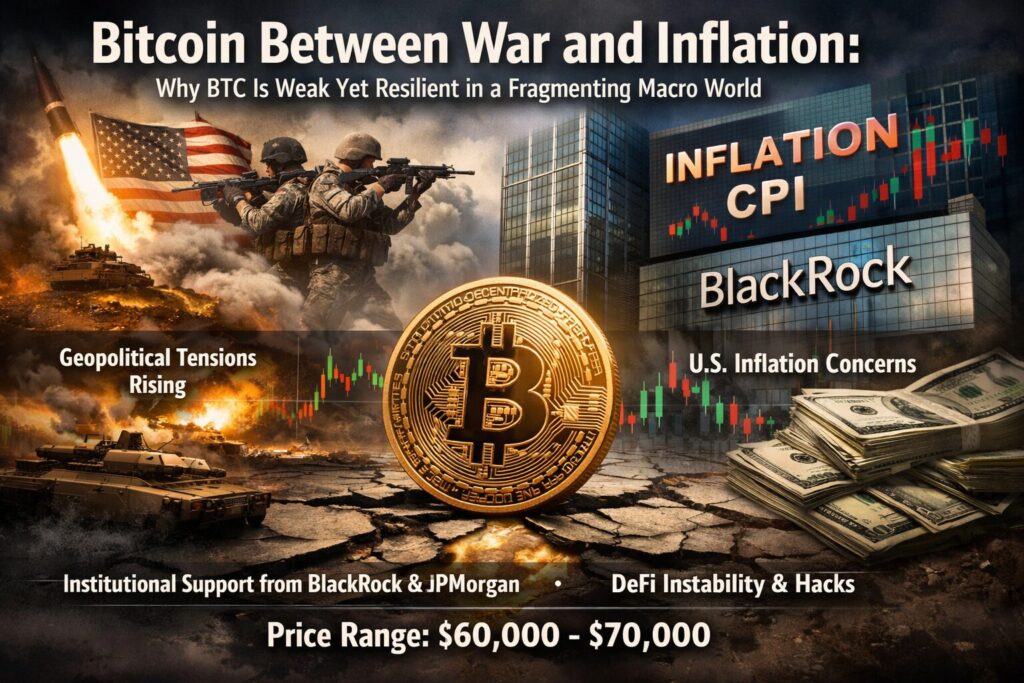
Key Points :
- Bitcoin is being pressured by escalating U.S.–Iran geopolitical tensions and rising oil-driven inflation concerns.
- Despite short-term volatility, downside levels continue to attract strong buying interest.
- Institutional developments—especially ETF expansion and major financial players—remain structurally bullish.
- Macro indicators such as U.S. CPI will play a decisive role in shaping near-term price direction.
- The expected trading range sits between $60,000 and $70,000, with both risk-off and safe-haven narratives coexisting.
1. A Market Pulled Between Fear and Opportunity
The cryptocurrency market, led by Bitcoin, is once again navigating a complex macroeconomic and geopolitical landscape. Over the past week, Bitcoin has demonstrated a pattern that has become increasingly familiar in recent years: sharp reactions to global uncertainty, followed by resilient recoveries driven by structural demand.
At the center of this volatility lies the escalating tension between the United States and Iran. Markets reacted swiftly to reports that Iran rejected a U.S.-proposed ceasefire, triggering fears of prolonged military conflict. These concerns were further amplified when President Donald Trump signaled the possibility of targeting Iranian energy infrastructure should negotiations fail.
This geopolitical uncertainty directly influenced global oil prices, which surged in response. Rising energy costs, in turn, reignited inflation concerns across global markets—particularly in the United States. As inflation expectations rose, investors shifted toward a risk-off posture, leading to a broad sell-off across equities and cryptocurrencies alike.
Bitcoin was not immune. Prices declined toward approximately $66,000, reflecting its continued classification—at least in the short term—as a risk asset rather than a pure safe haven.
However, the story did not end there.
2. The Resilience of Bitcoin: Why Buyers Step In at Lower Levels
Despite the initial sell-off, Bitcoin quickly found support. As geopolitical rhetoric softened temporarily and optimism around a potential de-escalation emerged, risk appetite returned to the market.
Equities rebounded sharply, particularly in the technology sector, and Bitcoin followed suit—recovering toward $69,000.
This pattern highlights a critical structural feature of Bitcoin’s current market behavior:
buyers are increasingly willing to accumulate during periods of weakness.
There are several reasons for this:
Institutional Accumulation
Large financial institutions continue to expand their exposure to Bitcoin. Firms like BlackRock are exploring new ETF structures, including yield-generating Bitcoin products, which could fundamentally change how institutional capital interacts with crypto markets.
Market Maturity
Bitcoin’s liquidity and global adoption have improved significantly. Unlike earlier cycles, sharp declines are often met with rapid absorption by long-term holders and institutional players.
Narrative Evolution
Bitcoin is no longer viewed purely as a speculative asset. Instead, it now occupies a hybrid position:
- Risk asset during liquidity tightening
- Safe-haven alternative during systemic crises
This dual nature explains why Bitcoin can fall alongside equities in one moment—and rise as a hedge in the next.
3. Geopolitics as a Market Driver: Oil, War, and Crypto
The current U.S.–Iran situation underscores how deeply interconnected Bitcoin has become with global macro conditions.
When tensions escalate:
- Oil prices rise
- Inflation expectations increase
- Central banks become more cautious
- Risk assets decline
Yet paradoxically, prolonged instability can also benefit Bitcoin.
In crisis scenarios, investors begin to question:
- Fiat currency stability
- Sovereign risk exposure
- Banking system resilience
This is where Bitcoin’s “digital gold” narrative re-emerges.
If geopolitical instability intensifies further, Bitcoin may transition from being treated as a risk asset to a capital preservation tool, particularly in regions directly affected by conflict or currency instability.
4. CPI: The Silent Catalyst That Could Move Everything
While geopolitics dominates headlines, the upcoming U.S. Consumer Price Index (CPI) release may prove even more influential.
If CPI shows:
Higher-than-expected inflation
- Rate cuts become less likely
- Bond yields rise
- Liquidity tightens
- Bitcoin faces downward pressure
Lower-than-expected inflation
- Market confidence improves
- Risk assets rally
- Bitcoin may break toward or above $70,000
The critical factor here is energy prices. If rising oil costs—driven by geopolitical tensions—feed into inflation data, markets could enter a prolonged period of uncertainty.
5. Structural Tailwinds: Institutions Are Not Leaving
Despite short-term volatility, the long-term outlook remains supported by institutional adoption.
Major players such as JPMorgan Chase and BlackRock continue to explore blockchain integration, custody solutions, and crypto-related financial products.
Additionally, regulatory developments—such as the proposed U.S. CLARITY Act—could provide clearer frameworks for digital asset classification and usage. Regulatory clarity is often a precursor to large-scale institutional inflows.
This trend suggests that:
downside volatility is increasingly being absorbed by long-term capital rather than speculative panic selling.
6. Risk Factors from Within Crypto: DeFi Vulnerabilities
While macro factors dominate, internal risks within the crypto ecosystem remain relevant.
A recent large-scale hack on the Solana-based decentralized exchange Drift Protocol has raised concerns about DeFi security and systemic risk.
Such incidents can:
- Trigger capital outflows from altcoins
- Increase market-wide risk aversion
- Temporarily weaken Bitcoin’s recovery
However, historically, these events often result in capital rotating back into Bitcoin, reinforcing its role as the “base layer of trust” in crypto markets.
7. Price Outlook: The Battle Between $60K and $70K
In the near term, Bitcoin is expected to trade within a defined range:
- Upper resistance: $70,000
- Lower support: $60,000
To better visualize this range:
Bitcoin Expected Price Range (Support vs Resistance)
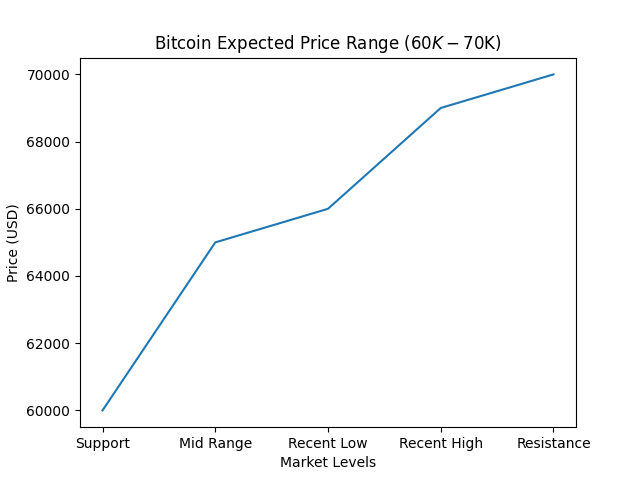
This range reflects a market caught between:
- Macro fear (war, inflation)
- Structural optimism (institutional adoption)
A breakout above $70,000 would likely require:
- Cooling geopolitical tensions
- Favorable CPI data
- Continued institutional inflows
A breakdown below $60,000, on the other hand, would likely be triggered by:
- Escalation into full-scale conflict
- Persistent inflation surprises
- Liquidity tightening
8. Strategic Implications for Investors and Builders
For readers seeking new opportunities in crypto, this environment presents both risks and advantages.
For Investors
- Accumulation strategies near support levels remain attractive
- Volatility can be used for structured entry (DCA, laddering)
- Monitoring macro indicators is now essential
For Builders
- Institutional infrastructure (custody, compliance, on-chain settlement) is a major growth area
- Hybrid models—combining CeFi UX with DeFi execution—are gaining traction
- Security and auditability are becoming competitive advantages
For Revenue Opportunities
- Yield-generating Bitcoin products (ETFs, staking-like structures)
- Cross-border settlement using blockchain rails
- Tokenized financial instruments
Conclusion: A Market Defined by Dual Forces
Bitcoin today stands at a unique intersection of global finance, geopolitics, and technological transformation.
On one side:
- War
- Inflation
- Monetary tightening
On the other:
- Institutional adoption
- Regulatory progress
- Technological innovation
This duality defines the current market.
Short-term volatility is unavoidable.
But beneath it lies a deeper trend:
Bitcoin is steadily evolving from a speculative asset into a foundational component of the global financial system.
For those willing to navigate uncertainty, this phase may represent not just risk—but one of the most important accumulation and innovation windows in crypto history.