Main Points :
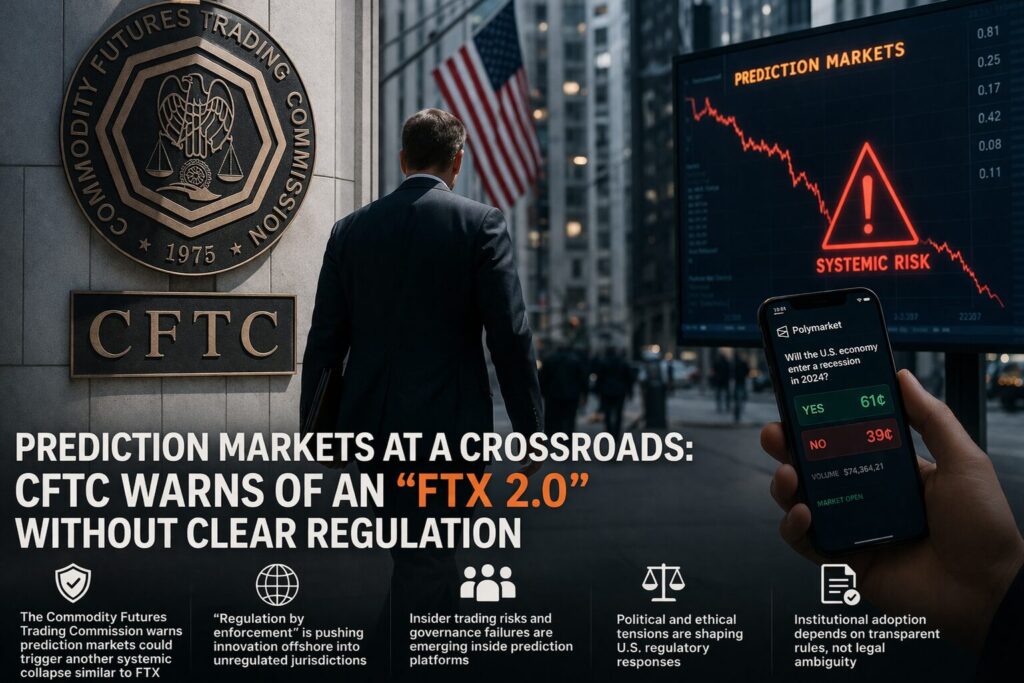
- The Commodity Futures Trading Commission warns prediction markets could trigger another systemic collapse similar to FTX
- “Regulation by enforcement” is pushing innovation offshore into unregulated jurisdictions
- Insider trading risks and governance failures are emerging inside prediction platforms
- Political and ethical tensions are shaping U.S. regulatory responses
- Institutional adoption depends on transparent rules, not legal ambiguity
1. A New Financial Frontier—or a Familiar Risk?
Prediction markets—platforms where users trade on the probability of future events—are rapidly evolving into a new frontier of financial innovation. From betting on election outcomes to forecasting macroeconomic indicators, these markets blur the line between finance, data, and speculation.
However, according to the leadership of the Commodity Futures Trading Commission, this innovation is entering dangerous territory. Without clear regulatory frameworks, prediction markets risk repeating the catastrophic failures seen in the collapse of FTX in 2022.
The core concern is not the concept of prediction markets themselves, but the infrastructure surrounding them—custody of funds, transparency of operations, and fairness of participation.
2. The Warning: “FTX Can Happen Again”
CFTC Chairman Michael Selig has issued a stark warning: if regulators fail to establish clear and enforceable rules, prediction markets could become the next epicenter of financial collapse.
FTX did not fail because crypto itself was flawed—it failed due to:
- Poor governance
- Lack of transparency
- Commingling of funds
- Weak regulatory oversight
Prediction markets today are showing early signs of similar vulnerabilities:
- Centralized custody structures
- Opaque liquidity mechanisms
- Limited disclosure requirements
- Potential insider advantages
Without intervention, these risks could scale rapidly as capital flows into the sector.
3. The Problem with “Regulation by Enforcement”
A key criticism raised by regulators themselves is the reliance on “regulation by enforcement”—a model where rules are not clearly defined in advance but are instead enforced through lawsuits and penalties after violations occur.
This approach creates three major problems:
Uncertainty for Builders
Startups and developers cannot design compliant systems without knowing the rules.
Capital Flight Offshore
Projects relocate to jurisdictions with lighter oversight, often sacrificing investor protection.
Uneven Playing Field
Well-funded entities can navigate legal ambiguity, while smaller innovators are excluded.
4. Market Structure Risks in Prediction Platforms
Prediction markets introduce unique structural risks beyond traditional exchanges:
Information Asymmetry
Participants with privileged information can manipulate outcomes or pricing.
Thin Liquidity
Low liquidity can exaggerate price movements, leading to distorted probabilities.
Event Resolution Risk
Disputes over outcomes (e.g., “Did an event actually occur?”) can undermine trust.
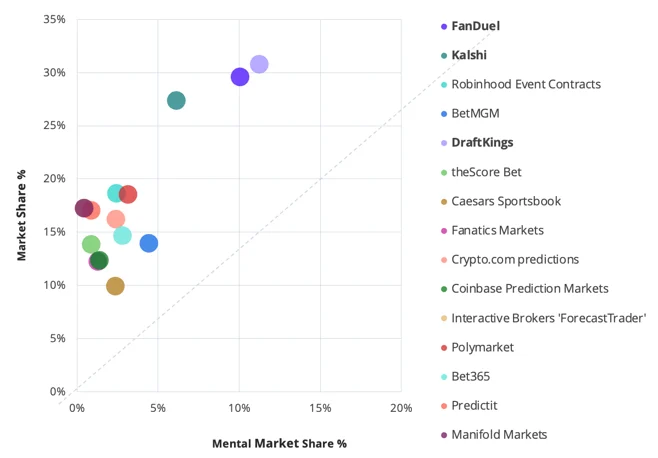
Example structure of prediction market trading and probability pricing
5. Political and Ethical Pressure Intensifies
Prediction markets are not just financial tools—they intersect with politics, ethics, and public perception.
In the United States:
- Lawmakers have proposed banning staff participation in prediction markets
- Concerns exist about betting on sensitive events (elections, conflicts)
- Sports prediction markets are under legislative scrutiny
This creates a regulatory paradox:
- Over-regulation may stifle innovation
- Under-regulation may enable abuse
6. The Offshore Migration Problem
When domestic regulation becomes unclear or hostile, innovation moves offshore.
This has already happened in crypto:
- Many exchanges relocated after U.S. crackdowns
- Liquidity shifted to jurisdictions with weaker oversightPrediction markets are beginning to follow the same pattern.
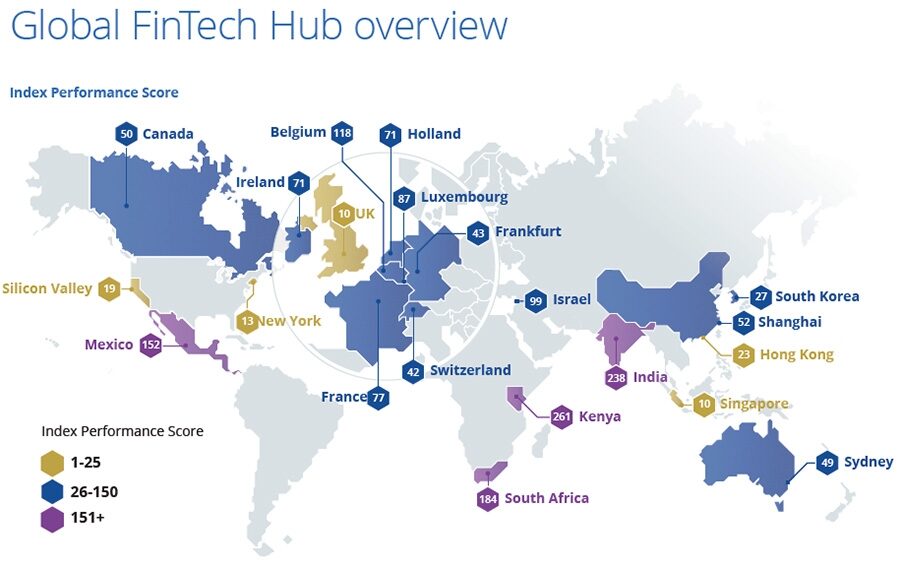
Global migration of crypto and prediction market platforms due to regulatory pressure
7. Institutional Adoption Depends on Clarity
For prediction markets to mature into a legitimate financial sector, institutional participation is essential.
However, institutions require:
- Legal certainty
- Custody standards
- Risk management frameworks
- Compliance infrastructure
Without these, prediction markets will remain speculative tools rather than financial infrastructure.
8. The Role of Blockchain: Opportunity and Risk
Blockchain introduces both solutions and new risks:
Opportunities
- Transparent on-chain settlement
- Programmable compliance
- Global accessibility
Risks
- Smart contract vulnerabilities
- Governance manipulation
- Oracle dependency (data feeds can be attacked)
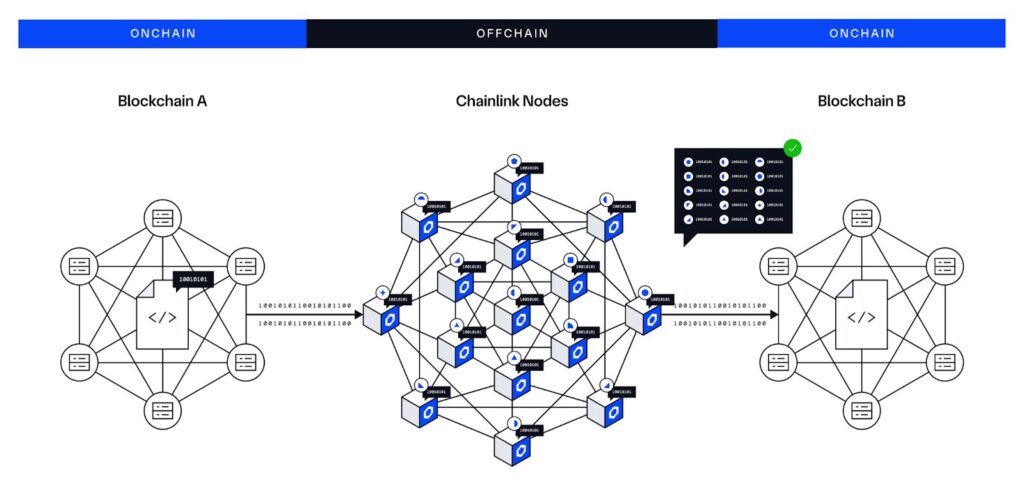
Blockchain-based prediction market architecture
9. What This Means for Builders and Investors
For your audience—builders and investors—this moment represents both risk and opportunity.
Opportunities
- Early-stage investment in compliant prediction platforms
- Infrastructure development (oracles, compliance layers, identity systems)
- Integration with payment rails and stablecoins
Risks
- Regulatory shutdowns
- Liquidity fragmentation
- Platform insolvency
10. Strategic Insight: Where the Market Is Heading
Prediction markets are converging with:
- AI-driven forecasting
- Tokenized real-world assets (RWAs)
- Institutional derivatives markets
This convergence could create a new asset class:
“Information-backed financial instruments”
Conclusion: Regulation as a Catalyst, Not a Constraint
The warning from the Commodity Futures Trading Commission is clear: without regulatory clarity, prediction markets risk becoming the next FTX-scale disaster.
However, regulation—if designed correctly—can serve as a catalyst:
- Enabling institutional adoption
- Protecting investors
- Unlocking global liquidity
The lesson from FTX is not to suppress innovation, but to structure it properly.
Prediction markets are not inherently dangerous—but unmanaged systems are.
The next phase of growth will belong to platforms that combine:
- Transparency
- Compliance
- Usability
- Trust