
Key Points :
- Crypto markets showed resilience despite macroeconomic stress and geopolitical tensions
- The U.S. Securities and Exchange Commission introduced clearer regulatory classification
- Legislative uncertainty continues around stablecoins under the CLARITY Act
- Emerging assets like Hyperliquid (HYPE) and Bittensor (TAO) led gains
- Crypto is increasingly behaving as an independent asset class rather than a risk proxy
A Market Moving Against the Tide
March 2026 presented a paradox rarely seen in global financial markets. While traditional assets such as equities and commodities faced downward pressure, cryptocurrencies demonstrated unexpected strength. According to data from Grayscale Investments, the FTSE/Grayscale Crypto Sector Index rose by approximately 1.6% month-over-month, even as the S&P 500 declined and gold prices softened.
This divergence marks a significant shift in how digital assets are behaving relative to macroeconomic forces. Historically, cryptocurrencies—especially Bitcoin—have been treated as high-risk assets, often moving in tandem with equities during periods of uncertainty. However, March’s performance suggests a decoupling trend may be underway.
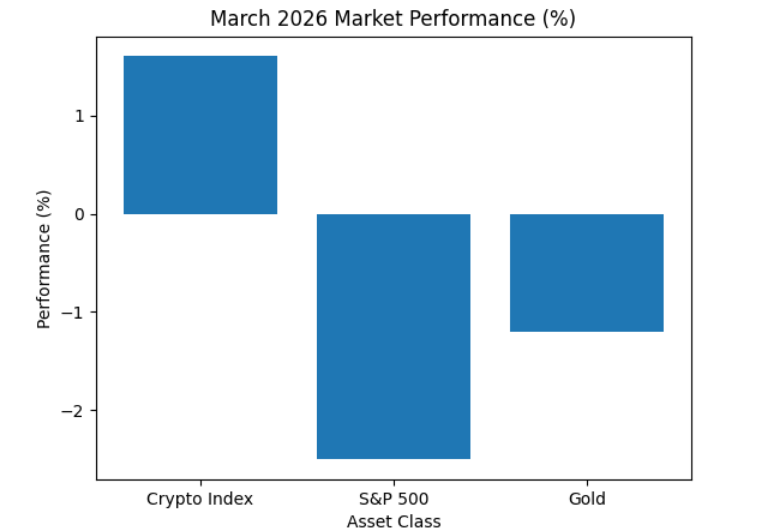
The chart above illustrates this divergence clearly. While traditional safe havens like gold declined alongside equities, crypto assets maintained positive momentum. This raises an important question: Are cryptocurrencies evolving into a new category of macro asset?
Geopolitics, Oil, and the Macro Backdrop
The backdrop to March’s performance was anything but stable. Rising tensions involving Iran pushed oil prices upward, increasing inflationary pressure globally. Central banks responded with cautious tightening, further weighing on equities and bonds.
Under such conditions, investors typically rotate into traditional safe-haven assets like gold or U.S. Treasuries. However, the decline in gold suggests that market participants may be reevaluating what constitutes a “safe haven” in the modern financial system.
Crypto’s resilience during this period may indicate that digital assets are beginning to serve as a hedge—not just against inflation, but against systemic inefficiencies in traditional finance. This aligns with a broader narrative emerging over the past two years: blockchain-based systems offer transparency, programmability, and global accessibility that legacy systems struggle to match.
Regulatory Clarity: A Turning Point
One of the most significant developments in March was the release of new interpretive guidance from the U.S. Securities and Exchange Commission. For years, regulatory ambiguity has been a major barrier to institutional adoption. The SEC’s latest framework attempts to address this by categorizing digital assets into five distinct groups.
Among the key takeaways:
- Digital securities are explicitly classified as securities
- Stablecoins may be treated as securities if they fail to meet certain criteria
- Limited safe harbor provisions were introduced for token issuers and DeFi protocols
This move is particularly important for developers and institutions alike. For developers, it provides clearer boundaries for compliance. For institutions, it reduces legal uncertainty, making it easier to allocate capital into the crypto space.
However, regulatory clarity is not without its trade-offs. Increased oversight could limit innovation in certain areas, particularly decentralized finance. The balance between regulation and innovation will remain a critical issue moving forward.
Legislative Friction: The CLARITY Act Debate
While the SEC’s guidance represents progress, legislative developments remain complex. The CLARITY Act has passed the House of Representatives but faces challenges in the Senate. At the center of the debate is whether stablecoin yields should be regulated as money market funds (MMFs).
This issue is more than a technical detail—it has profound implications for the future of decentralized finance. If stablecoin yields are treated as securities, many existing DeFi protocols could face significant compliance burdens.
For investors and builders, this creates both risk and opportunity. Projects that can adapt to regulatory requirements may gain a competitive advantage, while those that cannot may struggle to survive.
Altcoin Leadership: The Rise of Specialized Networks
Beyond macro trends and regulation, March also highlighted the growing importance of specialized blockchain networks. Two standout performers were Hyperliquid (HYPE) and Bittensor (TAO).
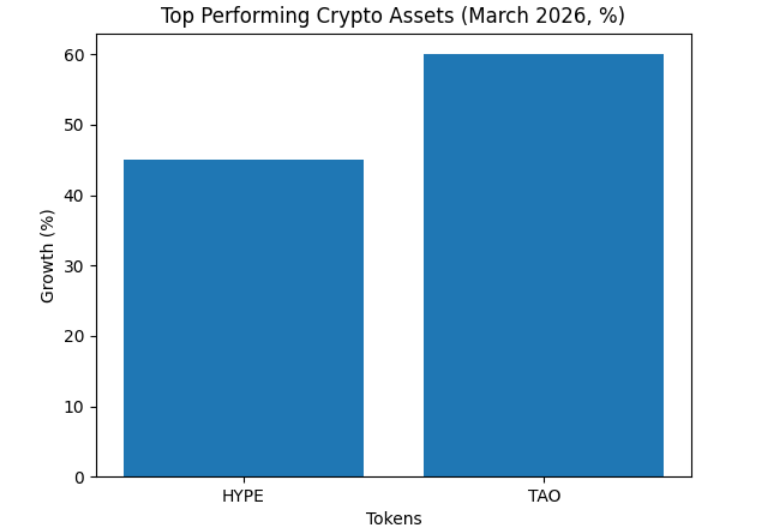
Hyperliquid’s growth was driven by increased trading volume in commodity futures, reflecting a broader trend toward on-chain derivatives. As traditional financial instruments migrate to blockchain platforms, protocols that facilitate high-speed, low-cost trading are gaining traction.
Bittensor, on the other hand, represents a different frontier: decentralized artificial intelligence. Its recent technical breakthroughs have positioned it as a leader in combining blockchain with AI infrastructure. This convergence could unlock entirely new use cases, from decentralized data markets to autonomous machine learning networks.
A New Investment Paradigm
What makes March 2026 particularly noteworthy is not just the performance of crypto assets, but what that performance represents. The market is beginning to recognize that cryptocurrencies are not merely speculative instruments—they are foundational technologies with real-world applications.
For investors seeking new revenue streams, this shift is critical. Opportunities are no longer limited to price appreciation. Instead, value can be generated through staking, liquidity provision, decentralized governance, and participation in emerging ecosystems.
Moreover, the rise of tokenized assets and on-chain financial infrastructure suggests that the line between traditional finance and crypto is becoming increasingly blurred. In this hybrid environment, the most successful participants will be those who can navigate both worlds effectively.
Implications for Builders and Institutions
For builders, the message is clear: usability and compliance are becoming just as important as innovation. Projects that can simplify user onboarding—such as integrating social logins or abstracting away wallet complexity—will have a significant advantage.
For institutions, the evolving regulatory landscape presents both challenges and opportunities. While compliance requirements may increase, so too does the potential for mainstream adoption. Financial institutions that embrace blockchain technology early may be better positioned to capture future growth.
Conclusion: The Emergence of Crypto’s “Independent Strength”
March 2026 may be remembered as a turning point in the evolution of digital assets. In the face of macroeconomic headwinds and geopolitical uncertainty, cryptocurrencies demonstrated a level of resilience that challenges traditional assumptions.
This “independent strength” is not merely a short-term anomaly—it reflects deeper structural changes in how value is created, transferred, and stored in the digital age.
For those seeking the next generation of financial opportunities, the message is clear: crypto is no longer just an alternative asset. It is becoming a core component of the global financial system.