Key Points :
- Ethereum is at risk of losing its #2 market cap position—not to Bitcoin, but to stablecoins like USDT
- Stablecoins are growing faster due to capital inflows rather than price appreciation
- Institutional demand for ETH is weakening, as seen in ETF outflows
- Macro uncertainty is pushing investors toward “crypto dollars” instead of volatile assets
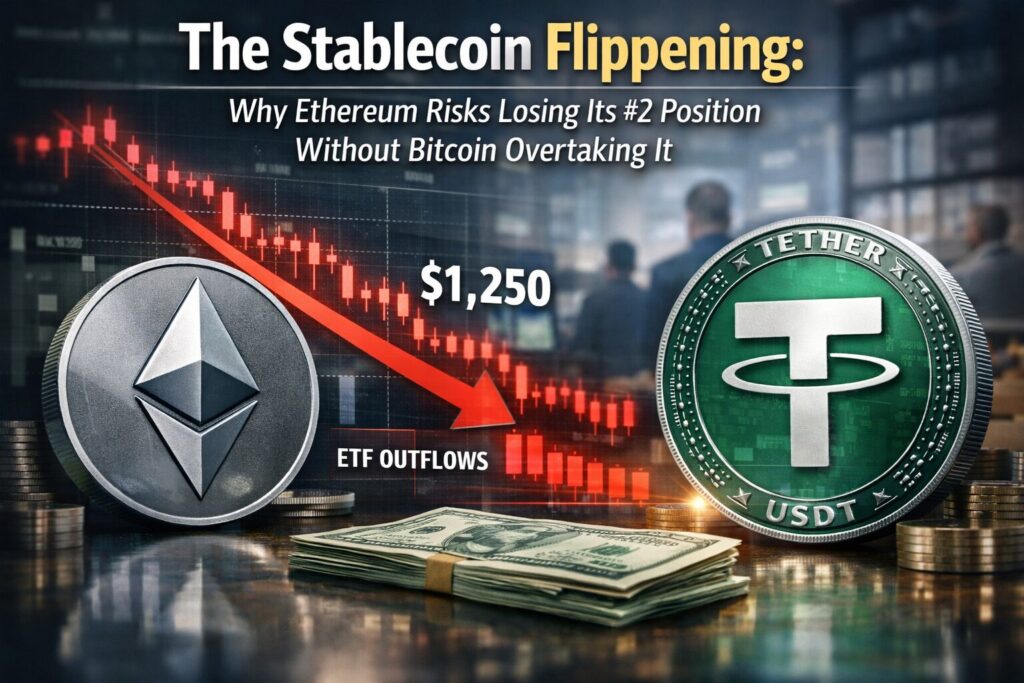
- Technical indicators suggest ETH may decline toward ~$1,250 in 2026
1. A New Kind of Flippening Is Emerging
The concept of the “flippening” has long been associated with a hypothetical scenario where Ethereum overtakes Bitcoin as the largest cryptocurrency by market capitalization. However, the current market dynamics suggest a very different narrative is unfolding—one where Ethereum risks losing its second-place position, not by surpassing Bitcoin, but by being overtaken by stablecoins such as USDT.
This shift represents a structural transformation in the cryptocurrency market. Instead of speculative growth driven by asset appreciation, capital is increasingly flowing into stability, liquidity, and utility. The rise of stablecoins is no longer just a side trend—it is becoming a dominant force reshaping market hierarchy.
2. Ethereum vs Stablecoins: A Diverging Growth Model
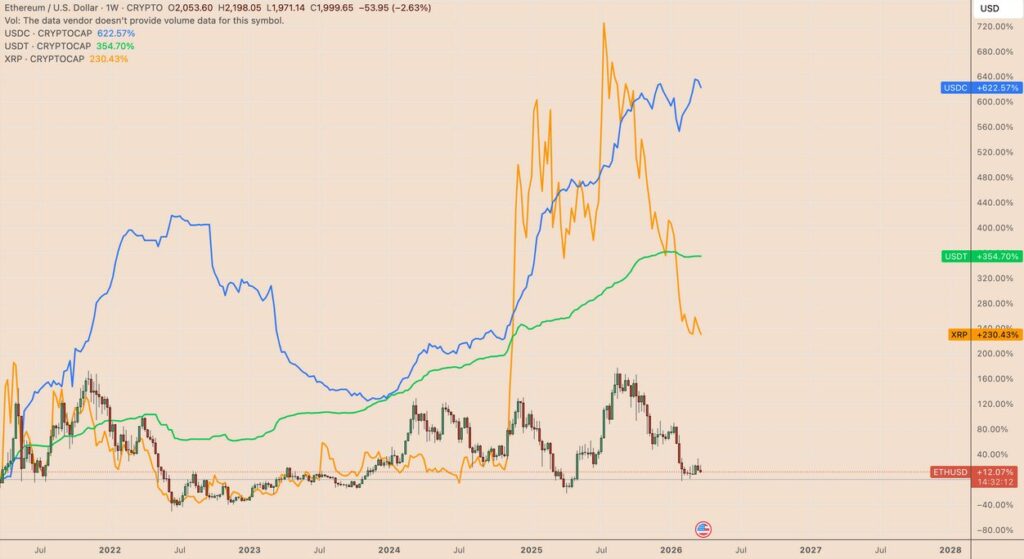
Ethereum’s growth has historically depended on price appreciation. Its value is tied to network usage, DeFi activity, NFT ecosystems, and broader investor sentiment. However, over the past five years, ETH’s market capitalization has grown by only about 11.75%, reaching approximately $240 billion.
In contrast, Tether (USDT) has surged by over 622.5%, surpassing $184 billion in market cap. Even USD Coin and XRP have outpaced Ethereum in growth.
The reason lies in their fundamentally different mechanisms:
- Ethereum (ETH) → grows through price appreciation
- Stablecoins (USDT/USDC) → grow through capital inflows
Stablecoins do not rely on speculative upside. Instead, they expand as more capital enters the crypto ecosystem and is parked in dollar-denominated digital assets.
3. The Rise of “Crypto Dollars” and Defensive Capital
The total stablecoin market has grown explosively—from roughly $5 billion in 2020 to over $310 billion in 2026. Within this ecosystem, USDT dominates with approximately 58% market share.
This growth reflects a key behavioral shift among investors. During periods of uncertainty, capital does not necessarily exit crypto—it rotates into stablecoins.
This phenomenon is often referred to as “dry powder”:
- Investors park funds in stablecoins
- Wait for better entry points
- Maintain liquidity without exiting the ecosystem
This dynamic benefits stablecoins regardless of whether the market is bullish or bearish.
Ethereum, however, requires risk-on sentiment to grow. When investors become defensive, ETH struggles to maintain momentum.
4. Macro Pressures and Institutional Weakness
Ethereum’s underperformance is not occurring in isolation. It is deeply tied to macroeconomic conditions:
- U.S. tariff tensions
- Geopolitical risks (Middle East conflicts)
- Reduced expectations of Federal Reserve rate cuts
These factors collectively suppress risk appetite.
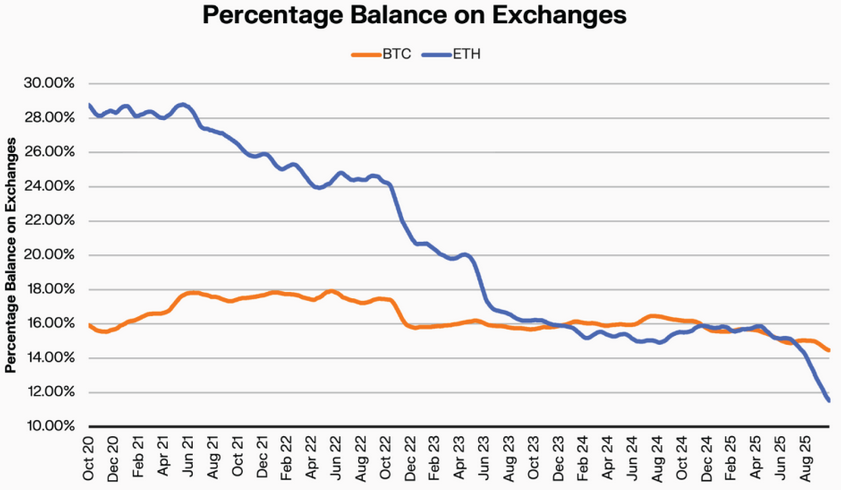
One of the clearest indicators of weakening institutional demand is the decline in Ethereum ETF assets:
- Peak: ~$31.86 billion (Oct)
- Current: ~$11.76 billion (March)
- Decline: ~65%
This suggests that institutional investors are reallocating capital away from ETH—potentially toward safer or more liquid instruments such as stablecoins.
5. Prediction Markets Signal a Shift
Market sentiment is increasingly aligning with this structural shift.
On platforms like Polymarket, over 59% of participants now believe Ethereum will lose its #2 position by 2026. This is a dramatic increase from just 17% earlier in the year.
Prediction markets are often forward-looking indicators of consensus belief. This sharp shift suggests that traders are not just reacting to current data—they are anticipating continued dominance of stablecoin-driven capital flows.
6. Technical Analysis: Bearish Signals for ETH
From a technical perspective, Ethereum’s outlook is also concerning.
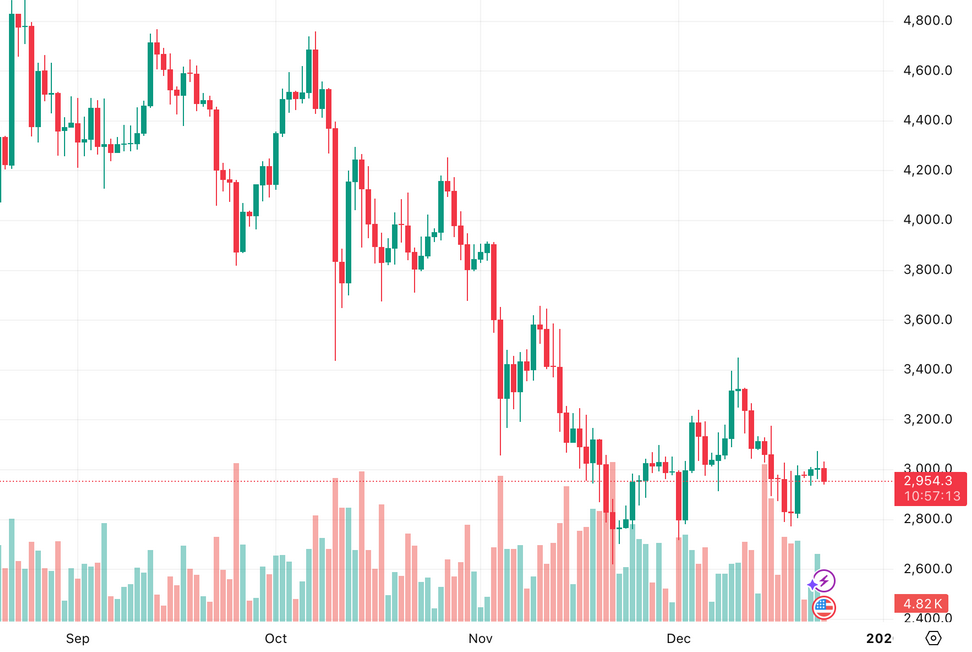
ETH is currently forming a bear flag pattern, a continuation structure that typically signals further downside.
If the lower trendline breaks decisively:
- Downside target: approximately $1,250
- Timeline: potentially by mid-2026
This aligns with broader macro and structural pressures, reinforcing the bearish case.

7. Why This Isn’t the End of Ethereum
Despite these risks, it is critical to understand that Ethereum’s declining relative position does not imply irrelevance.
Ethereum remains:
- The backbone of DeFi
- A dominant smart contract platform
- The settlement layer for many stablecoins
Ironically, the rise of stablecoins is partially built on Ethereum itself.
This creates a paradox:
- Stablecoins grow → Ethereum usage increases
- But ETH price does not necessarily follow
This divergence highlights a key evolution in crypto markets—utility does not always translate into token appreciation.
8. Strategic Implications for Investors
For investors seeking new opportunities, this shift presents several strategic insights:
1. Stablecoins Are No Longer Passive Assets
They are becoming active infrastructure for liquidity, yield generation, and cross-border finance.
2. Capital Rotation Matters More Than Price Trends
Understanding where capital flows—not just price movements—is critical.
3. New Yield Opportunities Are Emerging
Stablecoin-based DeFi strategies, RWAs (real-world assets), and on-chain treasury products are gaining traction.
4. Ethereum Requires Catalysts
Without renewed institutional demand or major innovation cycles, ETH may lag behind in relative valuation.
Conclusion
The emerging “stablecoin flippening” marks a profound shift in the cryptocurrency market. Ethereum is not being replaced as a technological platform—but it is being challenged as a store of market value.
This distinction is critical.
While Bitcoin remains the dominant macro asset, the real competition for Ethereum is no longer speculative altcoins—it is the rise of programmable dollars.
As the market matures, capital efficiency, liquidity, and risk management are becoming more important than pure upside potential. Stablecoins sit at the center of this transformation.
For forward-looking investors, the key question is no longer:
“Which crypto will grow the most?”
But rather:
“Where will capital choose to stay?”