
Main Points :
- Early Bitcoin whale from 2013 continues to send large BTC to exchanges with cumulative realized gains exceeding $360M.
- Ethereum ICO wallets are systematically selling large ether balances, including 38,800 ETH and additional 15,000 ETH, signaling profit‑taking.
- BTC and ETH prices have reacted with near‑term weakness — Bitcoin dropping over 5% and Ethereum over 7% in the past week.
- Despite selling from long dormant addresses, mid‑tier whales are accumulating BTC, and small wallets are gradually increasing holdings.
- Market impact is nuanced: continued profit‑taking may weigh on near‑term prices, while selective accumulation by other whales suggests limited downside.
- Key future drivers include dormant reactivation trends, sentiment shifts, and continued institutional flow dynamics.
1. The Resurfacing of Early Bitcoin Whales
Blockchain on‑chain data analytics firms continue to highlight a trend of long dormant Bitcoin wallets waking up after more than a decade offline.
One particular address, which acquired 5,000 BTC at roughly $332 in November 2013, has been moving coins to exchanges since late 2024, with incremental transfers continuing into March 2026. According to on‑chain experts, this wallet has cumulatively deposited roughly 4,000 BTC to Binance at an average price near $91,258, translating into over $360M in realized profits. The whale now retains about 1,000 BTC (~$66M).
These moves reflect long‑term holders taking advantage of the current bull‑bear transition, locking in gains after more than a decade of price appreciation.
Market Reaction
Bitcoin’s price has shown sensitivity to such large deposits, with renewed exchange supply often correlating with near‑term selling pressure. In the week following significant movements from dormant holders, BTC slipped more than 5%, briefly dropping below $66,000. This action underscores how historically inactive holders can exert meaningful influence on sentiment and price discovery.
Insert Figure 1 Here: Price Chart — BTC vs Dormant Wallet Activity (Time Series)
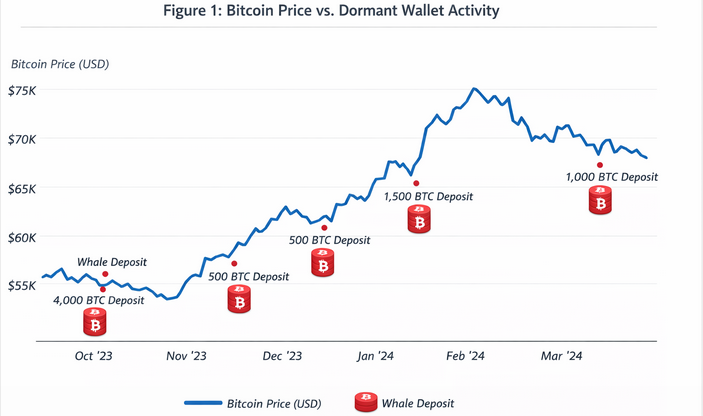
Description: A line chart showing Bitcoin price over 6 months, with markers for key whale deposits.
2. Ethereum ICO Participants Selling Into Strength
Alongside Bitcoin, Ethereum’s market has seen its own set of early participant reactivations. Data from on‑chain analytics shows a wallet that participated in Ethereum’s 2015 ICO holding 38,800 ETH has systematically sold roughly 11,552 ETH at average prices around $2,027, realizing over $23M in profit. The original acquisition cost was around $12,000, meaning the holder still retains a large embedded gain.
A separate ICO wallet also transferred 15,002 ETH to Coinbase, indicating continued profit‑taking from long‑held positions as prices hover near the $2,000 zone.
Ethereum Price Response
Ethereum has seen sharper downside than Bitcoin, with ETH down over 7% over the past week, dipping under $2,000 amid these selling pressures.
Insert Figure 2 Here: ETH Price vs Large Wallet Sales (Scatter Chart)
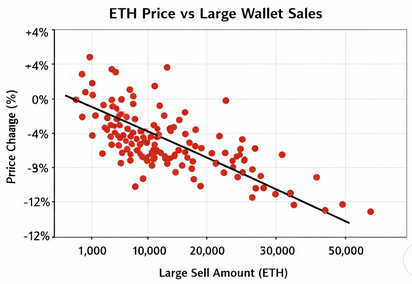
Description: A scatter plot showing large sell amounts vs price changes over recent weeks.
3. Broader Sell‑Off Context and Market Factors
While long‑dormant holders are realizing gains, other macro factors and market dynamics are also influencing prices:
- Larger market narratives suggest Ethereum and Bitcoin are contending with broader crypto risk‑off sentiment, including external macroeconomic pressures and technical factors driving short‑term volatility. Shorter term moves below psychological levels can intensify selling cascades among leveraged traders.
- According to independent analyses, some Ethereum whales and market makers have been selling portions of their holdings over recent weeks, contributing to persistent downward momentum.
Despite these pressures, selling from dormant holders is not universal. Many long‑term whales are not fully exiting positions and remain invested in both networks.
4. Contrasting Accumulation Trends
Interestingly, while some early holders cash out, newer whale classes and mid‑tier holders are behaving differently:
- On‑chain metrics show that wallets holding between 10 and 10,000 BTC have increased their holdings by approximately 0.45% over the past month, with roughly 61,568 BTC acquired, suggesting active accumulation behavior among certain segments.
- Smaller wallets (holding less than 0.01 BTC) have also increased, rising about 0.42%, pointing to broader retail engagement.
This pattern indicates that profit‑taking from legacy addresses could be partially absorbed by fresh demand from other classes of holders.
5. Implications for Crypto Investors and Strategic Takeaways
For readers focused on new assets, yield opportunities, and practical blockchain utilization, the ongoing trends suggest several strategic focal points:
A. Demand and Supply Cycles in Crypto Markets
- Large holders unlocking positions contribute to supply pressure, but accumulation by active whales can create a counterbalance.
- Recognizing these cyclical behaviors can inform entry, exit, or risk management timing.
B. Tech Utilization Versus Market Liquidity Movements
- Liquidity shifts driven by dormant wallets are market phenomena, not necessarily technology adoption signals. However, real‑world utilization and institutional activities — such as staking flows, ETF investments, and protocol governance participation — remain essential for long‑term value.
C. Adaptive Risk Frameworks
- If dormant holders continue selling while key support levels weaken, downside risk can persist. Conversely, sustained accumulation by proactive whales and increasing retail engagement may anchor price floors.
6. Looking Ahead: Key Variables to Monitor
The market’s direction will likely be shaped by these evolving factors:
- Continued reactivation of dormant addresses and pace of realized profit taking.
- Institutional flows, including ETF inflows/outflows and staking participation.
- Regulatory developments and macroeconomic conditions.
- Advances in practical blockchain solutions (DeFi products, staking yields, RWA tokenization).
Conclusion
The recent resurgence of dormant Bitcoin and Ethereum holders selling into strength marks a clear pivot in the crypto landscape. Legacy holders are realizing profits accrued over years, which has coincided with short‑term price weakness. However, mixed signals abound: while some whales sell, others accumulate, and smaller holders continue to engage, producing nuanced market dynamics. For investors seeking new assets, revenue opportunities, or practical blockchain adoption cases, understanding these deep on‑chain behavioral trends provides essential context for strategic decision‑making in a still nascent but rapidly evolving digital asset ecosystem.