
Main Points :
- Canaan’s cryptocurrency treasury has reached approximately $128 million in Bitcoin and Ethereum holdings.
- The company mined 86 BTC in February 2026, increasing total holdings to 1,793 BTC and 3,952 ETH.
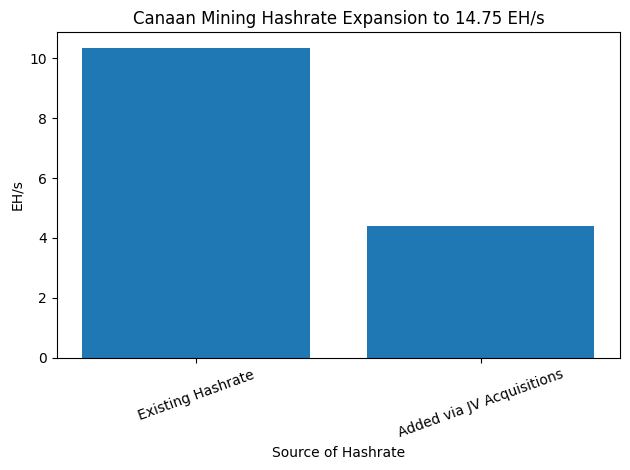
- Its deployed mining infrastructure has expanded to 14.75 EH/s, strengthening its competitive mining capacity.
- Strategic acquisitions of joint-venture data centers added about 4.4 EH/s to its network.
- Access to sub-$0.03/kWh electricity in West Texas significantly improves mining economics.
- While competitors increasingly pivot to AI and high-performance computing (HPC) infrastructure, Canaan is maintaining a long-term cryptocurrency accumulation strategy.
The Strategic Shift in Bitcoin Mining: Canaan Bets on Long-Term Crypto Accumulation
The cryptocurrency mining industry is undergoing a strategic transformation. Rising energy costs, volatile crypto markets, and the explosive growth of artificial intelligence infrastructure have forced many mining companies to reconsider their long-term business models. Some firms are selling mined Bitcoin immediately to finance operations, while others are repurposing their data centers for artificial intelligence (AI) or high-performance computing (HPC).
Yet one company is taking a different path.
Canaan, one of the world’s leading manufacturers of Bitcoin mining hardware and a vertically integrated mining operator, is strengthening its commitment to the cryptocurrency ecosystem. The company recently announced that its holdings of Bitcoin and Ethereum have reached an all-time high, signaling a strategic choice to accumulate digital assets rather than liquidate them.
This decision places Canaan in sharp contrast to several competitors that are increasingly shifting toward AI-focused infrastructure or aggressively selling their mined Bitcoin.
For investors, miners, and blockchain entrepreneurs, Canaan’s strategy provides a fascinating case study in how mining companies are adapting to a rapidly evolving digital asset economy.
Record-High Crypto Holdings Signal Long-Term Confidence
Canaan reported that its cryptocurrency treasury reached approximately $128 million, consisting of 1,793 BTC and 3,952 ETH as of February 2026.
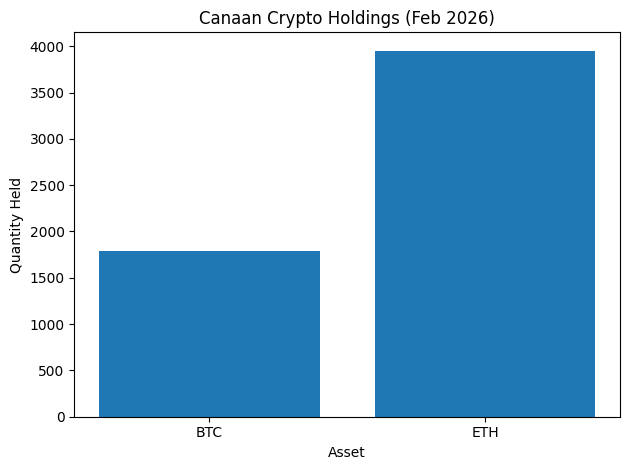
The company mined 86 BTC during February alone, adding to its growing reserves of digital assets.
Unlike many publicly listed miners that frequently liquidate Bitcoin to cover operational costs, Canaan appears to be embracing a treasury strategy similar to that adopted by several Bitcoin-focused corporations. Rather than treating mined Bitcoin as short-term revenue, the company views it as a strategic asset.
This approach suggests confidence in the long-term value appreciation of cryptocurrency.
For investors interested in crypto-aligned equities, this model resembles the strategy used by companies such as MicroStrategy—holding digital assets on the balance sheet as a core component of corporate strategy.
The implications are significant: if Bitcoin prices continue to rise over the next decade, companies that retain large mining-generated reserves could benefit from substantial balance-sheet appreciation.
Mining Capacity Expansion to 14.75 EH/s
Another key development is the rapid expansion of Canaan’s mining capacity.
By the end of February 2026, the company had deployed mining machines representing 14.75 exahashes per second (EH/s) of computing power.
To understand the scale:
- 1 EH/s = 1 quintillion hash calculations per second.
Hashrate is a fundamental metric in cryptocurrency mining. It measures how many cryptographic calculations a miner can perform each second when competing to validate new blocks on the Bitcoin network.
Higher hashrate means:
- Greater probability of earning block rewards
- Increased competitiveness in the global mining network
- More stable long-term mining revenue
For a company like Canaan, expanding hashrate is not merely a technical upgrade—it directly translates into greater mining productivity and stronger positioning in the global mining industry.
The expansion also demonstrates that the firm is continuing to invest aggressively in mining infrastructure despite industry uncertainty.
Strategic Acquisitions Boost Data Center Capacity
Canaan’s mining capacity increase was partly driven by a strategic investment in joint-venture mining operations.
In February 2026, the company acquired 49% stakes in three Cipher Mining joint-venture projects:
- Alborz
- Bear
- Chief Mountain
These investments added approximately 4.4 EH/s to Canaan’s mining capacity by expanding access to operational data centers.
This strategy allows Canaan to scale its mining operations faster than building entirely new facilities from scratch.
Joint-venture data centers provide several advantages:
- Immediate infrastructure deployment
- Reduced construction timelines
- Shared operational costs
- Geographic diversification of mining operations
Such partnerships are increasingly common in the mining industry as companies seek to scale rapidly while managing capital expenditures.
Cheap Energy in West Texas Strengthens Mining Economics
Energy costs are the single most important factor in cryptocurrency mining profitability.
Canaan’s recent expansion gives the company access to 120 megawatts of operational power capacity in West Texas, with electricity costs averaging below $0.03 per kilowatt hour.
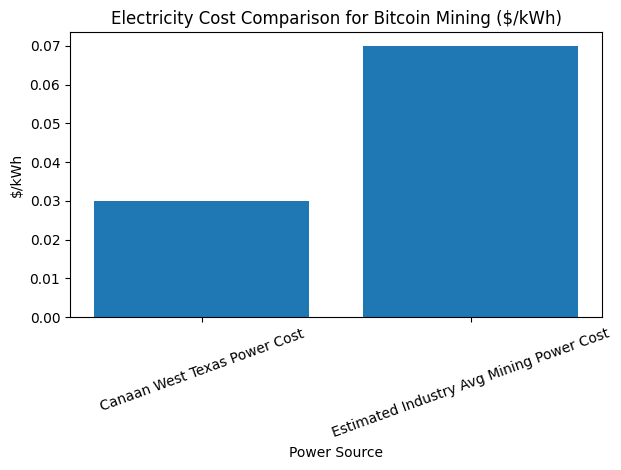
This extremely low energy price dramatically improves mining margins.
The energy strategy combines multiple power sources:
- Competitive long-term electricity contracts in Texas
- Direct grid connections in high-energy regions
- Integration with off-grid wind energy infrastructure at the Alborz facility
West Texas has become one of the world’s fastest-growing cryptocurrency mining hubs due to several factors:
- Abundant wind and solar energy
- Large power infrastructure capacity
- Favorable regulatory environments
- Competitive electricity markets
By locating operations in this region, Canaan can maintain strong mining profitability even during periods of lower Bitcoin prices.
The AI Pivot: Why Some Miners Are Selling Bitcoin
While Canaan is doubling down on cryptocurrency mining, many competing companies are moving in a different direction.
Several mining firms have begun selling large portions of their mined Bitcoin in order to invest in AI and high-performance computing infrastructure.
This trend is driven by the explosive demand for computing power created by generative AI models and large-scale machine learning systems.
Data centers originally built for cryptocurrency mining are increasingly being repurposed for:
- AI model training
- cloud computing infrastructure
- GPU-accelerated data processing
- high-performance computing clusters
For some mining companies, these markets offer more predictable revenue streams than cryptocurrency mining.
In February 2026, for example, several miners—including firms such as CleanSpark and Cango—sold significant portions of their mined Bitcoin rather than holding it.
This highlights a growing divide within the mining industry:
Two emerging strategies
- Crypto-focused treasury accumulation (Canaan model)
- Infrastructure pivot toward AI and HPC (competitor model)
The long-term winner of this strategic divergence remains uncertain.
Financial Growth and Revenue Expansion
Canaan also reported strong financial performance.
For the fourth quarter of 2025, the company reported total revenue of approximately $196.3 million, representing 121% year-over-year growth.
Of that total, $30.4 million came directly from Bitcoin mining operations.
The remaining revenue was largely generated from the company’s core business:
- ASIC chip design
- mining machine manufacturing
- mining software services
Canaan is therefore positioned as both:
- a hardware supplier to the mining industry, and
- a mining operator itself.
This dual model allows the company to capture value across multiple layers of the cryptocurrency mining ecosystem.
The Future of Mining: Accumulation vs Infrastructure Diversification
The global Bitcoin mining industry is entering a new phase.
Several key structural forces are shaping the sector:
- Rising network difficulty
- Increasing institutional participation in Bitcoin
- energy optimization strategies
- integration with renewable power
- data center diversification into AI
Within this changing environment, mining companies must choose between fundamentally different business models.
Canaan’s strategy focuses on long-term accumulation of digital assets, betting that Bitcoin and Ethereum will appreciate significantly over time.
Other companies are prioritizing stable infrastructure revenue through AI computing.
For investors searching for exposure to blockchain infrastructure, the distinction is important.
Companies that hold large cryptocurrency treasuries behave almost like leveraged Bitcoin investment vehicles, while those pivoting toward AI infrastructure resemble traditional data-center operators.
Conclusion: A Strategic Bet on the Long-Term Value of Crypto
Canaan’s decision to expand mining operations while accumulating Bitcoin and Ethereum represents a bold strategic stance in a rapidly evolving industry.
At a time when many mining companies are diversifying into AI infrastructure or selling mined Bitcoin to fund operations, Canaan is doubling down on the core thesis of cryptocurrency: that decentralized digital assets will continue to gain value and importance in the global financial system.
The company’s combination of:
- expanding mining capacity
- access to extremely cheap energy
- strategic data-center acquisitions
- and a growing cryptocurrency treasury
suggests a long-term commitment to the crypto economy.
For readers interested in new digital asset opportunities, the story of Canaan illustrates a broader industry question: will the future of mining be defined by Bitcoin accumulation, or by the transformation of mining infrastructure into the backbone of the AI economy?
The answer may determine the next phase of the cryptocurrency industry.