
Main Points :
- Strategy’s STRC preferred shares recorded $300 million in single-day trading volume, the largest since launch.
- Estimated capital raised could have enabled the purchase of approximately 1,420 BTC in one day.
- The company recently purchased 17,994 BTC for $1.28 billion, reinforcing its aggressive treasury strategy.
- STRC is part of a multi-layered financing structure using preferred equity to accumulate Bitcoin.
- Changes to the ATM (At-The-Market) issuance rules now allow fundraising even outside regular market hours.
- While the strategy accelerates BTC accumulation toward 740,000 BTC holdings, critics question sustainability due to dividend obligations and unrealized losses.
The Rise of Preferred Equity as a Bitcoin Accumulation Engine
Bitcoin treasury strategies are evolving rapidly as corporations experiment with new financial instruments to accumulate digital assets. One of the most aggressive examples is the company widely known for its Bitcoin treasury strategy—Strategy (formerly MicroStrategy). The company’s newest preferred share instrument, STRC, has quickly become a central mechanism for raising capital to purchase Bitcoin.
On March 10, STRC recorded an estimated $300 million in trading volume, marking the largest single-day volume since the instrument’s listing in July 2025. This figure is roughly 2.4 times the 30-day average volume of $124 million, signaling an unusually strong surge in demand and activity.
Based on dashboard data and filings submitted to the U.S. Securities and Exchange Commission (SEC), analysts estimate that this surge could have enabled Strategy to acquire approximately 1,420 BTC in a single day. The estimate is based on the company’s At-The-Market (ATM) issuance mechanism, which allows shares to be issued directly into the open market.
Under the estimation method used by analytics platform STRC.live, roughly 40% of the trading volume above the $100 par value is assumed to represent newly issued shares. After deducting a 2.5% broker fee, the remaining capital is assumed to be used for Bitcoin purchases. While this figure remains an estimate rather than a confirmed transaction record, it highlights how STRC is functioning as a high-velocity financing instrument for digital asset accumulation.
For investors and observers interested in practical blockchain adoption, this model represents a new frontier in corporate treasury management: using structured financial products to convert equity demand directly into Bitcoin accumulation.
Understanding STRC: A High-Yield Bitcoin Financing Instrument
STRC is a variable-rate perpetual preferred share introduced by Strategy in July 2025. Unlike common shares, preferred shares sit higher in the capital structure and typically pay dividends before common shareholders receive any distributions.
What makes STRC unique is its design. The instrument adjusts its dividend yield monthly, aiming to keep the share price close to its $100 par value. As of March, the annualized dividend rate has been set at approximately 11.5%.
This high yield is a critical incentive for investors. In an environment where traditional fixed income instruments struggle to deliver attractive returns, STRC offers a yield that is significantly higher than many bonds or preferred securities.
The trade-off, however, is that the funds raised through these preferred shares are primarily used to purchase Bitcoin rather than invest in conventional operating assets. In effect, investors are indirectly financing the expansion of one of the largest corporate Bitcoin treasuries in the world.
STRC is not the company’s first preferred share. It follows three earlier instruments:
- STRK
- STRF
- STRD
Together, these instruments form a multi-layered capital structure designed specifically to finance Bitcoin purchases.
This layered financing approach allows Strategy to access different pools of capital—equity investors, income-seeking investors, and speculative traders—while continuing to accumulate Bitcoin on a massive scale.
A $1.28 Billion Bitcoin Acquisition in One Week
The STRC surge did not occur in isolation. It followed a massive acquisition campaign that took place between March 2 and March 8.
During that period, Strategy raised approximately:
- $377 million through STRC issuance
- $900 million through common stock sales (MSTR)
Combined, the company raised roughly $1.28 billion.
Using those funds, Strategy purchased 17,994 BTC at an average price of $70,946 per Bitcoin.
This acquisition significantly increased the company’s already massive Bitcoin holdings and pushed the total treasury closer to 740,000 BTC.
Importantly, STRC alone accounted for approximately 30% of the capital used for the purchase. This reinforces the idea that preferred share financing has become one of the primary engines behind Strategy’s Bitcoin accumulation strategy.
For context, such accumulation dwarfs the reserves held by most corporations or even many institutional investors.
ATM Rule Changes Unlock Faster Fundraising
Another major development occurred on the same day as the trading surge: Strategy updated the rules governing its At-The-Market (ATM) issuance program.
Previously, the program placed limits on how many agents could issue shares per trading day. These restrictions effectively slowed the speed at which the company could raise capital.
Under the new rules, these limitations have been removed.
Now multiple sales agents can issue STRC shares:
- Before the U.S. market opens
- During regular trading hours
- After market close
This change dramatically increases the flexibility and speed of fundraising. Instead of waiting for market sessions, Strategy can now issue shares across extended trading windows.
For a company that converts capital almost immediately into Bitcoin purchases, this flexibility may significantly accelerate accumulation.
The Risks: Unrealized Losses and Dividend Burden
Despite the impressive scale of the strategy, the company faces growing scrutiny.
Strategy’s total Bitcoin acquisition cost has now reached approximately $56 billion, with an average purchase price of around $75,800 per BTC.
At current market prices, Bitcoin is trading below this average acquisition cost, leaving the company with substantial unrealized losses.
While unrealized losses are not unusual in volatile asset markets, the scale of the exposure raises questions among analysts.
Another concern is the dividend obligation attached to preferred shares.
Unlike common stock, preferred shares require regular dividend payments. With STRC yielding around 11.5% annually, the cumulative dividend burden could grow significantly if the company continues issuing large amounts of preferred equity.
In other words, Strategy is effectively trading long-term dividend obligations for immediate Bitcoin accumulation.
If Bitcoin’s price eventually rises significantly above the average purchase cost, the strategy could prove extremely profitable. But if the market stagnates or declines, dividend commitments could place pressure on cash flow.
The Bigger Trend: Bitcoin Treasury Strategies Are Expanding
Strategy’s approach is increasingly influencing other companies exploring Bitcoin treasury models.
Several emerging trends can be observed across the industry:
- Corporate Bitcoin Treasuries
More companies are experimenting with holding BTC as a strategic reserve asset. - Structured Financing for Crypto Exposure
Financial instruments such as preferred shares, convertible bonds, and tokenized securities are being used to fund crypto purchases. - Institutionalization of Bitcoin Accumulation
Bitcoin accumulation strategies are evolving from speculative purchases into structured capital strategies.
For investors seeking new crypto opportunities, this trend may lead to new asset classes that sit between traditional finance and digital assets.
Insert Graph Here
Strategy Bitcoin Holdings vs Capital Raised (2024–2026)
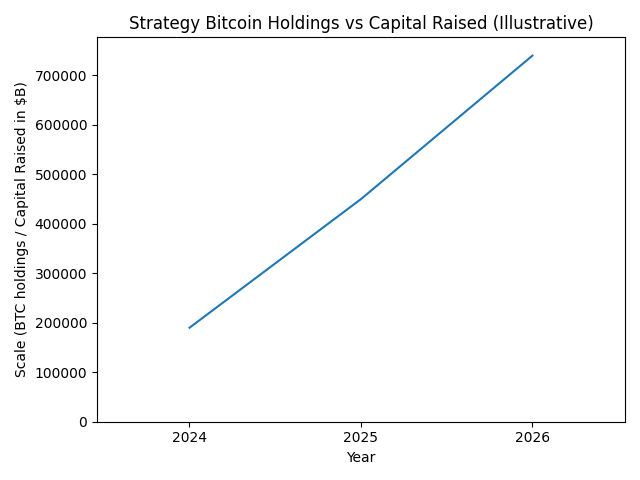
Description of Graph:
- X-axis: Timeline
- Y-axis: BTC holdings
- Bars: Capital raised from preferred shares and equity
- Line: Total BTC holdings
This visualization would illustrate how equity issuance directly translates into Bitcoin accumulation.
Insert Diagram Here
Strategy’s Multi-Layer Bitcoin Financing Structure

Layers:
Top Layer
Investor Capital
Second Layer
Preferred Shares (STRC, STRK, STRF, STRD)
Third Layer
ATM Market Issuance
Fourth Layer
Bitcoin Purchases
Bottom Layer
Corporate BTC Treasury
This diagram explains the structural flow of capital from investors to Bitcoin reserves.
What Investors Should Watch Next
Several key indicators will determine whether this strategy succeeds.
Bitcoin Price Recovery
The most important factor is whether Bitcoin’s market price rises above the company’s average acquisition cost of approximately $75,800.
If Bitcoin enters a new bull cycle, the company’s holdings could generate enormous gains.
Dividend Sustainability
Investors will closely monitor whether Strategy can maintain the dividend payments required by its preferred shares without creating financial strain.
Speed of Accumulation
With the removal of ATM restrictions and the introduction of after-hours issuance, Strategy could accelerate its capital-raising capacity.
This could push its holdings toward 740,000 BTC and beyond.
Conclusion: A Bold Experiment in Financial Engineering
Strategy’s STRC preferred shares represent a fascinating experiment in the intersection of traditional finance and digital asset accumulation.
By combining high-yield preferred equity with an aggressive Bitcoin treasury strategy, the company has effectively built a capital-raising engine dedicated to accumulating BTC.
The approach is controversial. Critics question whether issuing high-yield securities to fund a volatile asset is sustainable. Supporters argue that if Bitcoin continues its long-term growth trajectory, the strategy could produce extraordinary returns.
Regardless of the outcome, Strategy’s model is already reshaping how corporations think about capital markets, treasury reserves, and digital assets.
For investors searching for the next generation of crypto opportunities, the implications are profound: financial engineering may become just as important as blockchain technology itself in shaping the future of digital asset markets.